
Quick Answer
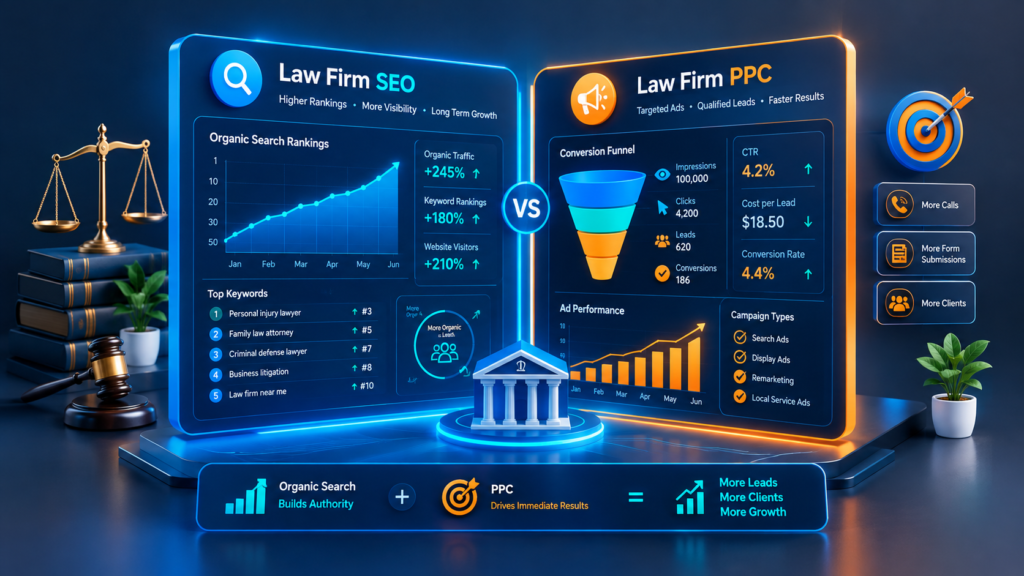
SEO and PPC can both generate qualified leads for law firms, but they work differently. PPC, particularly Google Search Ads, can generate enquiries soon after a campaign launches, provided the targeting, budget, and landing pages are effective. SEO builds organic visibility over time and can attract relevant prospects without charging for each click. For firms seeking immediate enquiries and sustainable growth, combining both channels can be effective. The right balance depends on practice area, competition, budget, and lead quality.
Introduction
A potential client searching for a personal injury lawyer, divorce attorney, or criminal defence solicitor may be ready to contact a legal professional. The challenge is making sure your firm appears when that person is looking for help.
Law firms commonly consider two search marketing options: search engine optimization (SEO) and pay-per-click advertising (PPC). Both can put your services in front of people searching online, but they require different investments, timelines, and management approaches.
Choosing the wrong strategy can lead to wasted advertising spend, slow progress, or website traffic that never becomes a genuine enquiry.
In this guide, we compare SEO vs PPC for law firms, explain how each channel affects lead generation, and outline how to measure performance so you can make informed marketing decisions.
What Is Law Firm SEO?
Law firm SEO is the process of improving a legal website’s visibility in unpaid search results. It involves optimizing website pages, publishing useful legal content, strengthening local search presence, and resolving technical issues that may affect search performance.
The goal is to help potential clients discover your firm when they search for relevant legal services.
For example, a law firm in Manchester might create a dedicated page explaining its employment law services. With useful content, clear contact information, appropriate local relevance, and sound technical SEO, the page may become more visible for relevant searches over time.
How SEO Generates Legal Leads
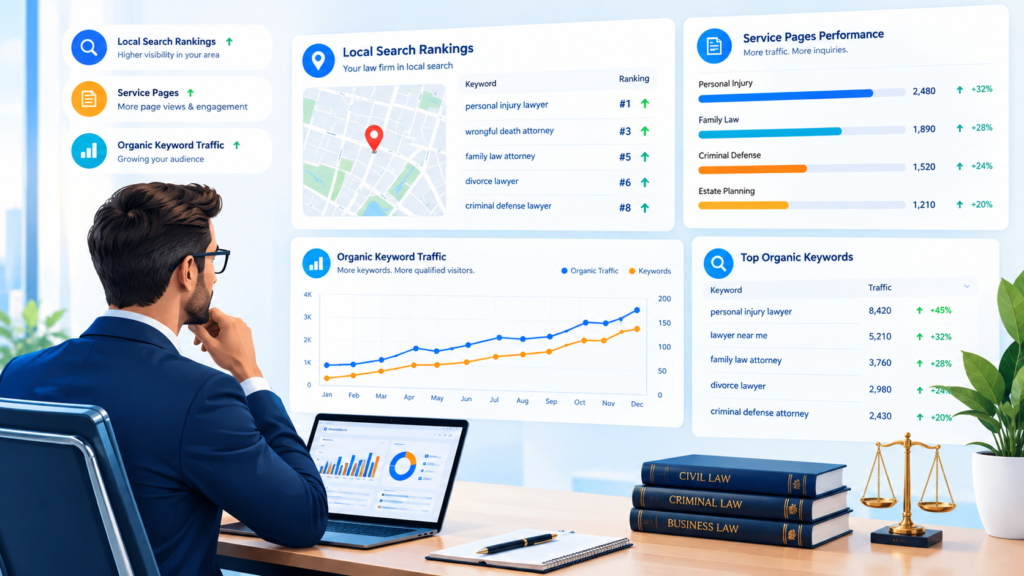
A well-planned SEO strategy can attract prospects at different stages of their decision-making process.
- Service searches: People searching for a divorce lawyer or employment solicitor may be comparing professionals.
- Local searches: People searching for a lawyer in a particular city may be looking for nearby legal assistance.
- Informational searches: People researching legal procedures may discover educational articles before deciding whether to contact a lawyer.
Effective Law Firm SEO includes keyword research, dedicated legal service pages, useful content, local SEO, technical optimization, and a clear route to contacting the firm.
Google’s SEO Starter Guide explains how helpful content and search-friendly website practices support discoverability. However, following SEO best practices does not guarantee specific rankings.
Benefits of SEO for Lawyers
Long-term organic visibility: Well-maintained pages can continue attracting relevant search traffic after publication, although rankings and traffic may change.
No direct charge per organic click: Unlike PPC, Google does not charge your firm for each click on an ordinary organic listing. SEO still requires investment in expertise, content, technical work, and ongoing maintenance.
Broader search coverage: A strong content strategy can target service-related searches, location-based queries, and questions potential clients commonly ask.
Trust and credibility: Helpful content, clear professional information, and an accessible website can help prospects evaluate your firm.
Limitations of Law Firm SEO
SEO usually takes time, and results depend on competition, website condition, location, content quality, and other factors. A new website in a competitive legal market may need substantial work before it attracts consistent enquiries.
SEO also requires ongoing monitoring. Publishing a few blog posts without improving service pages, local visibility, or technical performance is unlikely to create a complete lead-generation strategy.
What Is PPC for Law Firms?
PPC for law firms involves paying for advertising interactions, commonly clicks on search ads. Google Search Ads can display a firm’s services when users search for relevant legal terms, subject to campaign settings, auction conditions, and advertising policies.
Unlike SEO, PPC does not require your website to earn an organic ranking before it can receive paid search traffic.
For example, a firm offering immigration legal services might run a search campaign targeting people looking for immigration legal assistance in its service area. The ad can direct users to a relevant landing page explaining the service and offering a way to request a consultation.
Businesses looking to reach potential clients through paid search can benefit from a well-planned advertising strategy. KPTL Web Solution offers Google Ads services to help businesses explore paid advertising opportunities, improve campaign targeting, and measure campaign performance. For law firms, relevant keywords, well-structured campaigns, and focused landing pages are essential for attracting enquiries that match their legal services.
How Lawyer PPC Advertising Generates Leads
A well-structured legal search campaign typically involves:
- Keyword selection: Target searches relevant to the firm’s actual services.
- Geographic targeting: Focus on locations the firm can legitimately serve.
- Ad copy: Explain the service clearly without misleading claims or guaranteed outcomes.
- Landing page optimization: Match the page to the user’s search and make contacting the firm straightforward.
- Conversion tracking: Measure meaningful actions such as qualified enquiry submissions and phone calls.
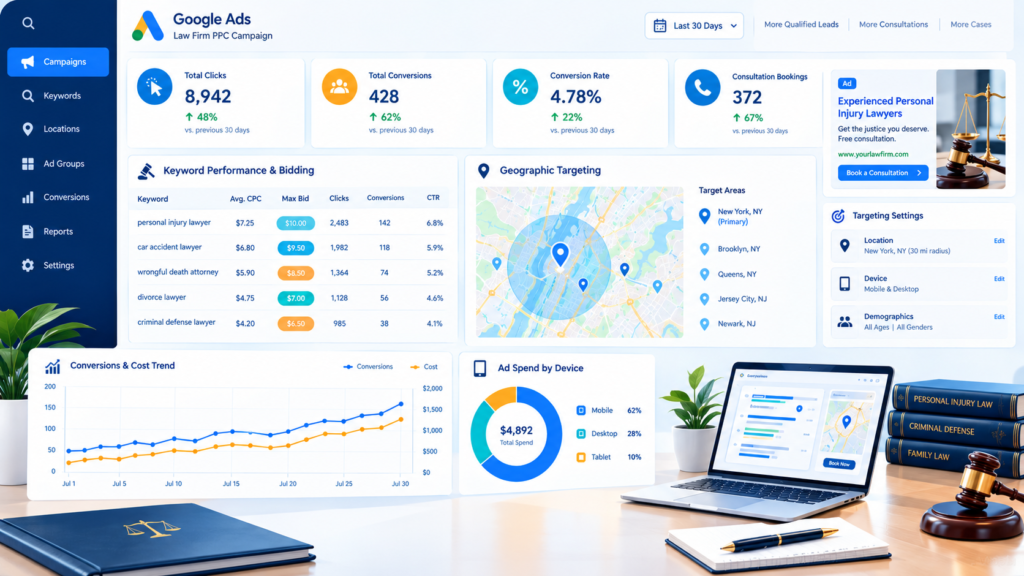
PPC can produce traffic shortly after launch, but traffic alone is not proof of success. The campaign must attract suitable prospects and turn a reasonable proportion of them into qualified enquiries.
Benefits of PPC for Law Firms
Faster campaign activation: Once ads are approved and eligible to serve, a campaign can begin attracting clicks without waiting for organic rankings to develop.
Control over targeting and budgets: Advertisers can adjust bids, budgets, locations, keywords, and schedules within the options available to their campaigns.
Useful performance data: Proper tracking can help identify which keywords and campaigns produce valuable actions.
Testing opportunities: Firms can test service messaging and landing page approaches before deciding where to invest further.
Limitations of Law Firm PPC Advertising
Legal keywords can be competitive, and every paid click carries a cost whether or not it becomes a client. Actual costs vary by practice area, location, competition, targeting, and campaign quality.
PPC also depends on consistent management. Poor keyword selection, irrelevant clicks, weak landing pages, and inaccurate conversion tracking can waste budget.
Advertising rules and applicable legal requirements must be reviewed before campaigns launch. Google’s advertising policies explain its requirements for compliant advertising.
SEO vs PPC for Law Firms: Key Differences
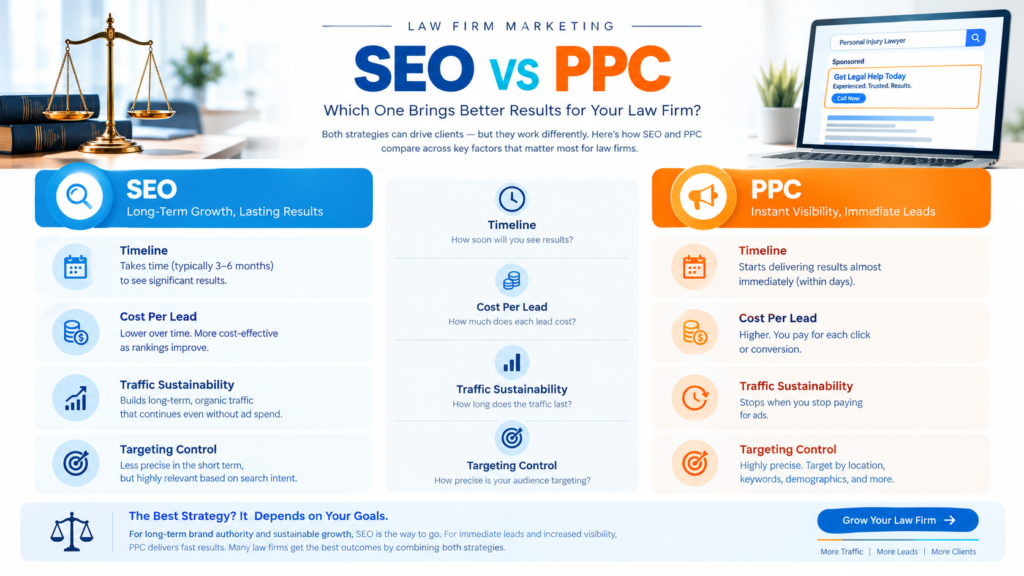
Although both channels can support legal client acquisition, they differ in how traffic is obtained, how investment works, and how results develop.
| Comparison Factor | Law Firm SEO | PPC for Law Firms |
| Time to start attracting traffic | Usually gradual | Potentially soon after launch and approval |
| Traffic cost | No direct charge per organic click | Advertiser pays for eligible paid interactions, commonly clicks |
| Initial investment | Strategy, content, technical work, and optimization | Ad spend, campaign setup, management, and landing pages |
| Long-term potential | Can build sustained organic visibility | Traffic generally depends on continued advertising |
| Targeting control | Influenced by content, relevance, and search algorithms | More direct control over available campaign targeting settings |
| Performance measurement | Rankings, organic traffic, enquiries, and client outcomes | Ad spend, clicks, conversions, cost per lead, and client outcomes |
| Main challenge | Building and maintaining visibility | Managing costs and generating qualified enquiries profitably |
| Best-fit objective | Sustainable search visibility | Testing demand or attracting enquiries sooner |
Neither channel automatically delivers better leads. Performance depends on the firm’s practice area, the relevance of its messaging, the quality of its website, and how effectively enquiries are handled.
Does SEO or PPC Generate More Qualified Leads for Law Firms?
The answer depends on what your firm considers a qualified lead and how well each channel attracts suitable prospects.
A qualified legal lead is an enquiry that fits your firm’s services, location, client requirements, and ability to take on the matter. A person who submits a form is not necessarily a qualified lead, and a qualified lead is not necessarily a signed client.
When SEO May Generate Better Results
SEO may be particularly suitable when your firm wants to build lasting visibility for core legal services and answer the questions potential clients ask before contacting a lawyer.
It can be valuable for firms that have time to invest in content, service-page improvements, and local search optimization.
For example, an employment law firm might publish a useful guide to workplace discrimination claims and connect it to a dedicated employment law service page. Some readers may need further information, while others may decide to request a consultation.
The strategy can attract prospects at multiple stages, but the firm must evaluate whether the traffic leads to relevant enquiries.
When PPC May Generate Better Results
PPC may suit a firm that wants to test demand for a particular service, promote a newly established practice, or increase visibility while its organic presence develops.
For example, a family law firm might launch a tightly targeted campaign for divorce consultations in its service area. It can monitor the search terms, enquiries, and eventual client outcomes to assess whether the campaign deserves more investment.
A campaign that generates many inexpensive enquiries is not necessarily successful if most prospects are outside the firm’s service area or need a different type of legal assistance.
Why Lead Quality Matters More Than Lead Volume
Consider two hypothetical campaigns:
- Campaign A: Generates 40 enquiries, of which 5 become clients.
- Campaign B: Generates 20 enquiries, of which 6 become clients.
Campaign B produces fewer enquiries but more clients. This illustrates why firms should evaluate the quality and outcomes of leads rather than judging marketing performance by enquiry volume alone.
These figures are illustrative, not industry benchmarks or actual client results.
How Much Does PPC Cost for Law Firms?
There is no single PPC price that applies to every law firm. Costs depend on the location, legal service, competition, keyword selection, bidding strategy, and campaign performance.
A firm targeting highly competitive searches may face different costs from a firm targeting a narrower service in a smaller market.
Your total investment should account for more than the advertising budget. Campaign management, landing page development, call tracking, analytics, and ongoing optimization may also contribute to the cost.
How to Calculate Cost per Lead
Cost per lead (CPL) is calculated by dividing the total campaign cost by the number of leads generated.
Formula:
Cost per lead = Total campaign cost ÷ Number of leads
For example, if a firm spends £2,000 on advertising and receives 40 enquiries, its cost per enquiry is £50.
However, if only 10 of those enquiries are qualified, the cost per qualified lead is £200.
This distinction helps law firms understand whether their advertising is attracting the right audience.
Google Ads provides conversion measurement guidance to help advertisers measure valuable actions and assess campaign performance.
How to Measure SEO and PPC Performance
Comparing SEO and PPC requires consistent measurement. The two channels generate traffic differently, but their contribution to legal client acquisition can be evaluated using related business outcomes.
Important SEO Metrics
Monitor:
- Organic impressions and clicks.
- Rankings for relevant legal service and location searches.
- Organic enquiries and qualified leads.
- Conversion rates on service pages.
- Cost of SEO relative to qualified leads and acquired clients.
Google Search Console can help you review your website’s organic search performance and identify opportunities for improvement.
Important PPC Metrics
Monitor:
- Advertising spend and click volume.
- Conversion rate and cost per conversion.
- Cost per qualified lead.
- Consultation bookings and completed calls.
- Signed clients and client acquisition cost.
- Return on ad spend (ROAS), when client revenue can be measured meaningfully.
Where possible, connect marketing data to your client relationship management system or intake process. This makes it easier to identify which campaigns produce suitable matters rather than merely recording form submissions.
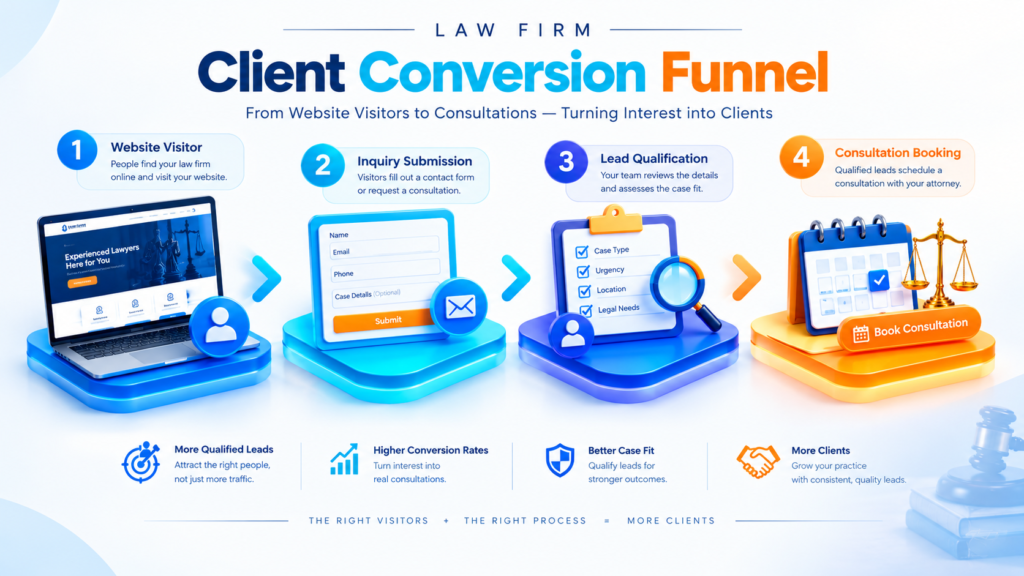
Track the Entire Client Journey
A practical law firm lead-generation process should distinguish between:
- Website visitor.
- Enquiry submitted or call received.
- Lead reviewed and qualified.
- Consultation booked or completed.
- Client retained.
Use privacy-conscious tracking and follow the legal and professional requirements that apply to your firm. Avoid sending confidential client or matter details to advertising platforms.
How to Reduce Law Firm Cost per Lead
Whether your firm invests in SEO or PPC, improving the conversion process can help make the budget more productive.
1. Target Specific Legal Services
Avoid sending every visitor to a generic homepage. Create focused pages for the legal services your firm actually offers, such as employment disputes, family law, or business litigation.
2. Improve Landing Page Relevance
The landing page should answer the visitor’s immediate questions, explain the service clearly, establish appropriate professional credibility, and make the next step obvious.
A strong page should include:
- A clear description of the legal service.
- Relevant information about the firm’s experience and approach.
- A straightforward contact form or phone option.
- Accessible contact information.
- Mobile-friendly design and reasonable loading speed.
For further guidance on website structure and user experience, read KPTL Web Solution’s article on why website design for small businesses is important for online growth.
3. Improve Keyword Relevance
For PPC, review search terms and exclude irrelevant queries where appropriate. For SEO, organize pages around genuine search intent instead of repeating the same keyword unnaturally.
Someone searching for legal advice may need educational information, while someone searching for a lawyer in a particular location may be closer to contacting a firm. Your pages and campaigns should reflect these differences.
4. Respond to Enquiries Promptly
A marketing campaign cannot compensate for a poor intake process. Establish a consistent procedure for responding to enquiries, checking whether the matter fits the firm’s services, and arranging consultations.
5. Review Results Regularly
Assess the quality of enquiries, not just traffic or clicks. Reallocate resources based on reliable evidence, while allowing enough time for SEO work to develop and enough data to evaluate advertising performance.
Should Law Firms Use SEO and PPC Together?
For many firms, combining SEO and PPC can provide a balanced approach to search marketing.
PPC can help attract enquiries while SEO work develops. SEO can build organic visibility for a wider set of relevant searches, reducing the firm’s dependence on paid traffic over time.
The channels can also inform one another. Search terms that generate qualified PPC enquiries may reveal useful topics or service-page opportunities for SEO. Organic search data may identify valuable queries that deserve a carefully measured paid campaign.
A Practical Combined Strategy
First 30 days: Audit the website, identify priority legal services, research keywords, set up conversion tracking, and launch a small, carefully targeted PPC test if appropriate.
Days 31–90: Improve service pages, refine ad targeting, review lead quality, and develop useful content for important legal queries.
After 90 days: Compare qualified leads and client outcomes across channels. Adjust budgets based on evidence, while recognizing that SEO timelines vary and meaningful organic growth may take longer.
These stages are a planning framework, not a guarantee of results. Legal advertising requirements, market conditions, and the firm’s resources should determine the actual timeline.
For a broader view of channel selection, measurement, and campaign planning, explore KPTL Web Solution’s Digital Marketing Guide 2026.
How to Choose the Right Law Firm Marketing Strategy
Before investing, answer five practical questions.
- How quickly do you need enquiries? PPC may help address immediate demand, while SEO builds longer-term organic visibility.
- Which legal services are most valuable to your firm? Prioritize the practice areas that fit your expertise, capacity, and business goals.
- How competitive is your market? Review the search landscape and estimate what level of effort or advertising budget may be required.
- Can your website convert visitors into enquiries? Fix unclear messaging, weak calls to action, and poor mobile usability before increasing traffic.
- Can you measure qualified leads and retained clients? Without reliable measurement, it is difficult to determine which channel deserves more investment.
Choosing the right marketing channels requires a clear understanding of your business goals, target audience, and available budget. Law firms looking to develop a coordinated strategy can explore KPTL Web Solution’s digital marketing services for support with planning and improving their online marketing efforts.
Your decision should reflect the economics of your practice, not a general claim that one marketing channel always outperforms the other.
Conclusion
SEO vs PPC for law firms is not simply a choice between free traffic and paid advertising. SEO requires sustained investment to build organic visibility, while PPC offers a way to attract search traffic sooner when campaigns are eligible and properly managed.
The stronger approach depends on your firm’s objectives, practice areas, competition, budget, and ability to convert enquiries into clients. For many firms, combining both channels while measuring qualified leads and client acquisition costs provides a more complete view of marketing performance.
If your firm wants to improve organic visibility, begin by reviewing its website, service pages, and search intent. If you need to test paid search demand, establish a clear budget and reliable conversion tracking first. KPTL Web Solution offers search engine optimization services to help businesses improve their organic search strategy.
Frequently Asked Questions
1. Is SEO or PPC better for law firms?
Neither is universally better. PPC can attract search traffic sooner, while SEO can build organic visibility over time. The appropriate choice depends on your budget, goals, market competition, and the quality of leads each channel generates.
2. Does SEO or PPC generate more leads for law firms?
The result varies by practice area, location, campaign quality, website experience, and competition. PPC may generate more enquiries during a short campaign period, while SEO may build a continuing source of organic leads. Track qualified enquiries and signed clients to compare them fairly.
3. How much does PPC cost for law firms?
There is no fixed price. Advertising costs vary according to legal service, location, competition, targeting, and bidding. Firms should account for management and conversion costs as well as media spend, and evaluate the cost per qualified lead rather than only the cost per click.
4. How long does law firm SEO take to work?
SEO results vary with the website’s current condition, competition, content quality, local market, and the work involved. Some improvements may be noticed earlier than others, but meaningful growth can take months or longer. No provider can guarantee a particular ranking or timeline.
5. How can a law firm generate more qualified leads?
Focus on relevant service keywords, useful and accurate legal content, local search visibility, focused landing pages, clear contact options, and a consistent intake process. Track whether enquiries fit your firm’s services and become consultations or retained clients.
6. Can law firms run Google Ads and SEO at the same time?
Yes. They can be complementary. PPC can support near-term visibility while SEO builds organic presence. Shared measurement can help identify valuable search terms and improve budget decisions. Campaigns must comply with applicable advertising rules and professional requirements.