You don’t need forty tools and a huge budget to market a business well in 2026. You need a clear plan, a handful of channels you actually understand, and a way to tell what’s working. That’s what this guide gives you.
Whether you’re a small business owner trying to get your first customers online, a freelancer building your own client base, or someone starting a marketing career, this digital marketing guide 2026 walks through everything from the basics to the newer stuff, AI, changing search behavior, and how to measure success without drowning in metrics. No fluff, no exaggerated promises. Just what works, what to watch for, and how to get started.
What Is Digital Marketing?
Digital marketing is any marketing that happens through the internet or digital devices. That includes showing up in Google search results, running ads on Instagram, sending emails to your customer list, posting videos on YouTube, and writing blog posts that answer people’s questions.
The core idea is simple: reach people where they already spend time online, give them something useful or interesting, and guide them toward becoming a customer.
Digital marketing vs. traditional marketing. Traditional marketing, billboards, TV ads, flyers, cold calling, pushes a message to a broad audience with little ability to track results. Digital marketing lets you target specific people, measure exactly how they respond, and adjust in real time. A billboard can’t tell you how many people looked at it and later bought something. A Google ad can.
Common examples you already see every day:
- A Google search ad above the organic results
- An Instagram post from a small bakery showing today’s specials
- A “you might also like” email from an online store
- A YouTube tutorial that quietly promotes a software tool
- A blog post that answers “how do I fix a leaky faucet” and links to a plumbing company
Why Digital Marketing Matters in 2026
Customer behavior has shifted, and it keeps shifting. A few realities worth understanding:
People research before they buy, almost always. Even a simple purchase, like choosing a local dentist, usually starts with a search or a scroll through reviews and social media. Businesses that aren’t visible in that research phase lose the customer before a sales conversation ever happens.
Mobile is the default, not the exception. Most browsing, searching, and shopping now happens on a phone. A website or ad that doesn’t work well on mobile is invisible to a large share of your audience.
Search results look different now. AI-generated summaries and answer boxes sit above traditional search listings for many queries. That changes how people find information, and it means content needs to genuinely answer questions, not just target a keyword.
Trust matters more, not less. With more content online than ever, people are more skeptical. Businesses that build trust through honest content, real reviews, and consistent presence tend to win over the long run, over businesses chasing quick wins.
None of this means digital marketing has become more complicated to start. Partnering with the right digital marketing services can help businesses execute thoughtfully, ensuring they stay ahead rather than just adding to the noise.
Main Types of Digital Marketing
| Marketing Channel | Primary Goal | Time to Results | Cost Model | Best Suited For |
| Search Engine Optimization (SEO) | Compounding organic visibility & high-intent traffic | 3–6 Months | Long-term investment (Low recurring cost) | Businesses wanting sustainable inbound leads |
| Search Engine Marketing (PPC) | Immediate top-of-page search visibility | Immediate (Days) | Pay-per-click (Ongoing ad spend) | Product launches, testing offers, high-intent sales |
| Content Marketing | Educating audience, building authority & SEO support | 2–4 Months | Creative production time | Establishing brand trust & long-term conversion |
| Social Media Marketing | Community engagement & brand awareness | 1–3 Months | Organic effort + Optional ad budget | Visual brands, B2B networking (LinkedIn), community building |
| Email Marketing | Direct lead nurturing & repeat customer retention | Fast (Immediate on send) | Low monthly software subscription | Owned audience monetization & cart recovery |
| Local SEO | Dominating “near me” map searches & phone calls | 1–3 Months | Low / profile optimization effort | Physical stores, clinics, restaurants, local contractors |
Each channel below does a different job. Understanding what each one is for matters more than trying to use all of them at once.
Search Engine Optimization (SEO)
Implementing professional search engine optimization improves your website’s visibility so it ranks higher in organic (unpaid) search results. It’s a long-term channel, you won’t see results in week one, but once you rank for the terms your customers search, that traffic doesn’t cost you per click. SEO works best for businesses willing to invest months, not days, and it compounds: content you publish this year can still bring visitors two years from now.
Search Engine Marketing and PPC Advertising
Pay-per-click (PPC) ads let you appear at the top of search results immediately by bidding on keywords. Use PPC when you need traffic now, launching a new product, testing a market, or filling gaps while your SEO builds up. The tradeoff: traffic stops the moment you stop paying.
Content Marketing
Content marketing means creating useful material, blog posts, guides, videos, case studies, that educates your audience and builds trust before they’re ready to buy. It supports SEO, gives you something to share on social media and in emails, and positions you as a credible source rather than just another ad.
Social Media Marketing
Social platforms help you build awareness, community, and direct relationships with your audience. Organic posts build familiarity over time; paid social ads extend your reach to people who don’t already follow you. Best suited to businesses that can post consistently rather than in occasional bursts.
Email Marketing
Email remains one of the highest-return channels because you own the list, no algorithm decides whether your message gets seen. It’s ideal for nurturing leads who aren’t ready to buy yet and for re-engaging past customers.
Affiliate Marketing
Affiliate marketing pays other people or sites a commission for referring customers to you. It works well when you have a product with healthy margins and want to expand reach without upfront ad spend, since you only pay when a sale happens.
Influencer Marketing
Partnering with people who already have an engaged audience can build trust faster than a cold ad, especially for consumer products. It works best with influencers whose audience genuinely matches your customer, not simply the ones with the biggest follower counts.
Video Marketing
Video, short-form clips, tutorials, product demos, captures attention that text alone often can’t. It’s useful across nearly every stage of the funnel, from a 15-second awareness clip to a detailed product walkthrough that closes a sale.
Local SEO
Local SEO helps businesses with a physical location or service area show up in “near me” searches and map results. A properly optimized Google Business Profile, consistent business listings, and local reviews matter here more than technical SEO tactics. This is essential for restaurants, clinics, contractors, and any business that serves a specific geographic area.
Conversion Rate Optimization (CRO)
CRO is the practice of improving your website or landing pages so more visitors take the action you want, buying, signing up, or requesting a quote. It’s often overlooked, but fixing a confusing checkout page or a weak call-to-action can outperform doubling your ad budget.
Online Reputation Management
Reviews and online mentions shape buying decisions before a customer ever contacts you. Reputation management means actively monitoring reviews, responding to feedback (good and bad), and encouraging satisfied customers to share their experience.
How to Create a Digital Marketing Strategy in 2026
A strategy isn’t a list of channels, it’s a plan that connects your goals to specific, measurable actions.
- Define business goals. Be specific: “get 50 qualified leads a month,” not “grow online presence.”
- Identify your target audience. Who are they, what problem do they have, and where do they spend time online?
- Research customer needs. Look at the questions people actually ask, search queries, reviews, customer support tickets.
- Analyze competitors. See what they’re doing well and where they’re leaving gaps you can fill.
- Select appropriate marketing channels. Choose two or three based on where your audience actually is, not every channel that exists.
- Create a content strategy. Plan what you’ll publish, how often, and how it supports your goals.
- Build a marketing funnel. Map how a stranger becomes aware of you, considers you, and becomes a customer.
- Set a realistic budget. Base it on what you can sustain for at least a few months, not a one-time burst.
- Launch campaigns. Start smaller than you think you need to, you’ll learn faster with a tight test.
- Track performance. Set up analytics before you launch, not after.
- Optimize based on data. Cut what isn’t working; put more into what is.
Example: A small landscaping business defines its goal as 15 new quote requests a month. Its audience is homeowners within a 20-mile radius. It picks local SEO and a Google Business Profile as its primary channel, with a modest Google Ads budget to fill early gaps while SEO builds. After 90 days, it reviews which channel produced actual booked jobs, not just clicks, and shifts budget accordingly.
Understanding the Digital Marketing Funnel
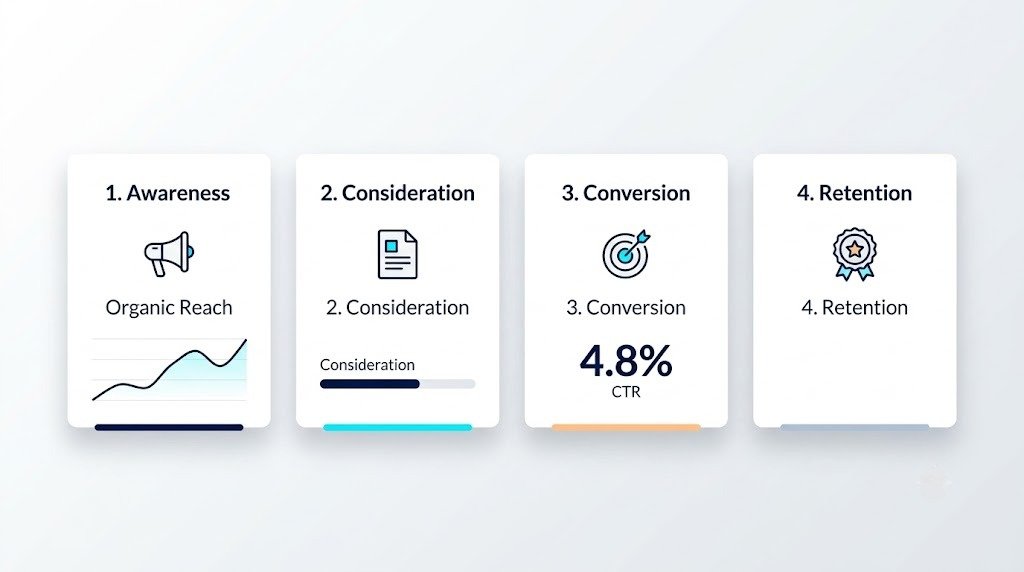
The funnel describes the journey a person takes from not knowing your business to becoming a loyal customer.
- Awareness: They discover you exist, through a social post, a search result, or a friend’s recommendation.
- Consideration: They compare you to alternatives, read reviews, and check your content.
- Conversion: They take the action, buying, booking, signing up.
- Retention: They come back, ideally more than once.
- Advocacy: They recommend you to others.
Different channels support different stages. Social media and video are strong for awareness. Content marketing and email nurture consideration. PPC and CRO drive conversion. Email and loyalty programs support retention. Reviews and referral programs fuel advocacy. A strategy that only targets awareness, lots of impressions, no follow-through, will struggle to convert.
SEO in 2026
SEO today is less about gaming an algorithm and more about genuinely answering what people are searching for. Key areas to focus on:
- Search intent: Match your content to what someone actually wants when they search a phrase, information, a product, or a specific answer.
- Helpful, people-first content: Write for the reader first. Following official guidelines for helpful, people-first content ensures your site builds real trust, whereas content created solely to manipulate search rankings tends to drop over time.
- On-page SEO: Clear titles, headings, and content structure that make both readers and search engines understand what a page is about.
- Technical SEO: A site that loads quickly, works on mobile, and doesn’t have broken links or crawl errors.
- Local SEO: Essential for location-based businesses (see above).
- Mobile usability and website experience: A slow or cluttered site loses visitors regardless of how well it ranks.
- AI-powered search experiences: Many searches now surface AI-generated summaries. Content written clearly, with direct answers near the top, has a better chance of being referenced.
- First-hand experience and trustworthy content: Original insights, real examples, and transparent sourcing tend to perform better than generic, recycled content.
SEO is not a one-time project, it’s ongoing. No one can guarantee a specific ranking, and any claim promising a #1 spot should be treated with skepticism.
AI and Digital Marketing in 2026

AI tools have become a normal part of the marketing workflow rather than a novelty. Common practical uses include:
- Researching topics and generating content outlines
- Personalizing website or email content based on user behavior
- Powering customer service chatbots for common questions
- Optimizing ad bidding and targeting
- Analyzing large sets of customer or campaign data
- Automating repetitive tasks like report generation or basic email sequences
What AI doesn’t replace. AI can draft, summarize, and suggest, but it can’t replace human judgment about what’s true, what’s on-brand, or what actually resonates with your specific audience. Content generated without review risks factual errors, generic phrasing, or claims that don’t hold up. Fact-check anything AI produces before publishing it.
Privacy and ethics matter. Be transparent about how you collect and use customer data, especially with AI tools that process personal information. Keep a human reviewing AI-assisted decisions that affect customers directly, such as pricing or personalized offers.
The most effective approach treats AI as a productivity tool that speeds up research and drafting, with a person still making the final call.
Social Media Marketing Strategy for 2026
Rather than trying to be active everywhere, choose platforms based on where your specific audience spends time:
- Instagram: Strong for visual products, lifestyle brands, and younger consumer audiences.
- Facebook: Broad reach, useful for local businesses and community-driven audiences.
- LinkedIn: The default for B2B, professional services, and career-focused content.
- YouTube: Long-form video, tutorials, and searchable content that has a long shelf life.
- TikTok: Short-form, discovery-driven content, strong for reaching younger audiences and building awareness quickly.
What actually works:
- Consistency beats intensity. Posting reliably a few times a week outperforms sporadic bursts of activity.
- Community building. Responding to comments and messages builds trust that one-way broadcasting doesn’t.
- Short-form video. It consistently gets more reach than static posts across most platforms.
- Social proof. Sharing customer reviews, testimonials, and user-generated content builds credibility faster than self-promotion.
- Measuring performance. Track engagement and, more importantly, whether social traffic leads to actual inquiries or sales, not just likes.
Content Marketing Strategy
Good content marketing does more than fill a blog calendar. It should:
- Attract people searching for answers related to your business
- Educate them on their problem and possible solutions
- Build trust by demonstrating real expertise
- Generate leads through natural calls-to-action
- Support conversions by addressing objections before they come up
Formats worth using:
- Blog posts that answer specific customer questions
- In-depth guides for bigger topics
- Case studies showing real results
- Videos that demonstrate a product or process
- Social posts that repurpose your best content
- Email newsletters that keep your audience engaged between purchases
- Educational resources like checklists or templates
Start by listing the ten questions your customers ask most often, that list is your content plan.
Email Marketing in 2026
Email marketing works best when it’s permission-based and genuinely useful, not just promotional.
- Building a list: Offer something valuable, a guide, discount, or resource, in exchange for an email address.
- Permission-based marketing: Never buy email lists. Recipients who didn’t opt in won’t engage, and it can damage your sender reputation.
- Segmentation: Group your list by behavior or interest so messages feel relevant, not generic.
- Personalization: Use the recipient’s name, past purchases, or browsing behavior to tailor content.
- Automation: Set up sequences that trigger based on actions, a welcome series for new subscribers, a follow-up after an abandoned cart.
- Campaigns: Balance promotional emails with genuinely useful content so your list doesn’t tune you out.
- Performance measurement: Track open rate, click rate, and, most importantly, how many emails actually lead to a sale or booking.
Paid Advertising and PPC Marketing
- Google Ads: Captures people actively searching for what you offer, high intent, often higher cost per click.
- Social media advertising: Reaches people based on interests and behavior, useful for building awareness or retargeting past visitors.
- Audience targeting: Narrow your audience based on demographics, interests, or past interactions with your business.
- Landing pages: Never send paid traffic to a generic homepage, build a page focused on one clear offer.
- Campaign objectives: Decide upfront whether you’re optimizing for awareness, leads, or direct sales, this changes how the campaign should be built.
- Budget planning: Start small, test what works, then scale the campaigns that perform.
- Conversion tracking: Set up tracking before you launch so you know which ads actually produce results, not just clicks.
- Campaign optimization: Review performance regularly and pause what isn’t working.
Essential Digital Marketing Tools
You don’t need every tool, pick a few that match your budget and needs.
- SEO tools: Keyword research and rank tracking platforms help identify opportunities and monitor progress.
- Analytics tools: Website analytics platforms show you where traffic comes from and what visitors do once they arrive.
- Social media management tools: Scheduling platforms let you plan and publish content across multiple platforms at once.
- Email marketing platforms: These handle list management, automation, and campaign tracking in one place.
- CRM software: Customer relationship management tools track leads and customers through your sales process.
- AI productivity tools: Useful for drafting content, summarizing research, and speeding up repetitive tasks.
- Website and conversion tools: Landing page builders and heatmap tools help you understand and improve how visitors interact with your site.
Choose tools based on what you’ll actually use consistently, an expensive platform you barely touch isn’t worth the subscription.
How to Measure Digital Marketing Success
- Website traffic: Total visits, a starting indicator, not a success metric on its own.
- Organic traffic: Visits from unpaid search, shows whether your SEO is working.
- Conversion rate: The percentage of visitors who take your desired action.
- Cost per lead: How much you spend, on average, to generate one lead.
- Customer acquisition cost (CAC): The full cost of acquiring one paying customer.
- Return on investment (ROI): Revenue generated compared to what you spent to generate it.
- Engagement rate: How much your audience interacts with your content, likes, comments, shares.
- Email open rate and click-through rate: How well your subject lines and content perform.
- Customer lifetime value (CLV): The total revenue a customer generates over their entire relationship with you.
Why vanity metrics aren’t enough. Impressions, follower counts, and page views can look impressive without translating into actual business results. A post with 10,000 views and zero inquiries hasn’t done its job. Always connect metrics back to a real business outcome, leads, sales, or bookings.
Common Digital Marketing Mistakes to Avoid in 2026
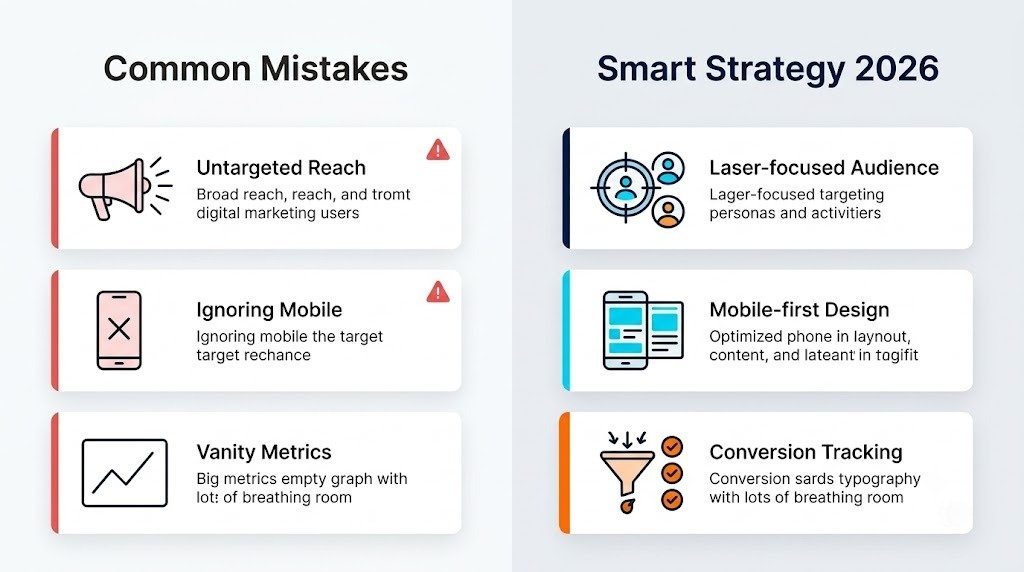
- Trying to target everyone. A message meant for everyone usually resonates with no one. Narrow your audience.
- Using too many channels at once. Spreading a small budget across five channels tends to produce weak results everywhere instead of strong results somewhere.
- Publishing without a strategy. Random posts and ads without a clear plan rarely add up to meaningful growth.
- Ignoring mobile users. If your site or ads don’t work well on a phone, you’re losing a large share of potential customers.
- Not tracking conversions. Without tracking, you can’t tell what’s actually working.
- Copying competitors. What works for another business may not fit your audience, budget, or strengths.
- Expecting instant results. SEO and content marketing especially take months to show meaningful traction.
- Using AI without human review. Unchecked AI content risks factual errors and generic messaging that undermines trust.
- Ignoring customer feedback. Reviews and direct feedback often reveal exactly what to fix or improve.
- Focusing only on traffic instead of business outcomes. More visitors only matters if some of them become customers.
Digital Marketing Trends to Watch in 2026
- AI-assisted marketing workflows: From content drafts to campaign analysis, AI is increasingly part of the daily process rather than a separate project.
- Personalization: Audiences increasingly expect content and offers tailored to their behavior, not generic messaging.
- First-party data: As third-party tracking becomes more limited, data you collect directly, email lists, on-site behavior, becomes more valuable.
- Search behavior changes: AI-generated answers are changing how people find information, putting more weight on content that directly and clearly answers questions.
- Short-form video: Continues to dominate attention across most social platforms.
- Community-driven marketing: Engaged niche communities often outperform broad, low-engagement audiences.
- Privacy-focused advertising: Regulations and platform changes continue to push marketers toward first-party data and consent-based targeting.
- Omnichannel experiences: Customers expect a consistent experience whether they find you on social media, search, or email.
- Automation with human oversight: The most effective teams use automation for efficiency while keeping a person responsible for judgment calls.
These are meaningful shifts, not guaranteed predictions, treat them as things to watch and test, not certainties to bet your entire budget on.
Digital Marketing for Small Businesses
Prioritize channels based on your goal and budget. If you need leads fast, a modest, well-targeted PPC campaign often outperforms scattered efforts. If you’re building for the long term, local SEO and content compound over time.
Lean into local SEO. A well-optimized Google Business Profile, consistent listings, and genuine reviews often deliver more return than paid ads for local service businesses.
Stay consistent, not constant. Publishing two solid, helpful posts a month beats ten rushed ones.
Pick one or two social platforms where your actual customers spend time, rather than trying to maintain a presence everywhere.
Measure what matters. Track leads and sales, not just likes and impressions.
Aim for sustainable growth. A slow, steady increase in qualified traffic and leads is more valuable, and more affordable, than a short-lived spike.
Example: A local bakery with a limited budget focuses on Google Business Profile optimization, posts consistently on Instagram with photos of daily specials, and builds a small email list through in-store sign-ups. Within a few months, “near me” search visibility and repeat customers from email promotions become the bakery’s two most reliable sources of new business, without any paid advertising.
How to Start Digital Marketing as a Beginner
- Learn the fundamentals. Understand the core channels, SEO, content, social, email, and paid ads, before specializing.
- Choose a specialization. SEO, paid media, content, and social each require different skills. Pick one to go deep on first.
- Practice with real projects. Offer to help a local business, run a personal blog, or manage a small campaign for practice.
- Learn SEO and analytics basics. Understanding how to read data is a skill that applies across every specialization.
- Build a portfolio. Document real results from your practice projects, even small ones, concrete examples matter more than certifications alone.
- Learn through practical resources. Free platform certifications, official documentation, and hands-on practice teach more than passive reading.
- Stay updated with industry changes. Digital marketing shifts constantly, following a few trustworthy industry sources keeps your skills current.
Ready to Scale Your Strategy?
Navigating modern algorithms, AI tools, and multi-channel campaigns takes time and consistency. If you want a tailored growth roadmap or need expert guidance to scale your brand, feel free to reach out to our marketing team to get started.
Frequently Asked Questions
What is digital marketing in 2026?
Digital marketing in 2026 is the practice of promoting a business through online channels, search engines, social media, email, and paid ads, while accounting for AI-driven search results, more privacy-conscious data practices, and audiences who expect personalized, mobile-first experiences.
How do I start digital marketing as a beginner?
Start by learning the core channels, then pick one specialization to focus on. Practice on real (even small) projects, learn to read basic analytics, and build a portfolio showing actual results rather than just theoretical knowledge.
Is SEO still important in 2026?
Yes. Even with AI-generated search summaries becoming more common, SEO still determines whether your content gets found and referenced at all. It’s an ongoing process rather than a one-time fix, and no one can guarantee specific rankings.
Which digital marketing channel is best?
There isn’t one best channel, it depends on your audience, goals, and budget. PPC and paid social deliver faster results; SEO and content marketing build long-term, compounding traffic. Most businesses benefit from combining a fast channel with a long-term one.
How is AI changing digital marketing?
AI speeds up research, content drafting, personalization, and data analysis. It doesn’t replace human judgment, content and decisions still need human review for accuracy, tone, and ethical use of customer data.
How long does digital marketing take to show results?
Paid ads can show results within days. SEO and content marketing typically take three to six months or longer to build meaningful traction. Set realistic timelines based on which channels you’re using.
What skills are needed for digital marketing?
Useful skills include basic SEO knowledge, content writing, analytics and data interpretation, familiarity with paid advertising platforms, and increasingly, comfort using AI tools as part of a workflow.
How can small businesses use digital marketing effectively?
Focus on one or two channels that match your budget and audience rather than spreading thin across many. Local SEO, consistent social media, and email marketing tend to offer strong return for limited budgets.
What are the main types of digital marketing?
The main types include SEO, PPC/search advertising, content marketing, social media marketing, email marketing, affiliate marketing, influencer marketing, video marketing, local SEO, conversion rate optimization, and online reputation management.
How do I measure digital marketing success?
Track metrics tied to real business outcomes, conversion rate, cost per lead, customer acquisition cost, and ROI, rather than relying only on traffic or engagement numbers, which don’t always reflect actual results.