
If you have looked into building a website recently, you have probably noticed that almost every hosting company and website platform now offers an AI website builder. Type in a few details about your business, and within minutes you get a full site with pages, images, and written copy already in place.
It sounds like the perfect shortcut. But is it actually good enough for a real business website, or just a fast way to get something online that still needs a lot of work?
The honest answer: it depends on what you need the website to do. AI website builders can be a genuinely useful starting point for simple business websites, but they still have real limits around customization, branding, SEO, and long-term growth. This article breaks down exactly where these tools help, where they fall short, and how to decide which path makes sense for your business.
What Is an AI Website Builder?
An AI website builder is a platform that uses artificial intelligence to generate most of a website automatically, based on information you provide about your business. Instead of starting from a blank page or a generic template, you typically answer a few questions or describe your business in plain language, and the AI produces a working website structure.
Depending on the platform, AI may help with:
- Organizing your site into pages and sections
- Writing initial homepage, service, and about page content
- Selecting layouts and design elements
- Generating or suggesting images
- Setting up basic SEO elements like page titles and headings
- Recommending colors, fonts, and overall style
The amount of AI involvement varies a lot between platforms. Some tools generate a nearly complete site in one step. Others use AI for specific pieces, like writing copy or suggesting a layout, while you still build the rest manually.
How Do AI Website Builders Work?
While every platform works a little differently, most AI website builders follow a similar general process.
You start by giving the AI information about your business, such as your industry, location, goals, and the type of website you want. The AI then generates an initial version of the site, often complete with pages, text, and images already filled in.
From there, you typically review and edit what the AI created. This can include rewriting text, swapping images, adjusting the layout, or changing colors and fonts. Once you are satisfied, you customize any remaining details, connect a domain, and publish the site.
Some newer tools go further, letting you describe changes in plain English and have the AI update the site for you, rather than manually dragging and editing elements. This is sometimes called a conversational or prompt-based builder. Not every platform works this way, so it is worth checking how a specific tool handles edits before you commit to it.
Are AI Website Builders Good Enough for Business Websites?
For many small businesses, yes, an AI website builder can produce a functional, professional-looking website. For others, especially those with specific branding, functionality, or growth needs, it may fall short.
AI builders tend to perform well on:
- Speed. A basic multi-page website that once took weeks can now be generated in minutes and refined in a day or two.
- Ease of use. You do not need design or coding skills to get a working site online.
- Initial design quality. Modern AI tools can produce clean, visually reasonable layouts, especially for straightforward business types.
- Simple business websites. A local service business, freelancer, or small shop with a handful of pages is often well within what these tools can handle.
Where they tend to struggle more is with:
- Deep customization. Most AI builders work from a library of pre-built sections and templates, so highly specific layouts or interactions may not be possible without manual workarounds.
- Branding. AI can apply your logo and colors, but building a website that truly reflects your brand’s personality still usually needs human judgment.
- Advanced SEO. Basic SEO elements are often included, but competitive SEO strategy generally requires more planning than an automated tool provides on its own.
- Performance and accessibility. Some AI-generated sites carry extra code or design choices that can slow load times or create accessibility gaps if nobody reviews them.
- Scalability. A site that works well with ten pages may need a rebuild once a business grows into ecommerce, multiple locations, or custom features.
In short, AI website builders are good enough for many straightforward business websites, but they usually need human review and, in some cases, human-led customization to become a strong long-term asset.
What Are the Advantages of AI Website Builders?
Used with the right expectations, AI website builders offer some real, practical benefits.
Faster initial website creation. Instead of starting from a blank page, you get a structured starting point almost immediately, which removes one of the biggest barriers to getting online.
Easier setup for non-technical users. You do not need to know how to code or use design software. Answering questions or describing your business is usually enough to get a working draft.
A useful starting point for beginners. If you have never built a website before, seeing a generated site gives you something concrete to react to and adjust, rather than facing an empty canvas.
Lower technical barrier to entry. Small business owners who previously needed to hire a developer for even a basic site can now get something live on their own.
Faster experimentation. Because generating a new draft is quick, you can test different structures, styles, or messaging approaches before settling on a final version.
These advantages matter most for businesses that need a website quickly, have a limited budget, or are testing a new idea before investing more heavily in their online presence.
What Are the Limitations of AI Website Builders?
AI website builders are not a complete replacement for thoughtful web design, and it helps to understand why before you commit to one.
Generic design. Many AI tools are trained on large sets of existing websites, which means the layouts they produce can look similar to countless other sites, especially in competitive industries. Not every platform has this problem to the same degree, but it is a common criticism.
Repetitive or generic content. AI-generated copy can sound reasonable on the surface but lack the specific details, tone, and personality that make a business sound credible and different from competitors.
Limited customization on some platforms. If your website needs a specific layout, custom interaction, or unusual page structure, you may hit the edges of what the builder’s templates and blocks allow.
Weak brand differentiation. A website that looks like it could belong to any business in your industry does little to build trust or memorability.
Need for human editing. Almost every AI-generated site benefits from a careful human review, both to fix factual errors and to sharpen the writing and design.
SEO limitations depending on the platform. Some builders offer solid control over titles, headings, and URLs. Others are more restrictive, which can limit how well you are able to optimize the site over time.
Performance and accessibility concerns. If a site is published without review, it may load slowly on mobile devices or create barriers for users relying on screen readers and other assistive technology.
Difficulty with complex functionality. Bookings systems, membership areas, advanced ecommerce, or custom integrations often require more flexibility than a basic AI builder provides.
Scalability concerns. A site built quickly for a small need may not hold up well as your business, product catalog, or content grows.
To be fair, not every AI website builder has all of these issues, and some platforms are actively working to address them. The right way to think about this is platform by platform, not as a blanket rule against AI tools.
AI Website Builder vs Professional Web Design
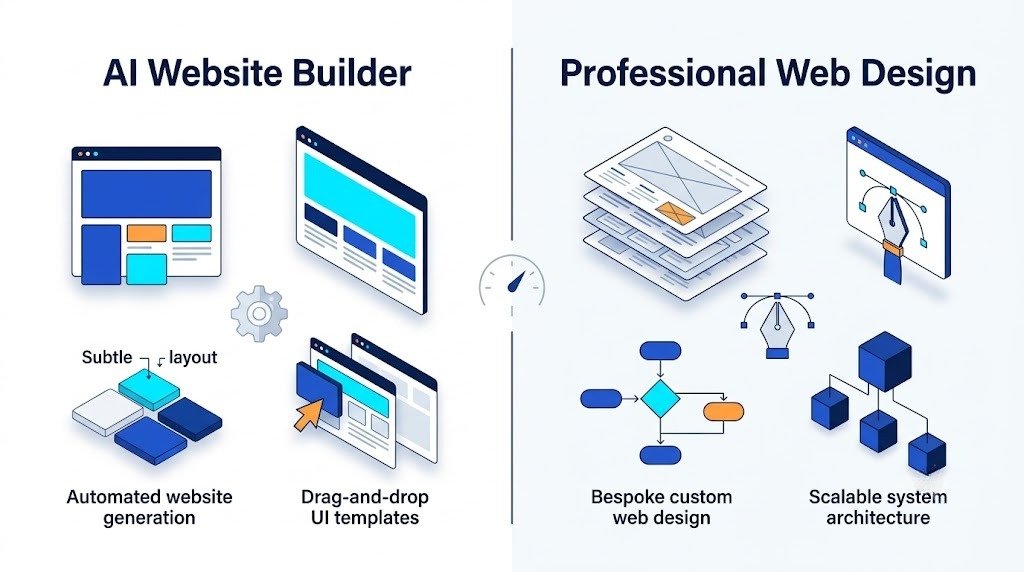
It helps to compare the two approaches directly, without treating either one as automatically better.
| Factor | AI Website Builder | Professional Web Design |
| Speed | Very fast, often live within hours or days | Slower, typically weeks depending on scope |
| Customization | Limited to available templates and blocks | Can be built around your exact needs |
| Branding | Generic unless heavily edited | Built around your brand from the start |
| SEO | Basic controls, varies by platform | Can be planned strategically from the ground up |
| Performance | Depends on platform and how the site is built | Can be optimized specifically for your goals |
| User experience | Template-based, generally solid for simple sites | Designed around how your specific customers behave |
| Technical functionality | Works well for standard features | Better suited to custom or complex functionality |
| Scalability | May require a rebuild as needs grow | Built with future growth in mind |
| Maintenance | Often simpler, platform-managed | May need ongoing developer support |
| Human expertise | Limited to what the AI generates and you edit | Strategy, design judgment, and testing throughout |
Neither option is automatically the right choice. AI website builders genuinely make sense for simple, fast-moving needs. Professional web design earns its value when a business has specific branding, functionality, or growth requirements that a template-based tool cannot fully support.
Can AI-Built Websites Rank on Google?
Yes, an AI-built website can rank on Google. There is no rule that automatically penalizes a website simply because AI was involved in creating it.
What actually determines ranking is the same set of factors Google has emphasized for years:
- Helpful, relevant content that matches what people are searching for
- Search intent alignment
- Solid technical SEO, including page structure and site speed
- Good page experience, especially on mobile
- Clear site architecture and internal linking
- Genuine relevance and trustworthiness
The real risk is not AI itself. It is publishing thin, generic, unedited content at scale purely to try to rank, without adding real value for readers. Search engines have become better at identifying that pattern, and it can hurt a site’s visibility regardless of whether a human or an AI tool produced the content.
In practice, this means an AI-generated website that is reviewed, customized, and filled with accurate, useful information about your specific business has a reasonable chance of ranking. A website that is published exactly as generated, with generic text that could apply to any business, is far less likely to perform well in search results over time.
Are AI Website Builders Good for SEO?
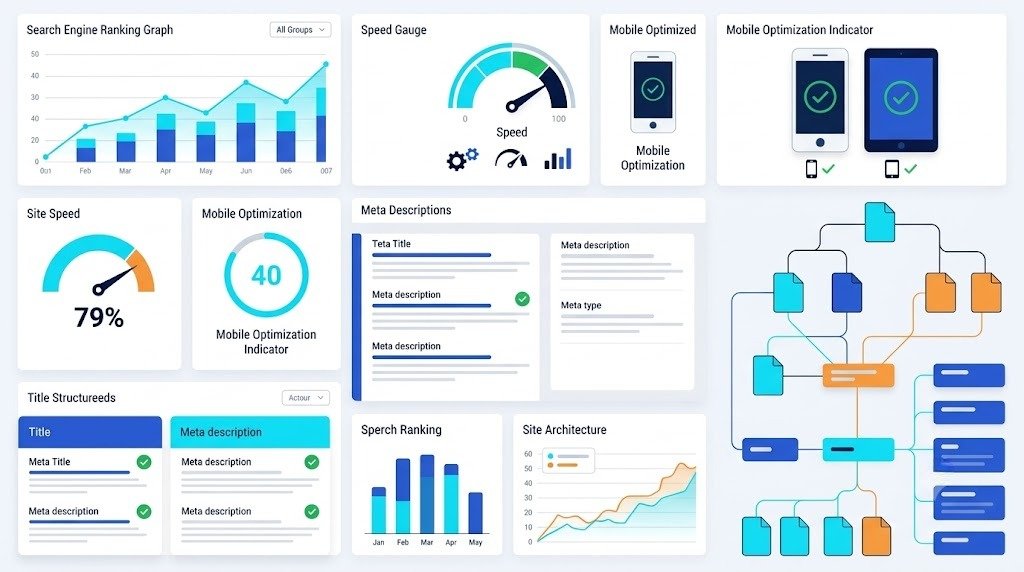
This depends heavily on the specific platform you choose. Some general points apply across most tools.
Title and meta controls. Many AI builders let you edit page titles and meta descriptions, though the level of control varies.
Headings. AI-generated pages usually include heading structures automatically, but it is worth checking that they follow a logical order rather than just looking visually correct.
URLs. Some platforms allow clean, customizable URLs. Others generate less flexible ones, which can matter for clarity and keyword relevance.
Image optimization. Check whether the platform allows you to add descriptive alt text and compress images, since both affect accessibility and page speed.
Mobile responsiveness. Most modern AI builders produce mobile-friendly layouts by default, though it is still worth testing on an actual phone before publishing.
Site speed. Page speed depends on how the platform handles code and media, and this varies noticeably between tools.
Internal linking. Basic AI-generated sites often lack a thoughtful internal linking structure between related pages, which is something you may need to add manually.
Content quality. This is the factor most within your control. Editing AI-generated text to be specific, accurate, and genuinely useful to your audience matters more for SEO than almost any other single decision.
No AI website builder automatically guarantees good SEO. The platform sets the technical foundation, but the content quality and ongoing optimization still depend on the person managing the site.
When Should You Use an AI Website Builder?
An AI website builder tends to be a good fit when:
- You need a simple, informational website with a handful of pages
- You are a new business testing an idea before investing further
- You run a personal or service-based business with straightforward needs
- You need a website for a temporary project or event
- You want a basic portfolio to showcase your work
- Your site does not require complex functionality or deep customization
In these situations, speed and low cost of entry often outweigh the limitations.
When Should You Hire a Professional Web Designer?
Professional web design tends to make more sense when:
- Strong, distinctive branding is important to how customers perceive you
- Your website needs complex functionality, like bookings, custom quotes, or membership areas
- You want a custom user experience built around how your specific customers browse and buy
- You are running or planning to run ecommerce with more than a handful of products
- SEO is a serious growth channel and you need a site built with that strategy in mind
- Your website plays a direct role in conversions and revenue
- You expect the site to grow significantly over the next few years
- You want ongoing technical support rather than managing everything yourself
This is not about one option being universally better. It is about matching the complexity of your business to the right level of investment.
How to Choose an AI Website Builder in 2026
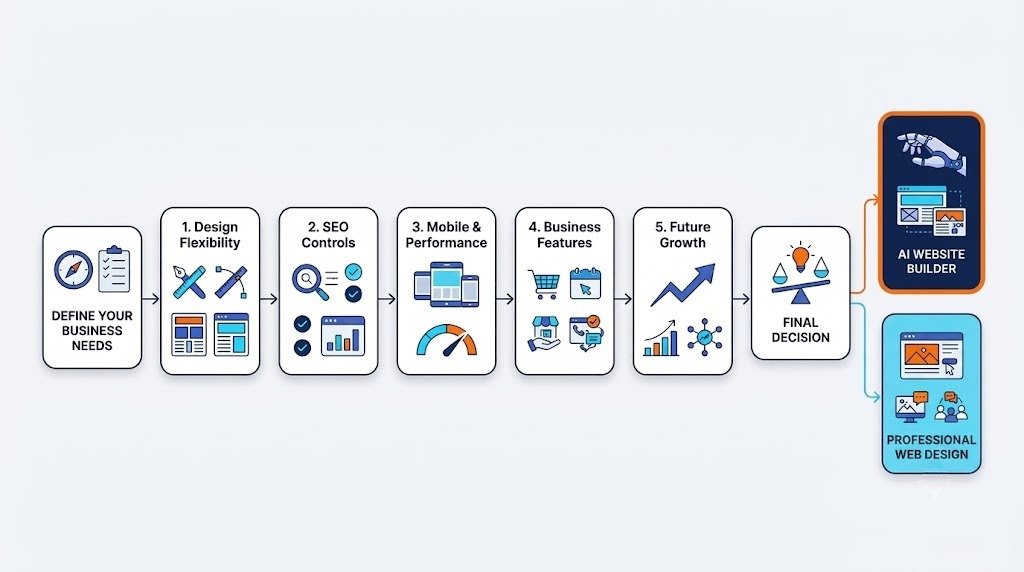
If you decide an AI website builder is the right fit, a few practical factors are worth checking before you commit to a platform.
- Ease of editing. Can you make changes easily after the AI generates the initial site?
- Design flexibility. How much can you adjust beyond the default templates?
- SEO controls. Can you edit titles, meta descriptions, headings, and URLs?
- Mobile responsiveness. Does the generated site look and function well on phones, not just desktop?
- Performance. Does the platform have a reputation for reasonably fast load times?
- Hosting. Is hosting included, and is it reliable?
- Security. Does the platform include basic security features like SSL certificates?
- Integrations. Can you connect tools you already use, like booking systems or email marketing?
- Content management. How easy is it to add or update pages over time?
- Ecommerce. If you plan to sell online, does the platform support it well, even at a small scale?
- Scalability. Can the site grow with you, or will you likely need to switch platforms later?
- Export or migration options. If you ever want to move away from the platform, is that realistically possible?
- Support. What kind of help is available if something goes wrong?
- Total ongoing cost. Look beyond the starting price to what you will actually pay monthly or annually once you add the features you need.
No single platform is the right choice for every business. The best fit depends on your specific goals, technical comfort level, and budget.
Common Mistakes to Avoid When Using an AI Website Builder
Even a strong AI-generated starting point can go wrong if these common mistakes creep in.
- Publishing the AI-generated website without reviewing it first
- Leaving generic AI-written content instead of editing it to reflect your actual business
- Ignoring your brand identity in favor of the default design
- Not checking how the site looks and behaves on mobile devices
- Skipping page speed checks before launch
- Forgetting basic SEO steps like page titles and descriptions
- Publishing inaccurate information about your business, services, or pricing
- Not testing for accessibility issues
- Using low-quality or irrelevant images
- Failing to test contact forms and calls to action before going live
- Choosing a platform without thinking about whether it can support future growth
Most of these mistakes are easy to avoid with a careful review before publishing, but they are also the most common reason AI-generated websites underperform.
Frequently Asked Questions
What is an AI website builder?
It is a platform that uses artificial intelligence to automatically generate a website’s structure, layout, and often its written content, based on information you provide about your business.
Are AI website builders good for business websites?
They can be, especially for simple, straightforward websites. Businesses with more complex branding, functionality, or growth needs often benefit from additional human-led customization or professional web design.
Can an AI website rank on Google?
Yes. Ranking depends on factors like content quality, search intent, technical SEO, and page experience, not on whether AI was involved in building the site.
Is an AI website builder better than WordPress?
It depends on your goals. AI builders are generally faster and easier for simple sites, while WordPress offers more flexibility and customization for businesses with specific or complex needs.
Are AI-built websites SEO-friendly?
Many include basic SEO features like editable titles and headings, but SEO friendliness still depends on the platform’s technical foundation and how well the content is optimized after publishing.
Can AI create a complete website?
AI can generate a complete initial website, including pages, layout, and content. Most businesses still benefit from reviewing and editing that output before it truly represents them well.
Should I use an AI website builder or hire a web designer?
Use an AI website builder for a simple, fast, low-cost website. Consider a professional web designer when you need custom functionality, strong branding, advanced SEO, or a site built to scale with your business.
What is the best AI website builder in 2026?
There is no single best option for every business. The right platform depends on your industry, budget, technical comfort, and how much customization and functionality your website needs.
Final Thoughts
AI website builders have made it genuinely easier for small businesses to get online quickly, and for many simple websites, they are good enough to do the job well. The tools are not a shortcut around good decision-making, though. A generated website still needs a careful human review to fix generic content, confirm the design fits your brand, and make sure the basics of SEO and accessibility are in place.
If your business has grown past the point where a template-based site can keep up, or if branding, custom functionality, and long-term SEO strategy matter to your growth, it may be worth exploring website design for small business with a team that can build around your specific goals rather than a general template. KPTL Web Solution works with businesses at both stages, whether you need guidance on getting the most out of an AI-generated site or a fully custom website built for the long run.