
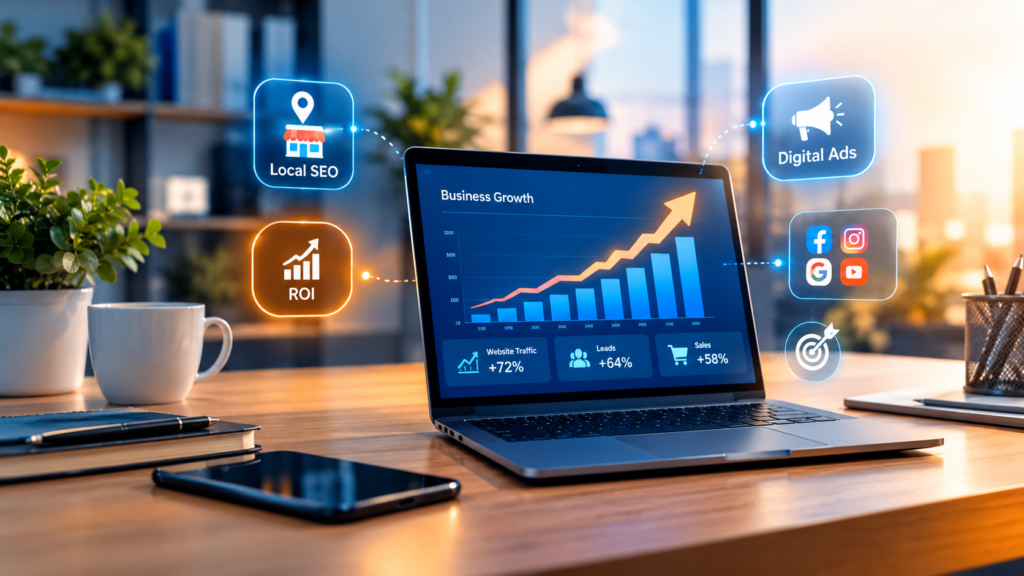
You know your product. You know your customers. What most small business owners don’t know, and shouldn’t have to, is how to run a profitable Google Ads account, structure a local SEO strategy that actually ranks, or build a content calendar that converts strangers into paying customers.
That gap is exactly where most small businesses lose money. Not because they aren’t working hard, but because marketing today has too many moving parts for any one person to master while also running the actual business. A digital marketing agency for small businesses exists to close that gap, not by replacing your expertise, but by adding the specialized skill set your growth stage demands.
This isn’t another surface-level list of “you’ll save time” and “you’ll get a nice website.” We’re going deeper into the real, financial reasons small business owners are shifting marketing budgets away from guesswork and toward agency partnerships, how the math actually works, and how to tell if it’s the right move for you.
The Real Problem: Most Small Businesses Aren’t Losing to Bad Products, They’re Losing to Bad Marketing Math
Here’s what rarely gets said out loud: small businesses don’t usually fail because the offer is weak. They stall because marketing spend isn’t tied to measurable return.
A business owner posts on Instagram a few times a week, boosts a post here and there, maybe runs a Google Ads campaign with default settings, and hopes something sticks. There’s no tracking of cost per lead, no clarity on which channel actually produces paying customers, and no system for improving results month over month. Decisions get made on instinct instead of data, and instinct is expensive when it’s wrong.
This is the pitfall a specialized agency is built to solve. It turns marketing from a guessing game into a repeatable, ROI-driven system, one where every dollar spent can be traced back to a result.
If you want a broader foundation before going deeper into strategy, our Digital Marketing Guide 2026 breaks down the core channels, trends, and practical tactics shaping small business marketing this year. Consider this article the next layer down: the specific reasoning behind why so many owners are now bringing in a dedicated partner to execute that strategy.
What a Digital Marketing Agency for Small Businesses Actually Delivers
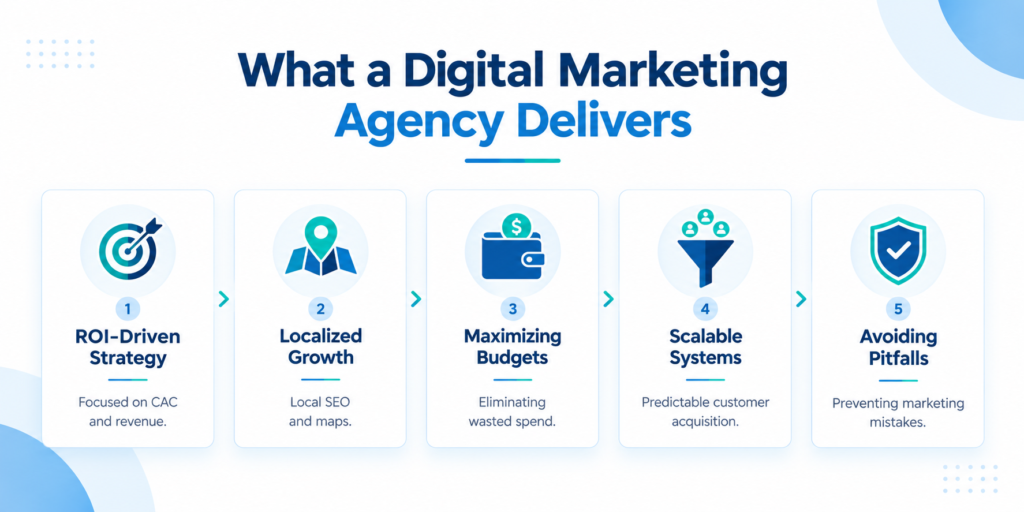
1. ROI-Driven Strategy, Not Just Activity
Posting content and running ads is activity. Knowing your customer acquisition cost (CAC), your average order value, and your return on ad spend (ROAS), and adjusting strategy based on those numbers, is ROI-driven marketing. That distinction matters more than almost anything else in this conversation.
A capable agency will:
- Set up proper conversion tracking before spending a single dollar on ads, so every click, form fill, and sale is attributed correctly
- Calculate what a customer is actually worth to your business over their full lifetime, not just their first purchase
- Kill underperforming channels quickly instead of letting them quietly drain your budget for months
- Reinvest saved budget into the channels producing real leads and sales, compounding results instead of spreading them thin
- Build reporting that connects marketing activity directly to revenue, not vanity metrics like likes or impressions
This single shift, from “let’s try things” to “let’s measure and scale what works,” is often the difference between a business that plateaus and one that compounds growth year over year. Owners who make this shift stop asking “is marketing working?” and start asking “which part of marketing is working best, and how do we do more of it?”
2. Localized Growth That Actually Reaches Your Buyers
Most small businesses serve a specific geography: a city, a metro area, a defined service radius. Generic marketing advice built for national e-commerce brands doesn’t translate well here, and applying it anyway is one of the most common reasons small business ad budgets underperform.
Local growth requires a different playbook:
- Local SEO optimization so you show up when someone searches “near me” or your city name, which is often the highest-intent search a customer can make
- Google Business Profile management, review generation, and local citation consistency across directories
- Geo-targeted ad campaigns that don’t waste budget showing your ads to people outside your service area
- Community-relevant content that speaks to local pain points, seasons, events, and buying habits specific to your market
- Local backlink building from regional publications, associations, and directories that strengthen your authority in local search results
A digital marketing agency for small businesses that understands localized growth won’t hand you the same national strategy they’d give an enterprise client. They’ll build around your actual buying radius, your local competitors, and the search behavior specific to your area. This is often the single highest-leverage investment a service-based or storefront business can make, because local intent traffic converts at a far higher rate than broad, untargeted traffic.
3. Making Tight Budgets Work Harder
Small business budgets are almost always smaller than what larger competitors can deploy. That’s not a disadvantage if the budget is managed with precision, but it does mean there’s very little room for wasted spend or trial-and-error experimentation without a plan.
Here’s what tight-budget marketing done right looks like:
- Prioritizing one or two channels deeply instead of spreading resources thin across five or six platforms at once
- Using retargeting to capture the large majority of website visitors who don’t convert on their first visit, a far cheaper win than constantly chasing brand-new traffic
- Testing small, scaling what works, and cutting what doesn’t before committing meaningful spend to any single channel
- Blending organic efforts (SEO, content, social) with paid channels so the business isn’t permanently dependent on ad spend just to generate leads
- Sequencing investments logically, building the foundation (site, tracking, offer clarity) before scaling paid traffic on top of it
An experienced agency has managed budgets like yours across dozens of clients and industries, and knows where the waste typically hides. That pattern recognition, built from seeing what fails repeatedly across similar businesses, is difficult to replicate without years of direct experience. It’s also one of the fastest ways a small business can protect its resources while still growing.
4. Scalable Customer Acquisition Systems
Here’s a distinction most blogs skip entirely: there’s a difference between generating a customer and building a system that generates customers predictably.
A one-off referral or a viral post is luck. A funnel that consistently turns cold traffic into leads, and leads into paying customers, is a system, and systems scale in a way that luck never does. Agencies build:
- Landing pages designed specifically for conversion, tested and refined rather than built once and forgotten
- Email nurture sequences that follow up automatically when a lead isn’t ready to buy yet, keeping the relationship warm without manual effort
- Multi-channel retargeting that keeps your brand visible until a prospect is ready to make a decision
- Clear reporting dashboards so you always know your cost per acquisition and how it’s trending
- Sales-and-marketing alignment, so leads generated by campaigns are followed up with quickly and consistently
This is the infrastructure that lets a small business scale its customer base month over month without the owner personally chasing every single lead by hand. It’s also what allows growth to continue even during the weeks an owner is focused on operations rather than outreach.
5. Avoiding the Common Pitfalls That Drain Small Business Budgets
Every agency that’s worked with small businesses has seen the same expensive mistakes repeat across industries:
- Chasing every new platform instead of mastering one or two that actually fit the target audience
- Running ads without a landing page built for conversion, sending paid traffic to a generic homepage that isn’t designed to close the sale
- No tracking setup, meaning decisions are made on gut feeling instead of data, long after the budget is already spent
- Inconsistent posting and messaging, which confuses both the algorithm and the audience about what the brand actually stands for
- Underestimating the sales cycle, expecting instant results from strategies, like SEO, that compound gradually over months rather than days
- Treating marketing as a one-time project instead of an ongoing, iterative process that needs regular refinement
A specialized agency isn’t just adding services. It’s removing the guesswork that causes these costly missteps in the first place, and replacing it with a process that’s been refined across many client accounts rather than trial-and-error on a single business.
The Compounding Value of SEO for Small Businesses
SEO deserves its own section because it’s the channel most frequently misunderstood by small business owners, and the one most often abandoned too early.
Paid advertising delivers traffic the moment a campaign launches, and that traffic disappears the moment spending stops SEO works differently. It builds slowly, but the results compound. A page that ranks well for a valuable search term continues generating traffic and leads for months or years without ongoing ad spend attached to that specific page.
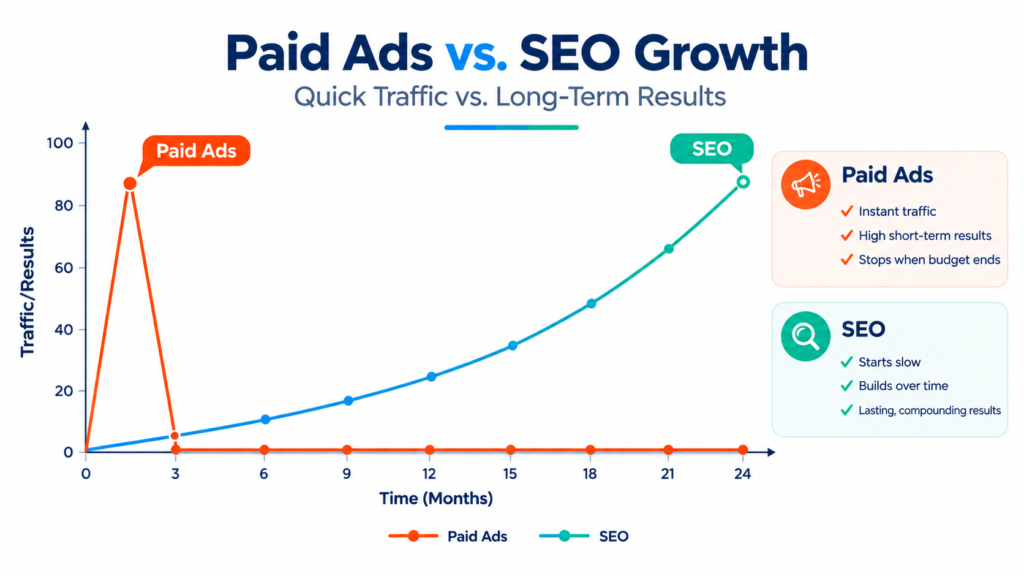
This is why an agency focused on ROI treats SEO as a long-term asset rather than a short-term tactic:
- Technical SEO ensures your website is actually crawlable, fast, and structured in a way search engines can understand
- On-page SEO aligns your content with the exact language your potential customers are searching
- Local SEO connects your business to geographically relevant searches, which is often where small businesses see the fastest return
- Content strategy builds topical authority over time, making it progressively easier to rank for new, related terms
Small businesses that invest consistently in SEO over twelve to eighteen months often reach a point where organic search becomes their most cost-efficient acquisition channel, reducing reliance on paid ads without reducing lead volume.
Building Brand Trust as a Growth Lever
There’s a softer, less discussed benefit to working with a digital marketing agency for small businesses: consistency builds trust, and trust drives conversion.
When a prospective customer encounters a business with a professional website, active and coherent social presence, positive reviews, and content that clearly demonstrates expertise, they’re more likely to choose that business over a competitor with a thinner, inconsistent presence, even if the underlying products or services are similar. Marketing isn’t only about generating leads. It’s about shaping the perception a prospect forms before they ever speak to your team.
An agency helps maintain that consistency across every touchpoint: website, social channels, email, ads, and reviews, so the brand feels cohesive and credible at every stage of the buyer’s journey.
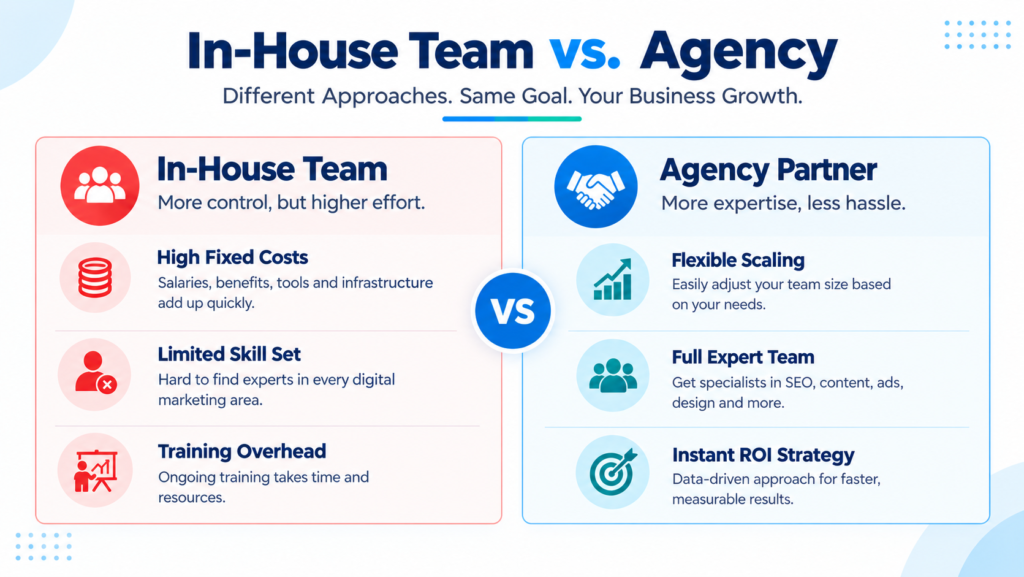
In-House Team vs. Hiring a Specialized Digital Marketing Agency for Small Businesses
This is the decision most owners eventually have to make. Here’s an honest breakdown of how the two options actually compare in practice, factor by factor.
Payroll and Overhead
An in-house team requires ongoing payroll, benefits, software licenses, and training investment for every team member added, and that overhead continues whether campaigns are performing well or not. An agency partnership works differently. Fees are typically consolidated and scalable, without the added overhead of employment costs, which makes it easier to plan resource allocation around actual results.
Skill Breadth
In-house, it’s common for just one or two people to be expected to cover SEO, paid ads, content, design, and analytics all at once. That’s a lot of ground for anyone to cover well. A specialized agency brings a full team, with each specialist focused on their specific channel, so no single discipline is left as an afterthought.
Tools and Software
When you build a team in-house, the business absorbs the cost of every platform and subscription separately, from SEO software to ad management tools to design and analytics platforms. Agencies typically already have enterprise-grade tools included as part of their service, so you get the benefit without managing the stack yourself.
Learning Curve
New in-house hires need ramp-up time to learn your industry, your brand voice, and your internal systems before they start producing meaningful results. Agencies bring proven playbooks and cross-industry experience from day one, which shortens the time between onboarding and actual performance.
Scalability
Hiring or restructuring an in-house team to match seasonal or growth-driven demand is slow and resource-intensive. With an agency, effort and spend can be adjusted up or down far more easily, so your marketing capacity flexes with your business instead of lagging behind it.
Objectivity
Internal teams can develop blind spots over time, or resist changing an approach simply because it’s familiar. An outside agency brings a fresh perspective and competitive benchmarking drawn from other accounts, which often surfaces opportunities an internal team would miss.
Risk and Continuity
An in-house team can become a single point of failure if a key employee leaves or is unavailable, leaving campaigns unmanaged in the gap. Agencies operate with team-based delivery, which builds in redundancy and continuity even if one specialist is out.
Focus
In a small business, marketing responsibilities often get split with other operational duties, competing for the same limited attention. With an agency, marketing execution is the sole focus, with resources dedicated accordingly rather than squeezed in around everything else.
For most small and growing businesses, the practical case favors an agency partnership, particularly in the early growth stages when resource allocation needs to stay lean and flexible rather than fixed and rigid.
How to Choose the Right Digital Marketing Agency for Your Small Business
Not all agencies are built for small business realities. Many are structured around enterprise retainers and processes that don’t translate well to a leaner operation. When evaluating a partner, look for:
- Transparent reporting, so you can see exactly where your budget is being allocated and what it’s producing
- Experience with businesses your size, not just enterprise case studies that don’t reflect your resources or timeline
- A strategy-first approach, not a “buy this package” sales pitch built around predefined service bundles
- Clear communication and realistic timelines, especially for organic strategies like SEO that take time to mature
- Flexibility to adjust the plan as your budget, goals, or season change throughout the year
- A willingness to explain their reasoning, rather than asking you to simply trust the process without visibility into it
This is exactly the kind of partnership our digital marketing services are built around: working as an extension of your team, with strategy grounded in your numbers, your market, and your growth stage, not a one-size-fits-all template borrowed from a much larger business.
Why Small Businesses Are Choosing KPTL Web Solution
At KPTL Web Solution, we work specifically with small and growing businesses that need marketing to perform, not just look good. That means:
- Strategy built around your actual acquisition costs and resource allocation, not inflated retainers designed for larger companies
- Local SEO and geo-targeted campaigns for businesses that live or die by their service area
- Transparent, plain-English reporting, so you’ll always know what’s working and why, without needing a marketing background to interpret it
- A team that treats your growth targets as our accountability, not a side project handled with leftover attention
- A long-term view of SEO and content, paired with a disciplined, ROI-focused approach to paid channels
We’re not here to sell you every service in the catalog. We’re here to build the specific system that gets your business its next round of customers, efficiently, predictably, and sustainably.
Ready to Turn Your Marketing Into a Growth Engine?
If you’re tired of marketing that feels like an ongoing expense instead of an investment, it’s time for a different approach. A specialized digital marketing agency for small businesses doesn’t just execute tasks. It builds the strategy, systems, and accountability your business needs to grow predictably, month after month.
Book a free consultation with KPTL Web Solution today and let’s map out exactly where your marketing resources should be going, and what kind of return you should reasonably expect from them.