
Quick Answer: Grab an independent consultant if you already possess hands to execute and strictly lack a high-level roadmap. Partner with an agency if your in-house bench is empty and you need people to design, build, write, and launch campaigns across multiple channels immediately.
The Scaling Crossroads: Why Your Choice Dictates Long-Term Momentum
Founders often treat this decision like flipping a coin over morning coffee. You post an ad, look through a dozen pitches, and assume the only difference boils down to how an invoice arrives.
It does not.
The practical gulf between a solo strategist and a collective agency comes down to day-to-day workflow friction. It dictates who touches your live campaigns, whose neck is on the line when numbers dip, and how many meetings happen before an idea turns into an active landing page.
Make the wrong call here and momentum vanishes fast. Before deciding, it helps to understand how to choose the best SEO marketing company so you don’t end up wasting your budget on mismatched agencies. Three months in, the consultant delivers a brilliant fifty-page deck, yet traffic stays flat simply because nobody inside the company had time to touch a keyboard and publish it. Conversely, scrappy startups often retain massive regional agencies expecting white-glove executive care, only to be handed down to an entry-level account coordinator who runs rigid, automated templates.
Neither provider is inherently broken. The problem is a fundamental operational mismatch.
The real penalty here is lost calendar time. While you spend two quarters untangling an ill-fitted working relationship, your direct rivals build compound authority in search rankings and customer acquisition. Sorting out this operational split is why we emphasize structural alignment in our breakdown of current digital marketing services that actually move search dials.
What Is an Independent Digital Marketing Consultant?

An independent digital marketing consultant functions as an outside specialist brought in to diagnose pipeline blockages and prescribe a custom playbook. They are rarely a faceless collective. More often, they are seasoned practitioners operating independently after years inside large firms or running marketing departments internally.
When you bring one on, you are hiring individual brains rather than a sprawling production facility. They audit what you currently run, spot where acquisition leaks happen, and organize your priorities into an actionable queue.
Direct Senior Guidance and Unfiltered Strategic Focus
The primary advantage of an independent consultant is obvious: zero organizational fluff. You speak directly with the seasoned professional whose name was on the proposal. No junior assistant drafts your strategy while a director glances at the slides five minutes prior to your monthly check-in call.
Direct accountability eliminates political corporate games. When organic rankings take a hit or a conversion funnel leaks users, you get immediate answers from the individual steering the ship. They remember what your team discussed three weeks ago about quarterly inventory goals because they do not juggle forty different client accounts simultaneously.
For founders exhausted by cookie-cutter proposals, this personal focus changes everything. A capable consultant brings real pattern recognition gathered across dozens of prior campaigns, adapting those lessons directly to your setup instead of forcing your brand into a rigid template.
Operational Limits and Execution Constraints
Let us look at the operational ceiling. A solo consultant has exactly twenty-four hours in their day. That constraint is purely mathematical.
Execution capacity remains their single biggest operational bottleneck. A consultant can construct your content strategy, audit your technical architecture, and map out your conversion pathways. Yet when it comes to writing twenty articles, coding custom schema into your template, or designing thirty variations of display ads, they hit a wall.
That production workload falls right back on your internal team. If your staff is already swamped with shipping orders, managing customer support, or keeping daily operations afloat, that pristine strategy will simply gather digital dust in a shared folder.
Furthermore, turnaround times stretch when unexpected technical fires ignite. One person handling several accounts cannot rebuild a broken page template while simultaneously troubleshooting a complex conversion tracking tag.
Ideal Scenarios for Choosing an Independent Consultant
Retaining an independent consultant makes clear sense in these specific operational situations:
- You retain an in-house team of writers, designers, or junior marketers who require clear direction and technical oversight.
- You need high-level advisory leadership without taking on executive payroll overhead.
- You are resolving an isolated, well-defined problem, such as recovering from a specific search penalty or untangling analytics discrepancies.
- You demand complete continuity and prefer working alongside one accountable individual across every review cycle.
What Does a Full-Service Digital Marketing Agency Deliver?

A full-service agency approaches your growth challenges through collective production capacity. Rather than buying hours from a single mind, you plug into an integrated production line: technical analysts, media buyers, graphic designers, copywriters, and front-end developers, all working under one roof.
This multidisciplinary setup is precisely why businesses routinely reach an inflection point where they seek complete outside execution, an operational shift we explore deeply in our look at why companies choose to work with an agency rather than piecing together piecemeal solutions.
Agencies eliminate single-person bandwidth bottlenecks. Where an independent strategist has to balance multiple competing tasks, an agency distributes deliverables across dedicated team members who specialize in discrete steps.
End-to-End Multidisciplinary Execution
Depth of production represents an agency’s primary operational advantage. If your roadmap demands a custom landing page created, five distinct ad angles tested, and a complete technical site speed cleanup completed in the same business week, an agency coordinates those tasks simultaneously.
This execution speed is crucial for businesses with no in-house creative staff. You avoid the headache of sourcing a reliable freelance developer on short notice, vetting a technical copywriter, or worrying whether your ad manager knows how to configure conversion tracking correctly. The agency supplies the execution hands and handles the internal handoffs automatically.
Communication Layers and Traditional Agency Friction
This structural scale inevitably introduces friction. Most established agencies run your communication through a dedicated account manager. While this keeps work organized, it inevitably inserts an operational buffer between you and the technical specialists manipulating your live campaigns.
Messages get relayed, context gets slightly warped in translation, and minor revisions can require multiple internal touchpoints before they reach a designer or developer. Onboarding periods also stretch out, as account teams routinely take several weeks simply completing discovery questionnaires and building out project management boards.
Furthermore, standardized processes sometimes lead to predictable, rigid reporting decks that highlight vanity metrics instead of directly answering your practical operational questions.
Ideal Scenarios for Partnering With an Agency
An agency partnership typically serves your business best under these working conditions:
- You operate without an internal marketing staff and require full, hands-on production across the board.
- You want to scale multiple acquisition channels simultaneously, from search optimization to programmatic ads, without hiring internal employees.
- Your company is scaling quickly and demands rapid creative production that an individual contractor cannot supply.
- You prefer holding a single entity responsible for complex, interconnected deliverables instead of managing disparate contractors yourself.
Channel-by-Channel: How SEO, Paid Media, Content, and Web Design Differ Across Both Models
Because generalized comparisons often blur the lines, observing how both structures tackle individual disciplines makes the distinction practical.
Search Engine Optimization
Under an independent consultant, search engine optimization leans heavily toward technical audits, log file analyses, and keyword gap reports. The consultant reviews your server responses, monitors ranking movements, and hands your internal team prioritized task lists covering metadata adjustments, URL migrations, or internal linking updates.
However, the consultant rarely produces the written content or enters your site editor to reformat your template structure. You get clear instructions, but your team must carry out the actual manual updates.
An agency operates SEO as a multi-step factory line. A technical analyst identifies crawl inefficiencies, a content strategist selects missing keyword opportunities, and in-house writers draft optimized articles. Simultaneously, an outreach specialist pitches editorial resources for backlink acquisition, while a developer fixes JavaScript rendering bottlenecks. This parallel structure is indispensable if your organic strategy relies on pushing out significant volumes of helpful editorial assets without pulling your internal staff away from daily operations, much like working with a dedicated seo marketing agency.
Paid Media and Advertising
Paid media demands constant, disciplined oversight. A consultant brings strong initial budget modeling, audience targeting logic, and campaign setup expertise. However, actively watching ad auctions, pausing fatiguing creatives, and building new visual variations every Tuesday burns finite weekly hours. In many cases, a consultant checks accounts on specific scheduled days, meaning unexpected spend spikes or account anomalies might sit longer between visits.
An agency media buyer generally lives inside advertising dashboards daily. They spot rising acquisition costs quickly, reallocate daily budgets toward winning audiences in near real-time, and coordinate with internal designers to refresh display creatives before audience fatigue sets in. If your customer acquisition strategy depends on aggressive split-testing and rapid ad refreshes, an agency setup easily outpaces a solo operator.
Content Marketing and Copywriting
Content is where the production divide becomes undeniable. A sharp consultant will build an exceptional editorial framework, complete with customer persona maps and intent-driven topic clusters. Yet unless they maintain reliable subcontractors, someone on your payroll must still sit down, write four thousand words of practical copy, source imagery, and handle the publishing steps.
Agencies solve that production barrier directly. They provide dedicated copywriters and editors who produce regular content schedules, match your brand tone, and format articles with proper headings and visual elements. This protects your content calendar from slipping whenever your internal staff gets pulled into urgent customer service problems.
Web Design and UI/UX
Designing high-converting digital assets is inherently collaborative. Creating responsive landing pages requires wireframing, user interface design, persuasive copywriting, conversion rate optimization logic, and clean front-end coding. A consultant can review your existing user flows and point out checkout drop-offs, but they usually lack the time or diverse skills required to rebuild those assets from scratch.
An agency contains those disparate disciplines under one roof. When a conversion bottleneck surfaces, their UX designer revises the interface, their copywriter sharpens the calls to action, and their developer pushes the live code to your staging server.
Side-by-Side Comparison: Consultant vs Agency
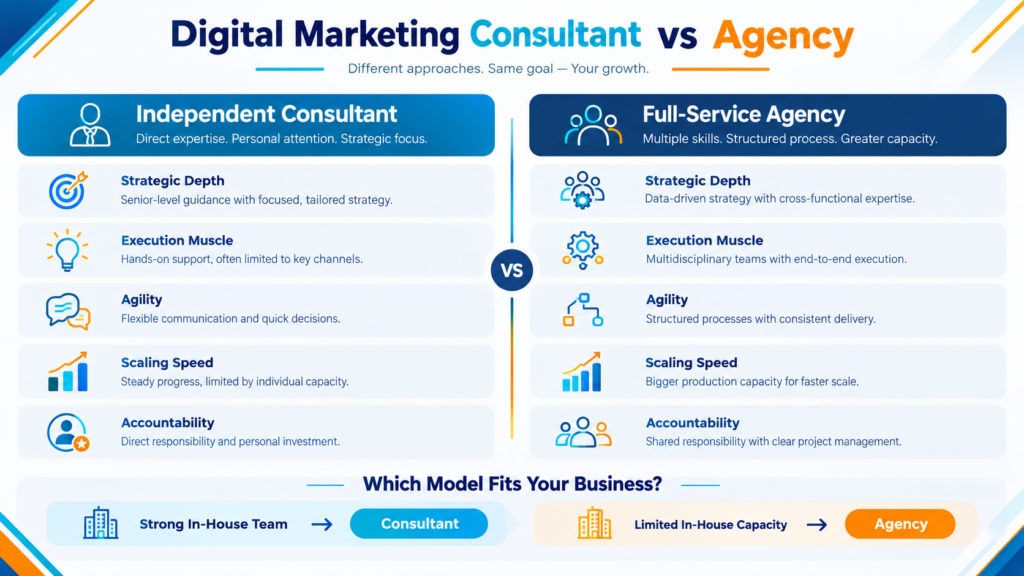
When you evaluate both models side by side across real-world business realities, clear operational distinctions emerge:
- Strategic Depth: A consultant delivers direct senior-level focus, customized thinking, and zero junior dilution. An agency offers structured, process-driven frameworks that can vary depending on which team members are assigned to your roster.
- Execution Muscle: A consultant typically provides guidance only, which demands that you supply your own internal production hands. An agency provides complete, turnkey muscle capable of producing finished creative, technical, and written deliverables.
- Agility: A consultant operates with minimal overhead and pivots direction instantly. An agency moves through structured internal workflows, which can mean slower turnaround on spontaneous, last-minute requests.
- Scaling Speed: A consultant is ultimately limited by single-person calendar limits. An agency expands output smoothly by bringing in additional team specialists as your marketing needs grow.
- Accountability: A consultant provides a single, direct human connection with zero middle layers. An agency routes accountability through an account management layer that coordinates the various specialists handling your deliverables.
Assessing Your Internal Capacity Before Signing a Contract

Before signing an agreement or locking in monthly commitments, take an uncompromising inventory of your internal team. Do you currently have reliable individuals who can write, edit, code, and design on a rigid weekly cadence? If your answer is yes, purchasing strategic direction from a consultant makes complete sense.
If your team is already running at peak capacity managing inventory, closing sales, and answering support tickets, hiring an advisory consultant will only create frustration. You will receive great recommendations that your team never has time to implement. In that situation, you require turnkey production support.
Take a moment to run through this honest operational audit:
- Content production: Can your team produce and publish a thoroughly researched, well-formatted piece of content within five business days without neglecting a primary operational duty? If that work constantly gets delayed, you have an execution bottleneck.
- Design capacity: Can someone in-house design high-resolution display ads, infographics, and landing page layouts from scratch? If your primary design asset is an executive tinkering with free browser templates on weekends, your production capacity is insufficient.
- Technical skills: Can your staff implement structured schema markup, clean up render-blocking JavaScript, or repair redirect loops without breaking your core site layout? Technical search fixes often linger indefinitely without dedicated developer support.
- Decision velocity: If an ad campaign burns budget inefficiently right now, can your team review the numbers and alter creative assets today? If that simple change requires three meetings and a committee vote, your operational structure is choking growth.
- Performance reporting: Does your business maintain an organized dashboard tracking customer acquisition trends, or does performance review happen only when someone panics over monthly bank receipts?
If your team passes four or five of these checkpoints comfortably, you have the operational infrastructure to benefit from an independent consultant. If you stumble on most of them, you require an agency partner or a hybrid team that can handle both the strategy and the heavy lifting.
Critical Red Flags to Watch for on Both Sides
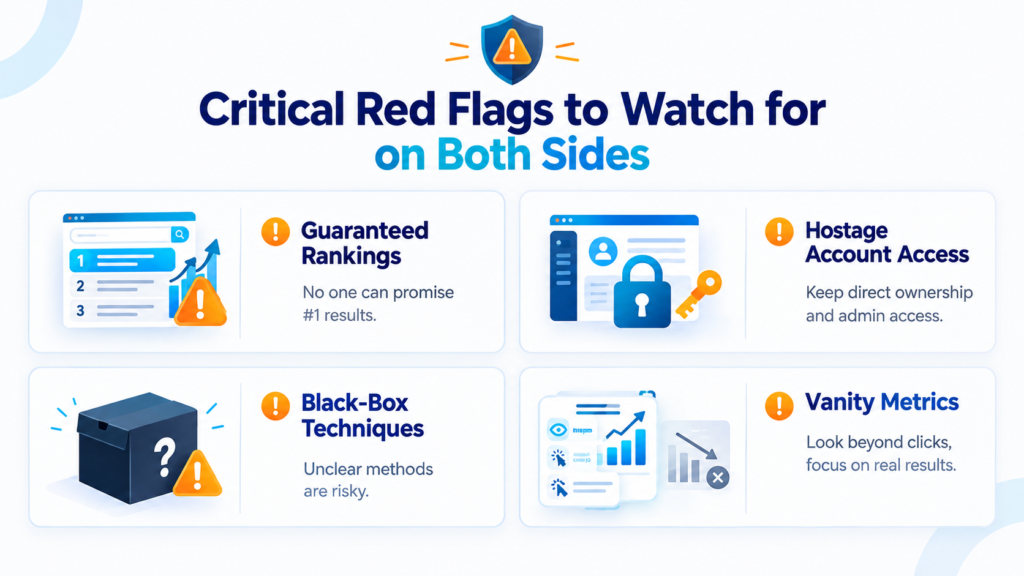
Whether you decide to hire an independent strategist or a multidisciplinary agency, watch for these common warnings during discovery conversations:
- Guaranteed number-one rankings: Search algorithms update constantly and depend on thousands of dynamic signals. Anyone promising guaranteed top rankings is relying on outdated tactics or being deliberately disingenuous.
- Hostage account access: You must maintain direct administrative ownership of your search consoles, ad platforms, and website properties. Any provider who builds accounts within their private infrastructure and denies you admin rights is building an artificial barrier to keep you trapped.
- Mysterious black-box techniques: High-performing marketing strategy relies on clear user psychology, fast technical delivery, and helpful content. If an agency or consultant claims their success relies on secret proprietary formulas they refuse to explain plainly, walk away.
- Vague vanity metrics: Be cautious of providers who fill monthly reviews with impression counts, click volumes, and keyword rankings while ignoring qualified inquiries, customer acquisition metrics, and bottom-line pipeline growth.
These standards matter because search engines reward clarity and genuine user value. Reviewing Google’s guidance on creating helpful, people-first content shows clearly that long-term digital growth comes from authentic value and operational consistency, not manipulative workarounds.
Why KPTL Services Delivers the Ideal Hybrid Advantage for Growing Brands
Most founders believe they are forced into an uncomfortable compromise: accept the bandwidth caps of a solo consultant or endure the bureaucratic layers and junior handoffs of a large agency.
KPTL Web Solution (KPTL Services) was intentionally designed to erase that operational friction. We operate as an integrated growth partner, uniting high-level strategic advisory with full, turnkey execution capabilities.
You receive direct, senior strategic guidance from practitioners who study your business model and understand your margins. Simultaneously, you gain access to an agile production team capable of designing interfaces, developing fast web experiences, creating optimized editorial content, and managing complex search campaigns without delays.
Our core service framework addresses every layer of your acquisition funnel:
- Search Engine Optimization: Built around rigorous technical architecture, clean user intent, and high-authority search visibility that endures algorithm updates.
- Search Engine Marketing & Paid Advertising: Direct-response campaigns engineered to capture qualified, high-intent buyer interest while ruthlessly cutting wasted ad spend.
- Conversion-Driven Web Design & UI/UX: Clean, responsive, lightweight digital experiences crafted to turn cold casual traffic into active, verified inquiries.
- Brand Strategy & Visual Identity: Distinctive visual positioning that builds trust and sets your business apart in crowded, competitive markets.
We discard empty vanity reporting entirely. Every update connects directly to the metrics that actually keep your doors open: pipeline inquiries, booked appointments, acquisition efficiency, and verified sales. To review how our integrated workflows operate across different business stages, explore our dedicated digital marketing services page for a detailed view of our approach.
Frequently Asked Questions
Is an independent consultant more economical than a full-service agency?
That comparison depends entirely on scope rather than the title on the contract. A consultant provides strategic roadmaps, while an agency provides both roadmap design and the specialized production hands to build it. You must evaluate what internal resources you have to deploy to calculate true overall efficiency.
How quickly can a business expect measurable results?
Sustainable organic search expansion typically demands between three and six months of sustained technical optimization and editorial publishing before compounding returns appear. Direct-response paid campaigns can gather performance data within days, though refining audiences and landing page conversion efficiency requires continuous testing over several weeks.
Can our company transition between models as we expand?
Yes. Businesses frequently hire an independent strategist to diagnose legacy problems and establish core systems, then transition to a full-service agency once production demands outgrow internal capacity. Similarly, brands leaving large agencies often engage specialized partners to regain direct strategic attention.
Does it make sense to employ both a consultant and an agency simultaneously?
Some established brands do run hybrid arrangements, using an outside strategist to provide unbiased audits while directing an agency team that manages daily creative production. However, this structure demands unambiguous boundaries to prevent conflicting directives from stalling progress.
What core questions should a founder ask prior to signing an agreement?
Ask who will directly manage and execute work on your accounts on a weekly basis. Demand clarity on account ownership rights, reporting intervals, communication channels, and previous case examples that reflect real businesses facing challenges similar to your own.
Final Verdict: Selecting the Partner That Matches Your Growth Stage
There is no universal correct choice, only the operational model that aligns with your available resources, internal headcount, and immediate growth targets.
If you already have capable staff ready to produce creative work and simply need an experienced mind to steer your campaigns, an independent consultant is a practical, agile choice. If your internal team is running at capacity and you need an outside group to build, write, design, and optimize your entire acquisition machine, an agency provides the horsepower you lack.
Be realistic about your current production bottlenecks before committing your resources. The ideal partner should feel like a natural, frictionless extension of your business, not an administrative headache you have to manage around.
If you are evaluating your alternatives and want an objective perspective on your growth channels, read our complete Digital Marketing Guide 2026 to schedule a detailed search and performance audit, and discover the most direct path to scaling your brand.