

Quick Answer: The best SEO marketing company for a small business starts with an audit, explains its plan in plain language, and sticks to Google-safe methods. It shows proof from past clients and reports on leads and sales, not just rankings. Walk away from anyone who guarantees the top spot, hides pricing, or pushes a long lock-in contract. Get the strategy in writing before you pay for anything.
Picking an SEO agency usually feels like handing your car keys to a mechanic who refuses to show you under the hood. You nod along. You hope. Then the invoice lands.
Get it right and you’ll have leads coming in for years. Get it wrong and you’ve paid for six months of reports nobody opened, and sometimes a site that’s worse off than before. Every pitch sounds great. That’s the catch.
Here’s how I’d walk you through it if we were sitting across a desk.
1. Why the Right SEO Marketing Company Matters for Small Businesses
When you run a small outfit, an agency that emails you an auto-generated PDF every thirty days is a payroll problem. Big brands can lose half a year and barely blink. You can’t.
So why bother? Because somebody with water across the kitchen floor types “emergency plumber near me” at 9 pm, and they aren’t browsing. They’ll call the first decent result. That buyer converts far better than a stranger who happened to spot your banner ad. Stop paying for ads and the clicks vanish, but a page that ranks keeps working.

Patience is the price. Most businesses see movement around month three to six. Switch agencies at month five and the clock resets to zero.
Say a dental clinic goes for the cheapest quote. It gets a bundle of unvetted offshore links, and rankings sit flat for half a year. Agency number two bills to clean out hundreds of junk links. One campaign, two invoices.
2. Define Your Goals Before You Talk to Any Agency
Decide what a good year looks like before you book a single sales call. Skip that and the agency picks your metrics for you. Usually that means impressions and “keywords ranked” while your phone sits silent.
Pick two or three plain goals. Thirty more quality inquiries a month. A top spot for your main service in your city. Less reliance on ads. Then put money next to each one.
Local service business. You count calls and booked jobs. Your average ticket is $350. Search sends 30 calls a month and you book 40% of them. That’s 12 jobs, roughly $4,200 a month. Pay $1,000 for SEO and the return is obvious without a spreadsheet.
B2B company. You count qualified demo requests. Deals average $12,000. Say you get ten good requests a month and close one. That single contract pays for a full year of fees. Volume barely matters here, because ten right-fit visitors beat 500 random ones.
The formula is short. Leads needed = target customers ÷ close rate. Ten new customers at a one-in-five close rate means about 50 leads a month. If an agency can’t show how its plan gets you there, the plan is fog.

Watch the first call closely. A decent agency asks about your margins and your best-selling services. A weak one slides a price sheet across before your coffee cools.
3. Check Their Experience With Businesses Like Yours
Relevant experience beats impressive experience. An agency that spent ten years on giant online stores may have no feel for a local clinic or a small B2B shop. The SEO rules are the same. The playbook isn’t.
Ask three things:
- Have you worked with businesses my size and in my industry?
- Can I see case studies with real numbers (leads, calls, revenue)?
- Can I talk to a current or former client?
Then check their answers. Read their Google reviews. Open their own website. An SEO company that can’t rank itself has already answered your question.
Local know-how matters too. For plenty of small businesses, the quick wins come from a solid Google Business Profile, consistent listings, and honest customer reviews. And ask who actually touches your account. Some agencies pitch with a senior strategist, then hand the work to a junior juggling thirty clients.
4. Make Sure They Follow Google’s Latest Recommendations
Old shortcuts can do real damage now. Google’s March 2026 core update began rolling out on March 27, and Google described the May 2026 core update as a regular update meant to surface relevant, satisfying content. Core updates aren’t penalties. They re-score quality across the web, so helpful pages tend to hold their ground. If you dropped, it doesn’t automatically mean you broke a rule.
A good agency builds around the official Google Search Essentials. Boiled down, that’s:
- Content for people. Original answers, not keyword padding.
- Real expertise. Accurate facts, named authors, proof you’ve done the work (the E-E-A-T idea).
- Clean links. No bought link schemes, no mass-produced junk pages.
- Pages that work. Fast, mobile-friendly, easy to use.
Why doorway pages fail. A plumber publishes 40 near-identical pages, one per nearby town, changing only the town name. Looks clever on a keyword report. To a visitor it says nothing new, and Google’s spam policies treat the pattern as a problem. One strong service page plus a few genuine location pages (real neighborhoods, real jobs) does far better.
What a good page feels like. A visitor lands from a phone on a weak signal. The headline matches what they searched. The page loads in a couple of seconds. Your phone number is right there. Prices, service areas, and hours are stated plainly. Reviews and real photos sit near the top. No pop-up blocks the screen.
Ask the agency, “How do you protect my site during Google updates?” A good team talks about quality and testing. A weak one talks about secret tricks.
5. Ask for an SEO Audit and a Written Strategy

Don’t sign before you see an audit. It should cover technical health, content gaps, backlinks, local listings, and competitors, and it should end in a written plan you can read without a dictionary.
A technical roadmap is a dated to-do list, not a mystery box:
- Month 1: Fix crawl and indexing errors, clear redirect chains, correct duplicate titles, compress heavy images.
- Month 2: Clean up the mobile layout, speed up the slowest pages, add local business markup.
- Month 3: Merge thin or overlapping pages, tighten internal links, set up call and form tracking.
A keyword gap analysis lists searches where competitors show up and you don’t. That dental clinic might find rivals on page one for “emergency dentist open Sunday” and “dental implants cost” while it’s invisible. Each keyword then gets sorted by intent (ready to book or just researching), difficulty, and the page that should target it. Five hundred loose keywords help nobody. A ranked plan does.
Treat the audit as a sample of the work. Generic software output with no human comments is a bad sign. A strong one names your city, your services, and your competitors, and flags a few fixes you can make this week.
6. Compare Pricing, Contracts, and Hidden Costs
Most small business SEO is sold as a monthly retainer, though some agencies offer one-off projects. Rock-bottom pricing usually means automated work or recycled content. Ask what’s included, whether there’s a setup charge, and how you cancel.
Hidden costs that catch owners off guard:
- Content add-ons. Strategy is included, but every blog post and landing page is billed on top.
- Technical implementation fees. The audit lists 40 fixes. A developer making them costs extra.
- Outreach and link placement fees. Ask whether they’re covered.
- Tool charges. Rank trackers and dashboards sometimes get passed to you.
- Messy CMS handoffs. An odd platform or a developer’s private server slows every change (and raises the bill).
- Website projects. Redesigns and migrations are often quoted separately.
- Exit terms. Some contracts want 60 to 90 days’ notice, or hold your reports until the last invoice clears.
A three to six month start with a review point is fair. A 12-month lock-in with no performance check is a gamble. Get the “covered and not covered” list in writing. You should always own your website, analytics, Business Profile, and content. If an agency won’t hand over access, walk.
7. Look for Clear Communication and Honest Reporting
SEO is slow, so trust carries a lot of weight. Notice whether the team listens, and whether they say “it depends” when that’s the honest answer.
Good reports go well past rankings. You want organic traffic, leads, calls, form fills, sales from search, top pages, and next month’s plan. Agree on one contact, a monthly call, and a dashboard you can open anytime.
Here’s the real test. Some reports show impressions climbing while your phone line stays dead. That’s a chart, not progress. An honest agency says so and changes course.
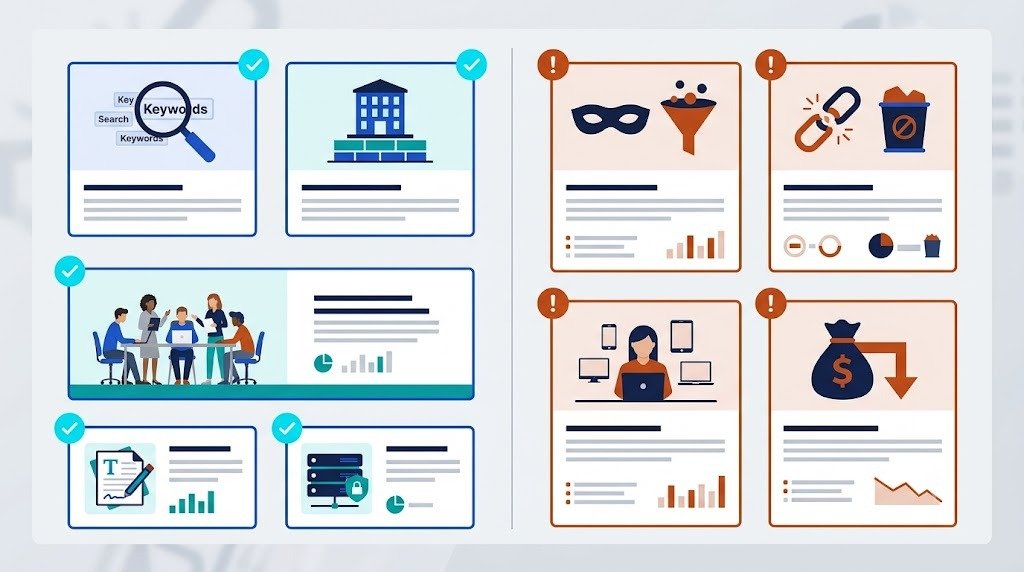
8. Spot the Red Flags Early
- Guaranteed rankings. Nobody controls Google.
- Secret methods. “Proprietary tricks” often means spammy links that blow up later.
- Bargain pricing. Real SEO takes skilled people and time.
- No case studies or references. No proof usually means no results.
- Pressure to sign today. Serious partners let you compare.
- Bulk AI content with no human review. Thin pages can hurt more than they help.
- No access to your accounts. Your data is yours.
How to test an agency during the pitch:
- Ask to see a real (or anonymized) Search Console report from a similar client.
- Search their claimed rankings yourself.
- Ask which tactics they refuse to use, and why.
- Ask about a campaign that struggled. Every agency has one.
- Ask what happens if targets slip at month six.
- Email a question before signing and see how fast and clearly they reply.
- Ask who writes the content and who fact-checks it.
Spot two flags and walk away. Skipping a bad agency is cheap. Cleaning up after one isn’t.
9. Why KPTL Services Is a Smart Choice for Small Businesses

KPTL Services works with growing businesses that want real results from search without confusing reports or bloated retainers. Its approach matches the checklist above: audit first, written strategy second, steady execution after that.
Owners and founders pick it for a few reasons:
- Audit-led planning. Every project starts by finding what holds your site back.
- Plain-language updates. You know what’s being done and why.
- Google-safe practices. Quality content and clean technical work, with no bought link bundles.
- Goals tied to revenue. Leads and sales, not vanity charts.
- One team for several needs. No juggling five vendors.
A typical project runs in four steps. Audit the site and competitors. Turn the findings into a prioritized plan. Do the work. Then track results against your goals and adjust.
Services Offered by KPTL Services
- Dedicated SEO services for higher rankings and steady organic traffic
- Google Ads services for fast, trackable leads while SEO builds
- Social media promotion to grow awareness and engagement
- Content strategy built around what your customers actually search for
- Website performance optimization for speed, usability, and conversions
- Online reputation building to earn trust before people reach out
These pieces work better together. Ads can bring inquiries in the first few weeks while SEO builds long-term visibility, and better reviews help both.
How KPTL Services Helps You Get Organic Leads
Traffic only matters if it turns into inquiries, so the work starts with buyer intent. The team finds the terms your customers actually use (service names, “near me” searches, comparison questions), then builds or improves pages that answer them clearly. Next it makes the site easy to act on, so a visitor can call, book, or request a quote without hunting. Finally it tracks which pages produce real inquiries and puts more effort there.
How KPTL Services Solves Ranking Drops
A sudden drop feels like a punch, but it’s usually fixable. The cause comes first. Did it line up with a Google core update? Did a site change break something? Did you lose key backlinks, or did a competitor publish something better? Then the team repairs technical issues, refreshes weak pages, and strengthens trust signals like reviews and author details. You get a straight explanation of what happened, too.
Ready to grow? Contact KPTL Services for SEO Audit & Strategy. Visit the KPTL Services contact page to schedule a consultation and get a clear plan for your business.
Frequently Asked Questions
1. How long does SEO take to work for a small business?
Early signs usually show within three to six months, with stronger lead growth after that. A local shop in a small market can move faster than a company competing nationally. Anyone promising overnight results is selling something else.
2. How much should a small business spend on SEO?
It depends on your market and competition. Work backward from your numbers. If a new customer is worth $500 in profit, ask how many customers the campaign must win to pay for itself. A higher fee with clear deliverables beats a cheap plan full of vague promises.
3. Can I do SEO myself instead of hiring a company?
You can handle the basics: claim your Google Business Profile, ask happy customers for reviews, and write useful pages about your services. Technical fixes and link building take specialist time. If you’d rather spend those hours running the business, hire someone who does this daily.
4. What should an SEO audit include?
Technical health, page speed, mobile usability, keyword gaps, content quality, backlinks, local listings, and a competitor comparison. It should end with a prioritized plan showing what gets fixed first, who does it, and when. A long list of errors with no plan is a report card, not an audit.
5. Why did my rankings suddenly drop?
The usual suspects are a Google core update, technical errors, lost backlinks, stale content, or a redesign that quietly broke redirects. Diagnose before you change anything. Check the timing against known updates, review recent site changes, and see which competitors moved up.
Final Thoughts
Choosing an SEO partner doesn’t have to be a coin flip. Set clear goals, check for relevant experience, and get a written strategy. Compare pricing, watch for hidden costs, and test the agency’s claims before you sign. Pick a team that follows Google’s people-first guidelines and reports on leads, not just rankings.
If you want a partner that fits this checklist, Contact KPTL Services for SEO Audit & Strategy and take the first step toward steady organic growth.