

Quick Answer
SEO typically takes 3 to 6 months to show measurable improvements, while more competitive industries may require 6 to 12 months or longer to achieve significant growth in rankings, organic traffic, and leads. However, the exact SEO timeline depends on your website’s current condition, competition, keyword difficulty, content quality, technical performance, and consistency of optimization.
Some improvements, such as fixing indexing issues or optimizing existing pages, may show effects within weeks. On the other hand, building authority, ranking for competitive keywords, and generating consistent sales from organic search often takes considerably longer. Therefore, businesses should evaluate SEO through measurable progress rather than expecting immediate results.
Introduction
One of the first questions business owners ask before investing in search engine optimization is how long it will take to see results. After all, every company wants to attract more customers, increase website traffic, and generate a return on its marketing investment.
However, SEO works differently from paid advertising. With Google Ads, businesses can begin receiving paid traffic shortly after launching a campaign. Organic search performance develops gradually as search engines discover pages, evaluate their relevance, and determine which results best satisfy users’ needs.
This does not mean businesses must wait without seeing progress. A well-planned SEO strategy can produce early improvements in indexing, search impressions, keyword visibility, and website engagement before substantial traffic growth appears.
In this guide, we explain realistic SEO timelines, the factors that influence results, and the practical steps businesses can take to improve performance. By understanding what to expect at each stage, you can make better marketing decisions and evaluate your SEO investment more confidently.
How Long Does SEO Take to Work? A Month-by-Month Timeline
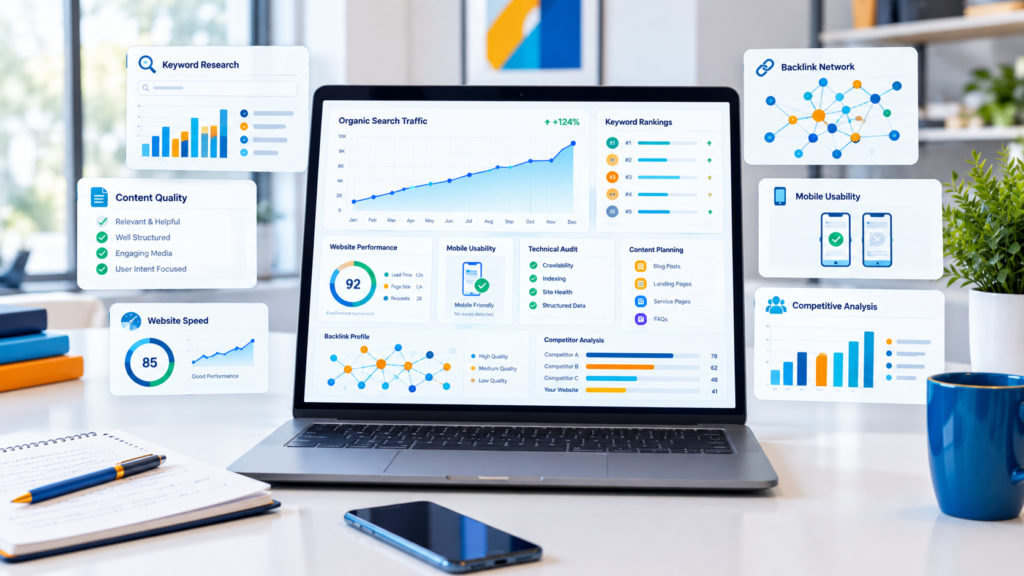
SEO results rarely appear all at once. Instead, improvements usually develop across several stages. The following timeline provides a practical planning framework, although actual results will vary by website and industry.
Month 1: Website Audit and SEO Foundation
During the first month, the primary objective is to identify problems and establish a strong foundation. SEO professionals typically review website structure, indexing status, page speed, mobile usability, keyword targeting, existing content, and competitor performance.
For example, a business may discover that important service pages are missing from Google’s index or that several pages target the same search intent. Resolving these issues can make the website easier for search engines to understand.
Keyword research is also important at this stage. Instead of targeting only broad terms, businesses should identify relevant keywords that match their services and the needs of potential customers.
However, completing an audit does not guarantee an immediate ranking improvement. The purpose of the first month is to identify opportunities, prioritize changes, and create a measurable SEO roadmap.
Months 2–3: Optimization and Early Search Visibility
Once the initial problems have been identified, the next step is to implement improvements. This may include optimizing title tags, meta descriptions, headings, internal links, website content, image attributes, and important service pages.
Technical SEO work may also continue during this period. Meanwhile, publishing useful content helps businesses address customer questions and build topical relevance.
During months two and three, early indicators may include increased search impressions, more indexed pages, improved rankings for less competitive keywords, and additional clicks from organic search.
Nevertheless, these changes will not happen at the same speed for every website. A new domain may take longer to establish visibility than an established website with relevant content and existing authority.
Months 3–6: Measurable SEO Results
For many businesses, this is the period when SEO progress becomes easier to evaluate. Optimized pages may begin ranking for more relevant queries, organic clicks may increase, and selected service pages may attract more qualified visitors.
An Ahrefs survey found that three to six months was the most common response when SEO professionals were asked how long it takes to see results. This is a useful benchmark, not a guarantee for individual websites.
At this stage, businesses should examine whether their target keywords are improving and whether the additional traffic is relevant to their services.
For example, a web design company may receive more visits from searches related to business website design. If those visitors explore service pages and submit enquiries, the campaign may be contributing to business growth even if its most competitive keyword has not reached the first page.
Months 6–12: Stronger Growth and Business Opportunities
After six months of consistent work, some websites may begin experiencing stronger organic visibility and more predictable traffic growth. Existing content can continue attracting visitors, while new pages create additional opportunities to rank for relevant searches.
However, highly competitive industries may require more time, resources, and authority-building activities. Businesses targeting broad national keywords often face greater competition than those targeting specific services or local searches.
During this stage, the focus should shift towards improving conversion rates, updating underperforming pages, expanding successful content, and identifying new keyword opportunities.
SEO should also become more data-driven. Instead of publishing content simply to increase the number of pages, businesses should invest in topics that attract relevant visitors and support commercial objectives.
What Factors Affect How Long SEO Takes?
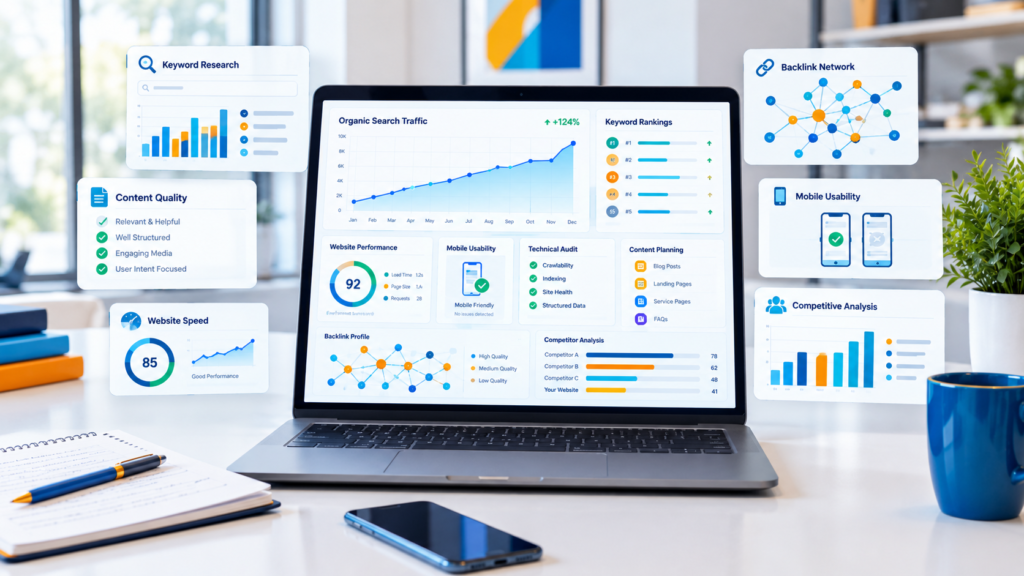
There is no universal SEO timeline because websites start from different positions. Understanding the following factors can help you estimate a more realistic timeframe for your business.
1. Website Age and Existing Authority
A new website usually needs time to establish its presence in search results. It may have few backlinks, limited content, and little historical search performance.
In comparison, an established website may already have indexed pages, relevant backlinks, brand recognition, and existing keyword rankings. These advantages can provide a stronger starting point.
However, an older domain does not automatically rank well. A website with outdated content, technical problems, or a poor reputation may still struggle to achieve meaningful results.
2. Keyword Competition and Search Intent
Keyword difficulty is another major factor affecting SEO timelines. Broad keywords such as “digital marketing” or “SEO services” may attract strong competition from established agencies and authoritative websites.
More specific searches, such as “technical SEO audit for a small ecommerce website,” may offer more achievable opportunities, depending on the market.
Therefore, businesses should balance keyword search volume with competition, commercial relevance, and search intent. The goal is not simply to attract more visitors but to reach people who are genuinely interested in the products or services offered.
3. Technical SEO and Website Performance
Technical problems can prevent search engines from properly discovering or understanding important pages. Common issues include incorrect canonical tags, broken internal links, accidental noindex directives, redirect errors, duplicate content, and slow page performance.
Resolving these problems may improve a website’s ability to be crawled and indexed. However, technical improvements alone do not guarantee higher rankings because content relevance, competition, and other signals also matter.
Businesses can strengthen this foundation through a professional SEO service and optimization strategy that addresses technical health, content quality, keyword targeting, and website structure together.
4. Content Quality and Search Intent
Publishing more articles does not automatically produce better SEO results. Content needs to answer the questions users are asking and provide information that genuinely helps them make decisions.
For example, someone searching for “how much does website design cost” may want pricing factors, examples, and budgeting guidance. A page that only promotes a company’s services may fail to satisfy that intent.
Useful content should be accurate, clearly structured, original, and supported by relevant experience or reliable sources. Updating outdated pages and adding missing information can also improve their usefulness.
Google’s guidance emphasizes helpful, reliable, people-first content rather than content created primarily to manipulate rankings.
5. Backlinks and Brand Credibility
Relevant backlinks can help search engines discover pages and understand relationships between websites. They may also introduce a business to potential customers through referral traffic.
However, backlink quality matters more than simply increasing the number of links. Relevant editorial mentions, industry publications, useful resources, and genuine business partnerships can support long-term visibility.
Avoid buying large quantities of manipulative links or participating in link schemes. Such shortcuts may create risks without delivering sustainable benefits.
6. Consistency of SEO Implementation
SEO requires ongoing attention. A strategy may include technical improvements, content development, internal linking, local optimization, competitor analysis, and performance monitoring.
If recommendations remain unimplemented for several months, the campaign may progress more slowly. Similarly, publishing content without reviewing its performance can result in wasted effort.
Businesses should maintain a realistic schedule and prioritize tasks according to their potential impact. Consistent, focused improvements are generally more useful than making random changes whenever rankings fluctuate.
How Can You See SEO Results Faster?
Although no ethical SEO professional can guarantee a specific ranking date, businesses can improve their chances of making progress by focusing on the right activities.
Start With a Technical SEO Audit
Before investing heavily in new content, check whether search engines can access important pages. Review indexing reports, sitemap configuration, robots directives, redirects, broken links, and canonical tags.
Use Google Search Console to identify indexing problems and understand which queries are generating impressions and clicks.
Fixing critical technical issues first helps ensure that other SEO activities have a stronger foundation. Still, remember that requesting indexing does not guarantee that a page will appear in search results.
Target Relevant, Achievable Keywords
Avoid building your entire strategy around a few highly competitive keywords. Instead, identify a balanced group of informational, commercial, and local search terms.
For instance, a digital marketing company could create content around specific services, customer problems, and industry requirements rather than repeatedly targeting the same broad phrase.
Long-tail keywords often have more specific intent, although their search volumes may be lower. When these searches attract the right audience, they can still generate valuable business opportunities.
Improve Existing Pages Before Publishing More Content
Your website may already contain pages with promising rankings or impressions but relatively few clicks. Improving these pages can be more efficient than creating entirely new content.
Review titles and descriptions for clarity, strengthen introductions, answer missing questions, update outdated information, and add useful internal links.
In addition, make sure each page serves a clear purpose and offers something valuable beyond what competing pages already provide.
Strengthen Your Website’s Internal Linking
Internal links help visitors discover related information and help search engines understand the relationship between pages.
For example, a blog about SEO timelines can link naturally to a relevant service page, a technical SEO guide, or an article about digital marketing strategies.
A well-planned internal linking structure connects informational content with important commercial pages without forcing irrelevant links into the text.
Improve User Experience and Conversion Paths
SEO success is not limited to rankings and traffic. Visitors should be able to understand your offer, find relevant information, and take the next step without confusion.
A clear navigation structure, mobile-friendly design, readable content, fast-loading pages, and accessible contact details all support a better website experience.
Businesses planning a new website or an upgrade can explore web design and development services to understand how website structure and usability fit into their wider online growth strategy.
How Should Businesses Measure SEO Progress?
Waiting for a first-page ranking is not the best way to evaluate every stage of an SEO campaign. Instead, track several indicators that show whether the strategy is moving in the right direction.
Organic Impressions and Clicks
Google Search Console shows how often website pages appear in Google Search, how many clicks they receive, and which queries generate visibility.
An increase in impressions may indicate that your pages are appearing for more searches, even if clicks have not increased significantly yet.
However, impressions alone do not prove business success. Review click-through rates, query relevance, landing pages, and changes over time to understand the bigger picture.
Keyword Rankings and Organic Traffic
Monitor a consistent set of relevant keywords rather than focusing on isolated daily ranking changes. Search results can vary by location, device, search context, and competition.
Also, use Google Analytics to assess organic sessions, engagement, and important actions. Compare performance across meaningful periods and account for seasonal changes where relevant.
Leads, Sales, and Return on Investment
For business owners, the most important outcome is often qualified enquiries, purchases, bookings, or revenue.
Set up appropriate conversion tracking and connect organic traffic with business outcomes. For example, a service business can measure contact form submissions and qualified calls, while an ecommerce company can measure purchases and revenue.
This approach helps decision-makers distinguish between traffic that looks impressive and traffic that contributes to growth.
SEO vs Paid Advertising: Which Produces Faster Results?
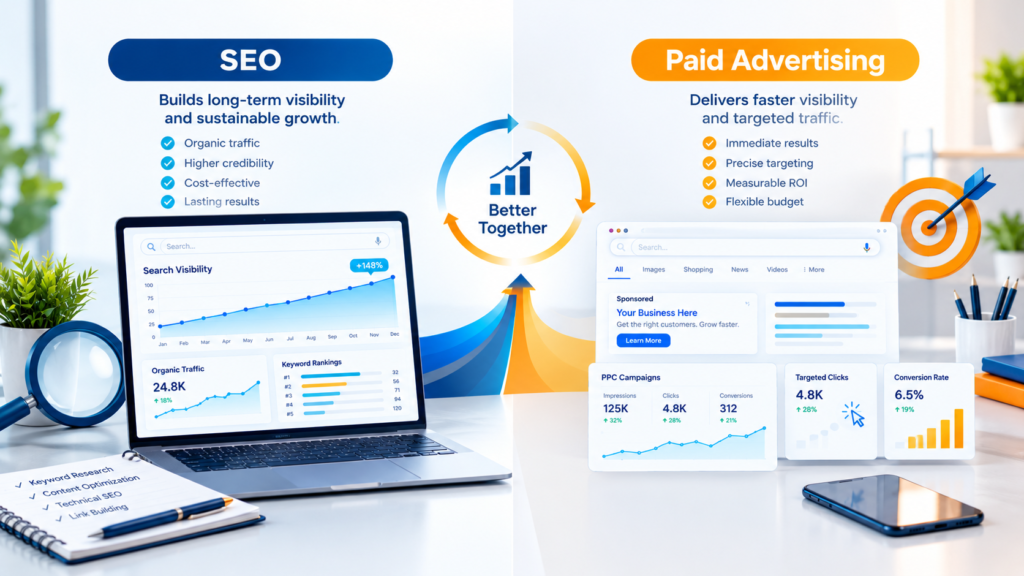
Paid advertising can generate visibility shortly after campaigns become active, provided the targeting, budget, landing pages, and tracking are configured properly. SEO generally requires more time because organic rankings cannot simply be purchased.
However, both channels serve different purposes. Paid advertising can help businesses test offers, reach customers quickly, and generate immediate campaign data. SEO can build long-term visibility and attract visitors without paying for every organic click.
For many businesses, the most practical strategy is to use each channel according to its strengths and available resources.
A broader digital marketing strategy can help businesses coordinate organic search, paid campaigns, content, and other channels around shared commercial objectives.
Similarly, social media marketing can support brand awareness and content distribution, although social activity should not be treated as a guaranteed direct ranking factor.
The right balance depends on your budget, competition, customer acquisition goals, and the time available to achieve them.
Common SEO Mistakes That Delay Results
Some businesses unintentionally slow their progress by focusing on activities that do not address their actual problems.
One common mistake is expecting every keyword to rank within a month. SEO timelines vary considerably, and early ranking changes do not guarantee future performance.
Another mistake is publishing large volumes of repetitive or low-value content. Search engines aim to provide useful results, so content should be created for real users rather than simply to target additional keywords.
Businesses may also neglect technical issues, ignore conversion tracking, or change their strategy too frequently to measure its impact properly.
Finally, relying on spammy backlinks or guaranteed-ranking promises can create unnecessary risk. Choose a transparent SEO process that explains the work being performed, the metrics being monitored, and the limitations of the campaign.
If you are evaluating external support, this guide on why small businesses hire a digital marketing agency can help you consider the value of specialist expertise, strategic planning, and ongoing reporting.
How to Set Realistic SEO Goals for Your Business
Start by defining what success means for your company. A local service provider may prioritize calls and enquiries from a specific region, while a national ecommerce brand may focus on category visibility, product traffic, and online sales.
Next, establish a baseline using your existing traffic, keyword rankings, conversion rates, and lead volume. Without this information, it becomes difficult to determine whether SEO is improving performance.
Then, divide your goals into practical milestones. During the early months, focus on technical health, indexing, and content optimization. As visibility develops, assess traffic quality, keyword performance, and conversions. Over a longer period, review whether organic search is contributing to sustainable customer acquisition.
Review reports regularly and make decisions based on evidence rather than isolated fluctuations. If progress remains limited after several months, investigate possible causes instead of assuming that more content or backlinks will automatically solve the problem.
A clear strategy, realistic expectations, and consistent measurement help business owners manage their SEO investment more effectively.
Conclusion: When Should You Expect SEO to Deliver Results?
For many businesses, SEO begins showing measurable improvements within three to six months, while more competitive campaigns may require six to twelve months or longer to achieve substantial results. However, these are planning ranges rather than guaranteed deadlines.
The actual timeline depends on your website’s starting position, keyword competition, technical condition, content quality, implementation speed, and ongoing optimization.
The most effective approach is to establish a strong technical foundation, target relevant keywords, publish helpful content, build a sensible internal linking structure, and measure progress against business goals.
SEO is not simply about achieving higher rankings. It is about helping the right people discover your business, find useful answers, and become customers.
Ready to improve your website’s search visibility? Explore KPTL Web Solution’s SEO services to learn how a structured SEO strategy can support your business goals and long-term organic growth.
Frequently Asked Questions About SEO Timelines
1. Can SEO show results in 30 days?
Yes, some early improvements may appear within 30 days, particularly after fixing technical problems or optimizing existing pages. However, significant traffic growth and competitive rankings usually require more time.
2. Why is my website not ranking after three months?
Possible reasons include technical SEO issues, strong competition, weak content relevance, insufficient website authority, indexing problems, or delays in implementing recommendations. Review Search Console data and your SEO strategy before deciding what to change.
3. How long does local SEO take to work?
Local SEO timelines vary according to location, competition, business category, website quality, and the completeness of your business information. Some local improvements may appear relatively quickly, while stronger visibility in competitive markets can take several months.
4. How long does it take to rank on Google’s first page?
There is no fixed timeline for reaching Google’s first page. Less competitive, highly relevant queries may improve sooner, while broad and competitive keywords can require extensive work over many months or longer.
5. Does publishing more blog posts improve SEO faster?
Not necessarily. Publishing useful, original content that matches search intent is more important than publishing a high volume of articles. Content quality, internal linking, competition, and website performance also influence results.
6. Should I stop SEO if I do not see results in three months?
Not automatically. Three months may be too early to evaluate the full impact of a campaign. Review leading indicators such as indexing, impressions, keyword movement, and implemented improvements. If there is no meaningful progress, investigate the reasons and adjust the strategy.
7. Can an SEO agency guarantee first-page rankings?
No reputable SEO agency can guarantee a particular Google ranking or a fixed date for achieving it. Google advises businesses to be cautious of providers that promise guaranteed rankings. Choose an agency that offers a clear process, transparent reporting, and realistic performance expectations.