Quick Answer
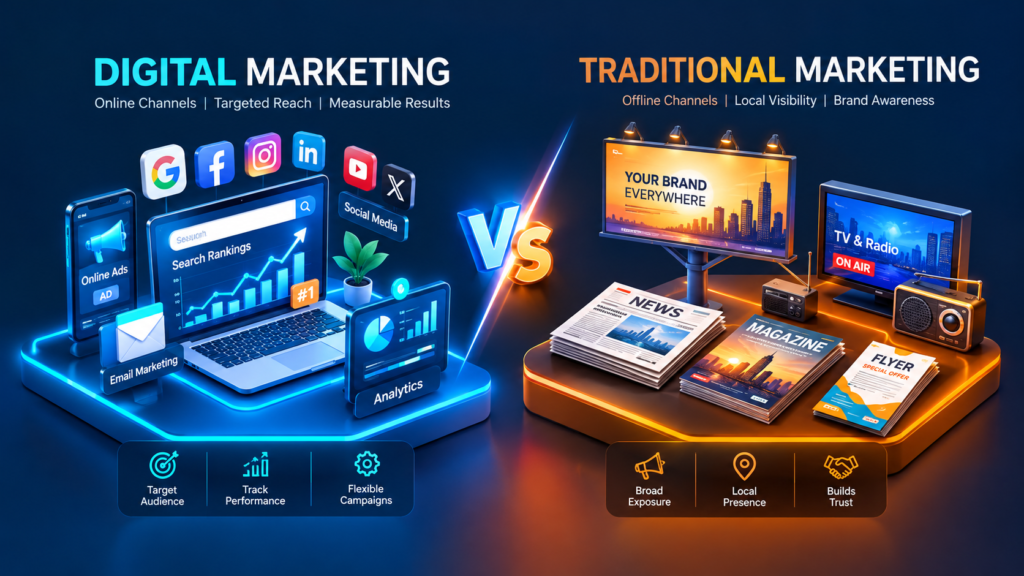
Digital marketing promotes products and services through online channels such as websites, search engines, social media, email, and online advertisements. It helps businesses reach targeted audiences, track performance, and adjust campaigns using data. Traditional marketing uses offline channels such as television, radio, newspapers, billboards, and brochures to build brand awareness and reach audiences. The main difference is how businesses connect with customers and measure results. For many companies, combining both approaches can create a balanced marketing strategy.
Introduction
Marketing has always played an important role in business growth. However, the way companies communicate with customers has changed significantly. Earlier, businesses relied heavily on newspaper advertisements, television commercials, radio promotions, and outdoor banners. Today, customers can discover products through Google searches, social media posts, online reviews, email newsletters, and digital advertisements.
This shift has made the difference between digital marketing and traditional marketing an important consideration for business owners, entrepreneurs, and company decision-makers.
Choosing the right approach is not simply about following the latest trend. Instead, businesses need to understand where their customers spend time, how they make purchasing decisions, and which marketing activities deliver measurable results.
For example, a local restaurant may benefit from Google Business Profile optimization and social media marketing, while a regional manufacturer may use industry events, print advertising, and email campaigns to reach potential buyers. Both approaches can work when they support a clear business objective.
In this guide, we will explain how digital marketing and traditional marketing differ, explore their advantages and limitations, and help you decide which approach best suits your business.
What Is Digital Marketing?
Digital marketing refers to promoting products, services, and brands through internet-based platforms and digital technologies. It allows businesses to connect with potential customers through search engines, websites, social media networks, online advertisements, and other digital channels.
One of its biggest advantages is that businesses can reach specific audiences based on factors such as location, interests, search intent, and online behaviour, depending on the platform and available targeting options.
For example, a company offering website development services can publish helpful articles, improve its search engine visibility, run Google Ads campaigns, and share useful content on LinkedIn. These activities help potential customers discover the company when they need its services.
Digital marketing also allows businesses to monitor performance through tools such as Google Analytics and Google Search Console. By reviewing website visits, enquiries, conversions, and search performance, marketers can identify opportunities to improve their campaigns.
Common Types of Digital Marketing

Search Engine Optimization (SEO): SEO improves a website’s visibility in organic search results. Businesses can attract people who are actively looking for their products or services by publishing useful content, improving technical website performance, and building relevant website authority. Explore KPTL’s search engine optimization services to understand how SEO can support online visibility.
Pay-Per-Click Advertising (PPC): PPC allows businesses to pay for advertising placements on platforms such as Google Ads. These campaigns can help generate targeted website traffic, leads, and sales. However, results depend on factors such as competition, landing page quality, bidding strategy, and the offer being promoted.
Social Media Marketing: Platforms such as Facebook, Instagram, and LinkedIn help businesses build brand awareness, share updates, engage with customers, and promote products. A consistent social media strategy can strengthen relationships with existing customers while introducing the brand to new audiences.
Content Marketing: Blogs, guides, case studies, videos, and other educational resources help customers understand their problems and evaluate possible solutions. Quality content can support SEO, build trust, and assist customers throughout the buying journey.
Email Marketing: Email campaigns help businesses share useful information, promote offers, follow up with leads, and maintain customer relationships. When messages are relevant and sent with appropriate permission, email can become a valuable channel for repeat business.
Website Marketing: A professional website acts as a central destination for potential customers. It explains what the business offers, demonstrates credibility, answers common questions, and encourages visitors to take action. Businesses can explore professional web design services to understand how website design contributes to a stronger online presence.
What Is Traditional Marketing?
Traditional marketing refers to promotional activities delivered through established offline channels. These methods generally reach audiences through physical media, broadcast communication, printed materials, and in-person interactions.
For decades, businesses have used traditional marketing to introduce products, establish brand recognition, and connect with customers within specific geographic areas. Although digital channels have expanded, traditional marketing remains useful in industries and communities where offline communication influences purchasing decisions.
For instance, a new supermarket may distribute leaflets across nearby neighbourhoods, advertise on local radio, and display banners near its premises. These activities can help residents become aware of the store before visiting it.
Traditional marketing can also create repeated exposure. A person who sees the same billboard during a daily commute may gradually become more familiar with the advertised brand.
Common Types of Traditional Marketing
Television Advertising: Television commercials allow businesses to communicate with large audiences through visual storytelling, sound, and demonstrations. They can be useful for brand awareness, although production and advertising costs may be substantial.
Radio Advertising: Radio advertisements help businesses reach listeners during commutes, at work, or while completing daily activities. Local stations can be particularly useful for promoting restaurants, retail stores, events, and regional services.
Newspaper and Magazine Advertising: Printed advertisements allow companies to reach readers through local newspapers, trade publications, and specialist magazines. These channels may be suitable when the publication attracts the business’s intended audience.
Outdoor Advertising: Billboards, posters, banners, and transit advertisements create visibility in physical locations. Their effectiveness depends on placement, audience movement, message clarity, and the frequency of exposure.
Direct Mail and Brochures: Printed catalogues, promotional leaflets, and mailed offers give customers physical information they can review later. These methods may be effective for local promotions or audiences that respond well to printed material.
Events and Trade Shows: Exhibitions, conferences, product demonstrations, and networking events enable businesses to interact directly with potential customers. These activities can be especially valuable for B2B companies where trust, product demonstrations, and personal relationships influence decisions.
Digital Marketing vs Traditional Marketing: Key Differences
Although both approaches aim to attract customers and grow a business, they differ in their delivery methods, targeting capabilities, costs, and measurement options.
1. Audience Reach and Targeting
Digital marketing allows businesses to target audiences using available demographic, geographic, interest-based, and behavioural signals. For example, a company can promote its services to people in selected cities or create campaigns for users searching for specific solutions.
Traditional marketing can also target audiences, but targeting often depends on the location, publication readership, broadcast audience, or distribution area. A billboard near a commercial district may reach thousands of people, although not everyone will be interested in the advertised service.
Therefore, digital marketing often provides more precise targeting options, while traditional marketing can be effective for reaching broad local audiences.
2. Cost and Budget Flexibility
Digital marketing offers flexible entry points for many businesses. Companies can begin with organic SEO, social media content, or a small advertising campaign and increase investment as they learn what works.
However, digital marketing is not automatically inexpensive. Competitive keywords, paid advertising, professional content production, and ongoing technical work can require substantial investment.
Traditional marketing costs vary by channel. Printing leaflets for a local campaign may be affordable, while television advertising or premium billboard placements can require larger budgets.
Before choosing either approach, businesses should consider the complete cost, including creative production, distribution, campaign management, and follow-up activities.
3. Measurement and Performance Tracking
One major difference between digital marketing and traditional marketing is the level of performance data available.
Digital campaigns can often be tracked through impressions, clicks, website sessions, enquiries, purchases, and conversion rates. These measurements help businesses understand how customers interact with their campaigns.
Traditional marketing performance can be harder to measure directly. Nevertheless, companies can use unique phone numbers, promotional codes, customer surveys, QR codes, and campaign-specific landing pages to estimate its impact.
The important point is that marketing success should be evaluated through business outcomes rather than exposure alone.
4. Customer Interaction and Engagement
Digital marketing creates opportunities for two-way communication. Customers can comment on social media posts, submit website enquiries, respond to emails, and interact with businesses through online chat.
Traditional marketing is often more one-way. A newspaper advertisement or billboard presents a message, but the customer usually needs to contact the business separately to respond.
Nevertheless, offline marketing can also encourage direct interaction through events, product demonstrations, store visits, and face-to-face conversations.
Businesses should choose channels based on how their customers prefer to ask questions, evaluate products, and receive support.
5. Speed and Campaign Flexibility
Digital campaigns can often be launched, paused, or adjusted relatively quickly. Marketers can test different advertisements, revise landing pages, and change targeting based on performance.
Traditional campaigns may require more preparation. Printing materials, booking advertising space, producing television commercials, or arranging events can take additional time.
However, speed should not be confused with effectiveness. A campaign launched quickly may still perform poorly if its message, audience, or offer is unsuitable.
6. Trust and Brand Credibility
Digital marketing can build trust through helpful articles, customer reviews, case studies, demonstrations, and transparent communication. Customers can research a company before contacting its sales team.
Traditional marketing can reinforce credibility through visible local presence, established publications, physical materials, and face-to-face interactions.
Neither approach automatically guarantees trust. Misleading claims, poor customer service, or inconsistent brand communication can damage credibility regardless of the channel.

7. Long-Term Value
Some digital marketing activities, particularly SEO and content marketing, can continue attracting relevant visitors after the initial content has been published. However, maintaining those results requires regular updates, technical improvements, and continued competition analysis.
Traditional campaigns often generate exposure during a defined period, such as a newspaper advertising run or a billboard booking. Their lasting value depends on factors such as brand recall, repeated exposure, and customer response.
For this reason, businesses should compare the long-term value of each channel instead of judging performance only by its initial cost.
Digital Marketing vs Traditional Marketing Comparison Table
| Factor | Digital Marketing | Traditional Marketing |
| Main channels | Search engines, websites, email, social media | TV, radio, print, billboards, direct mail |
| Audience targeting | Often highly specific | Often based on location or media audience |
| Budget flexibility | Can support small or large campaigns | Depends on the selected channel |
| Measurement | Detailed online tracking is often available | Frequently requires indirect measurement |
| Customer interaction | Online, often two-way | Broadcast or physical, depending on the format |
| Campaign changes | Often quick to implement | May require additional production or booking |
| Long-term opportunities | SEO and content can attract ongoing traffic | Brand recall and repeated exposure |
| Best suited for | Online discovery, lead generation, measurable campaigns | Local awareness, offline reach, physical engagement |
The comparison shows that neither method is universally superior. The better choice depends on your audience, objectives, industry, available resources, and the way customers make purchasing decisions.
Advantages and Disadvantages of Digital Marketing
Digital marketing gives businesses multiple ways to attract potential customers and measure campaign results. Nevertheless, it also requires ongoing management and a clear strategy.
Advantages of Digital Marketing
A major advantage is the ability to reach customers across different locations without needing a physical presence in every market. For example, a service provider based in India can attract customers in the United Kingdom or Australia through search engines, relevant content, and targeted advertising.
Another benefit is performance visibility. Businesses can analyse website traffic, lead quality, and campaign conversions to understand where enquiries originate. This information supports better decisions about future marketing investment.
Digital marketing also allows companies to build long-term customer relationships. Email newsletters, useful social content, and educational articles can keep a brand relevant even when customers are not ready to purchase immediately.
Additionally, businesses can connect several channels through a coordinated strategy. A helpful blog post may attract organic search traffic, a social media post may introduce the article to a wider audience, and an email campaign may encourage interested readers to return.
Disadvantages of Digital Marketing
Digital channels are competitive. A website may take time to gain organic visibility, and paid advertising can become expensive in markets where many businesses compete for the same customers.
Furthermore, digital marketing requires regular attention. Websites need maintenance, content needs updating, and advertising campaigns require monitoring. Poor targeting or weak landing pages can waste both time and money.
Businesses must also protect customer information, follow applicable privacy requirements, and use responsible tracking practices.
Therefore, digital marketing works best when it is supported by realistic goals, relevant content, appropriate technical resources, and ongoing performance analysis.
Advantages and Disadvantages of Traditional Marketing
Traditional marketing remains relevant because customers do not make every purchasing decision online. Physical advertising and personal interactions can influence how people recognise and evaluate a brand.
Advantages of Traditional Marketing
Traditional marketing can create strong local visibility. A shop opening in a residential area, for example, may benefit from banners, local newspaper advertisements, and printed offers distributed nearby.
Physical marketing materials can also be useful when customers prefer tangible information. A printed catalogue, product brochure, or event handout gives people something they can keep and review.
In addition, traditional marketing can reach people who rarely use particular digital platforms. Radio, outdoor advertising, and local events may provide valuable opportunities to connect with these audiences.
Disadvantages of Traditional Marketing
Some traditional channels require substantial upfront spending. Television production, premium print placements, and outdoor advertising can be difficult for small businesses to justify without a clear estimate of their likely return.
Another limitation is measurement. It may be challenging to determine precisely how many people purchased a product because they saw a newspaper advertisement or billboard.
Traditional campaigns can also be less flexible once materials have been printed or advertising slots have been booked. If a price changes or a message needs correction, updating the campaign may involve additional cost and time.
For these reasons, businesses should establish campaign objectives and tracking methods before investing in traditional advertising.
Which Marketing Strategy Is Better for Small Businesses?
For many small businesses, digital marketing is a practical starting point because it supports local discovery, online enquiries, and measurable campaigns. However, the right mix depends on the product, audience, and buying process.
A local plumber, for example, may benefit from local SEO, a well-designed website, customer reviews, and a carefully managed Google Ads campaign. These channels can help potential customers find the business when they need a repair.
A neighbourhood clothing store might combine Instagram promotions with local flyers and in-store offers. Meanwhile, a B2B software company may prioritise SEO, educational content, LinkedIn, email marketing, and industry events.
Businesses should begin by identifying their ideal customers, understanding their purchasing behaviour, and setting clear objectives. The U.S. Small Business Administration’s marketing and sales guidance also recommends defining the target market, marketing goals, promotional methods, and budget.
If your company wants to strengthen its online presence, explore digital marketing services that align with your goals. Businesses looking to attract customers through search can also consider a focused SEO strategy rather than trying to use every channel at once.
How to Combine Digital and Traditional Marketing Effectively
An integrated marketing strategy connects online and offline activities so that customers receive a consistent message across different touchpoints.
1. Keep Your Brand Message Consistent
Use consistent brand colours, messaging, offers, and contact information across your website, social media profiles, printed brochures, and advertisements. This helps customers recognise your business and understand what makes it different.
2. Connect Offline Campaigns With Online Experiences
Add a QR code to brochures, posters, or event materials that directs customers to a relevant landing page. You can also use campaign-specific URLs or promotional codes to measure responses.
For example, a local retailer can advertise a seasonal offer through printed flyers and direct customers to an online page where they can view products, check availability, or contact the store.
3. Use Digital Channels to Support Sales Conversations
After meeting prospects at an exhibition or business event, companies can share useful resources, product information, and follow-up emails where appropriate. This helps maintain communication after the initial interaction.
Similarly, sales teams can use website case studies, service pages, and customer testimonials to support discussions with prospective buyers.
4. Measure the Results of Each Channel
Track the outcomes that matter to your business, such as qualified enquiries, completed purchases, repeat customers, and revenue. Use suitable analytics tools for digital activity and dedicated tracking methods for offline campaigns.
For paid online promotion, review Google Ads as one potential way to reach customers with relevant search intent. However, evaluate its performance against other channels before increasing your investment.
5. Improve the Strategy Over Time
Marketing should be reviewed regularly rather than treated as a one-time activity. Compare campaign results, identify the channels generating valuable leads, and adjust your budget based on evidence.
The most effective combination may change as your business grows, your audience changes, or new competitors enter the market.

How to Choose Between Digital Marketing and Traditional Marketing
Before investing in either approach, ask five practical questions.
Who are your customers? Identify their age range, location, interests, needs, and preferred ways of discovering businesses. Choose channels that help you reach the right people.
What is your primary goal? Brand awareness, website traffic, lead generation, store visits, and repeat purchases require different campaign strategies.
What resources can you allocate? Consider your budget, staff capacity, creative resources, and ability to manage campaigns consistently. A smaller, well-managed campaign may be more useful than spreading resources across too many channels.
How will you measure success? Establish relevant key performance indicators before launching. Depending on your goal, these may include cost per qualified lead, conversion rate, customer acquisition cost, sales revenue, or brand awareness measures.
How long can you wait for results? Paid advertising can begin generating visibility relatively quickly, although conversions are not guaranteed. SEO and content marketing often require sustained work before meaningful results develop. Traditional campaigns also vary in how quickly they influence awareness and sales.
By answering these questions, business owners can make more informed decisions and avoid investing in channels simply because competitors are using them.
The Future of Digital Marketing and Traditional Marketing
Marketing continues to evolve as customer expectations, technology, and media habits change. Digital platforms are introducing new advertising formats, automation tools, and AI-assisted capabilities. At the same time, traditional channels continue to offer opportunities for physical visibility, local recognition, and personal interaction.
Businesses will increasingly benefit from connecting their marketing activities rather than treating each channel as a separate effort. For instance, customer questions collected by a sales team can inform website content, while insights from digital campaigns can help refine messages used in brochures or events.
However, technology alone does not create an effective marketing strategy. Businesses still need to understand their customers, communicate real value, protect customer information, and deliver a positive experience after generating interest.
Google’s guidance on helpful, reliable, people-first content is particularly relevant to businesses investing in SEO. Content should answer genuine customer questions and provide meaningful value rather than simply repeat keywords.
Ultimately, the future belongs to businesses that remain adaptable, measure performance sensibly, and choose marketing methods based on customer needs.
Frequently Asked Questions
Is digital marketing better than traditional marketing?
Digital marketing can be more suitable for businesses seeking online visibility, precise audience targeting, and detailed performance tracking. Traditional marketing may be more effective for certain local audiences, physical promotions, and broad brand awareness. The best approach depends on your objectives and customers.
What is the main difference between digital marketing and traditional marketing?
Digital marketing uses internet-based channels such as websites, search engines, social media, email, and online advertising. Traditional marketing uses channels such as television, radio, newspapers, billboards, brochures, and direct mail. Their main differences involve delivery methods, targeting, measurement, and customer interaction.
Is traditional marketing still effective in 2026?
Yes. Traditional marketing can remain effective when it reaches the right audience with a relevant message. Local events, outdoor advertisements, print campaigns, and radio promotions may support business objectives, especially when combined with suitable digital channels.
Which marketing method is more affordable?
Neither method is always more affordable. Digital marketing offers flexible options, including organic SEO and social media content, but advertising and professional services can require significant investment. Traditional marketing ranges from relatively inexpensive flyers to costly broadcast campaigns. Businesses should compare total costs with the results achieved.
Can a business use digital and traditional marketing together?
Yes. Combining the two can help businesses reach customers through multiple touchpoints. For example, a company can promote an event through local print advertising, attract visitors through social media, collect enquiries on its website, and follow up with interested prospects by email.
Which type of marketing is best for generating leads?
Digital marketing can support lead generation through SEO, landing pages, email marketing, and paid advertisements. However, traditional marketing can also generate leads through events, referrals, direct mail, and local promotions. Lead quality, conversion rates, and acquisition costs should guide the decision.
How should a company measure marketing success?
A company should measure performance against its business goals. Useful metrics include qualified leads, conversion rate, customer acquisition cost, revenue, repeat purchases, and return on marketing investment. For offline campaigns, unique phone numbers, QR codes, promotional codes, and customer surveys can help estimate results.
Conclusion
Understanding the difference between digital marketing and traditional marketing helps businesses allocate resources more effectively and build stronger customer relationships. Digital marketing provides opportunities for online discovery, targeted campaigns, ongoing engagement, and detailed performance analysis. Traditional marketing can deliver local visibility, physical brand exposure, and valuable face-to-face interactions.
Neither approach guarantees success on its own. Results depend on the quality of the message, the suitability of the channel, the customer experience, and the ability to measure and improve performance.
For most businesses, a practical strategy begins with clear goals, a well-defined audience, and a realistic budget. From there, companies can select the channels that best support their growth and combine online and offline activities where they add value.
The key is not to choose digital marketing or traditional marketing simply because one is more popular. It is to invest in the methods that help your business reach the right customers, build trust, and generate sustainable results.