
Quick Answer
An effective SEO strategy rests on six connected parts: keyword and search-intent research, helpful and original content, a technically sound website, trusted backlinks, local and brand visibility, and ongoing measurement. When these work together, your business appears in front of buyers at the exact moment they search. In short, you plan around what customers ask, answer it better than competitors, make your site easy for Google to read, earn trust from other sites, and track results every month.

If you run a company, you have probably heard that search engine optimization is “important.” However, few people explain what a working plan actually contains. After more than ten years in this field, I can tell you that most businesses do not fail at SEO because it is complicated. They fail because they pick one tactic, such as blogging or link building, and ignore the rest. This guide walks through every essential piece in plain language, so you can judge any proposal, agency, or in-house plan with confidence.
Why a Clear SEO Strategy Matters for Your Business
Organic Traffic Is the Most Reliable Growth Channel
Paid ads stop the moment your budget stops. Organic rankings, on the other hand, keep delivering visitors long after the work is done. Moreover, people tend to trust organic results more than adverts, which means those visitors often convert at a higher rate. For a decision-maker, that translates into a lower cost per lead over time.
A solid search engine optimization strategy also compounds. Each page you publish, each link you earn, and each technical fix you make adds to a stronger foundation. Consequently, the second year of an SEO campaign usually performs far better than the first, provided the plan is structured correctly.
Google Rewards Helpfulness, Not Shortcuts
Google’s recent core and helpful content updates make one message very clear: content written for people beats content written for algorithms. Pages that show real experience, honest answers, and a good user experience are the ones that hold their positions. Meanwhile, thin pages stuffed with keywords keep losing ground.
This is good news if you run a genuine business. You already know your customers, your products, and your industry better than any competitor who is simply copying articles. A smart SEO plan lets you turn that knowledge into visibility.
Component 1: Research That Starts With the Customer
Keyword Research Shows What People Actually Search
Every SEO strategy begins with keyword research. Put simply, you are listening to your market. Which phrases do buyers type when they have a problem? How often do they search? How many competitors already answer those questions well? Tools can supply the numbers, yet your sales team and customer emails often reveal even better ideas.
For best results, build a keyword map. Assign one primary keyword to each page and support it with related terms. For example, a page about accounting services might target one main phrase and include secondary keywords like “small business tax help” and “monthly bookkeeping.” As a result, every page has a clear job, and you avoid pages competing against each other.
Search Intent Decides Whether Visitors Convert
Ranking for a keyword is pointless if the page does not match what the searcher wants. Someone typing “best CRM software” wants comparisons, while someone typing “CRM pricing” is closer to buying. Therefore, you should classify every keyword as informational, commercial, transactional, or navigational before writing a single word.
When the content matches the intent, visitors stay longer, click further, and enquire more often. Google notices these signals and rewards them. In my experience, fixing intent mismatch alone has lifted traffic by 30 percent or more on pages that previously sat on page two.
Component 2: Content That Earns Trust and Rankings
Create Helpful, People-First Pages
Content is the engine of any SEO content strategy. Google’s own guidance on creating helpful, reliable, people-first content stresses originality, depth, and first-hand expertise. Ask yourself a simple question before publishing: would a customer feel satisfied after reading this, or would they go back to search again?
To write that kind of page, answer the main question early, explain the reasoning clearly, and add proof such as examples, data, or photos from your own work. Additionally, keep your language simple. Short paragraphs, clear headings, and plain words make your pages easier to read on a phone, where most searches now happen.
Build Topic Clusters, Not Random Blog Posts
Publishing scattered articles rarely moves the needle. A better approach is the topic cluster: one in-depth pillar page supported by several focused articles that link to each other. This structure shows Google that your site covers a subject thoroughly, which strengthens your topical authority.
If you need help planning this, a team offering professional SEO services can map clusters to your products and target audience. Likewise, regular publishing through a company blog, such as the KPTL Services blog, keeps your site fresh and gives you more chances to rank.
Component 3: On-Page SEO That Makes Every Page Clear
Optimize Titles, Headings, and Snippets
On-page SEO is where strategy meets execution. Your title tag, meta description, headings, and opening paragraph should all tell Google and readers what the page offers. Include the primary keyword naturally in the title and the first 100 words, then use variations throughout. However, never force it; keyword stuffing damages both readability and rankings.
Write meta descriptions like mini advertisements. Although they are not a direct ranking factor, a compelling description raises your click-through rate, and a higher click-through rate brings more visitors from the same position.
Strengthen Internal Linking and Page Structure
Internal links guide visitors and search engines through your site. They spread authority from strong pages to newer ones and help Google understand which pages matter most. For instance, a blog post about marketing should naturally point to your digital marketing services page with descriptive anchor text.
Schema markup deserves attention too. Structured data helps search engines display rich results such as reviews, FAQs, and product details. Consequently, your listing takes up more space on the results page and attracts more clicks.
Component 4: Technical SEO That Keeps Your Site Healthy

Speed, Mobile Experience, and Core Web Vitals
A brilliant article means little if the page loads slowly. Google measures real-world experience through Core Web Vitals, which track loading speed, responsiveness, and visual stability. Since the majority of searches occur on mobile devices, a clean, fast, mobile-friendly layout is no longer optional.
This is where your website’s build quality matters. A well-structured site created by experienced web designers loads faster, converts better, and avoids many of the technical problems that hold rankings back. In other words, design and SEO should be planned together rather than fixed separately.
Crawlability, Indexing, and Security
Search engines must be able to find and understand your pages. Check that your XML sitemap is submitted, your robots.txt file is not blocking important sections, and your site uses HTTPS. Also fix broken links, duplicate pages, and redirect chains, because each one wastes crawl budget and confuses ranking signals.
Google’s SEO Starter Guide is an excellent reference for these basics. Run a technical audit at least twice a year; small issues grow quietly, and catching them early is far cheaper than recovering from a traffic drop.
Component 5: Authority Through Backlinks and Brand Signals
Earn Quality Links, Not Quantity
Backlinks remain one of the strongest trust signals. When respected websites link to you, Google reads that as a vote of confidence. Nevertheless, one link from a relevant industry publication is worth more than fifty from low-quality directories. Focus on relevance and reputation every time.
Practical ways to earn links include publishing original research, contributing expert commentary, partnering with suppliers and local organizations, and creating useful tools or guides that others want to reference. Avoid paid link schemes; Google’s spam systems are better than ever at spotting them.
Build E-E-A-T: Experience, Expertise, Authoritativeness, Trust
Google evaluates quality through the lens of E-E-A-T. For a business, that means showing real people, real credentials, and real results. Add author bios, case studies, customer reviews, certifications, and clear contact details. Furthermore, keep your About page honest and detailed, since it helps both users and quality raters understand who stands behind the content.
Brand mentions matter as well. When customers talk about your company across social platforms, review sites, and news pages, you build recognition that supports rankings indirectly. That is why many companies pair SEO with social media marketing to widen their reach.
Component 6: Local Visibility and Ongoing Measurement
Win Local Searches With Google Business Profile
If you serve customers in a specific city or region, local SEO can deliver your fastest wins. Claim and fully complete your Google Business Profile, keep your name, address, and phone number consistent everywhere, and encourage satisfied customers to leave detailed reviews. Moreover, reply to every review, positive or negative, because responsiveness signals reliability.
Create location-specific pages with genuinely useful details rather than copied templates. You can see how this works in practice by browsing the location pages structure on a business site that serves multiple areas.
Track, Test, and Refine Every Month
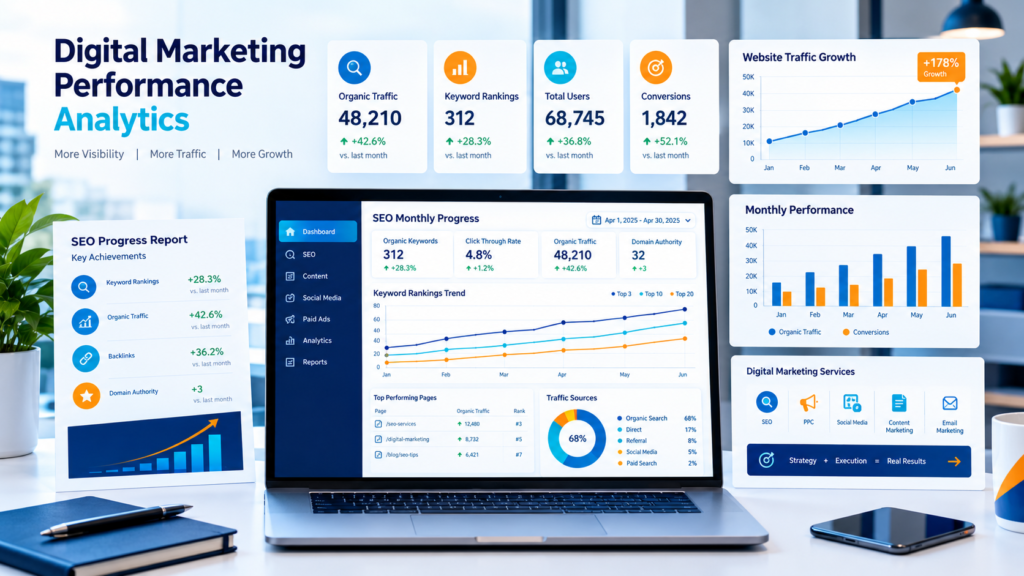
SEO is never finished. Set clear goals, such as organic leads, qualified traffic, and revenue from search, instead of chasing vanity metrics like impressions alone. Google Search Console and Google Analytics give you the data you need to see which pages gain, which decline, and which queries bring paying customers.
Review results monthly and adjust. Update older articles, improve pages stuck on positions 5 to 15, and double down on topics that convert. As a result, your SEO plan becomes a living system that improves with every cycle rather than a one-time project.
How to Put Your SEO Strategy Into Action
A Simple Order of Priority
If the list feels long, start in this order. First, fix any technical issues that block crawling or slow your site. Second, research keywords and intent for your top services. Third, improve existing pages before creating new ones. Fourth, publish helpful content consistently. Finally, build authority and track results. This sequence gives you early wins while the long-term assets grow.
Be realistic about timing, too. Most businesses see early movement within three to four months, with stronger returns after six to twelve. Patience, combined with steady execution, beats any quick trick.
Know When to Bring in Experts
Some companies manage SEO internally, while others prefer outside help for speed and specialist skills. Either path works, as long as someone owns the strategy and reports honestly on progress. If you would like a clear, tailored plan for your business, you can talk to the KPTL team and get practical guidance without pressure.
Final Thoughts: Build SEO as a Business Asset
An effective SEO strategy is not a single tactic; it is a connected system. You research what customers want, create helpful content, keep your website fast and crawlable, earn trust through links and reputation, strengthen local presence, and measure everything. Each part supports the others, and together they produce steady, compounding growth in qualified traffic.
Start with one improvement this week, whether that is fixing a slow page, rewriting a weak title, or planning your first topic cluster. Small, consistent steps, guided by a clear SEO strategy, will move your business up the rankings and put more customers within reach.