
Okay, story first. Seriously, it still bugs me.
My buddy locked his keys in his car last month. He’s on the curb, thumbs going crazy, typing “locksmith near me.” Calls the first guy who doesn’t look shady. Done. Meanwhile a locksmith two streets over, twenty years in the trade, never even knew the job existed.
His listing? Trash. Wrong hours, zero photos, a phone number he stopped picking up ages ago.
Look, I see this every single week. Owners who are brilliant at the actual work and kinda hopeless at being found. Ask them to search their own business on a phone and you get this weird silence, like I asked about their taxes.
Listen, word of mouth is great. But it only reaches people who already know somebody who knows you. Everyone else searches, and they do it fast, one thumb, slightly grumpy, a glance at the map, a glance at the stars, maybe two reviews. Gone.

Don’t freak out though. Local search is honestly the fairest fight left in marketing. A giant chain can’t be more relevant to a person standing in your neighborhood than you are (it really can’t), so you just gotta prove it.
Four things do most of the heavy lifting:
- A Google Business Profile that’s actually finished
- Reviews from real people, recent ones
- A website that says where you work
- Listings that agree with each other everywhere
Those same signals feed the AI summaries at the top of a lot of results now. Yep. So grab a coffee and let’s get into it.
What Are Local SEO Services and Why Your Business Needs Them
Local SEO is just getting found by people close by. Think “dentist open Saturday” or “best tire shop in town.” You want a spot in the map section and the listings right under it.
Local SEO services are the grunt work behind that. Usually it’s stuff like:
- Setting up and fixing your Google Business Profile
- Correcting wrong details on directories
- Building proper location pages on your site
- Handling and answering reviews
- Earning local mentions and links
- Tracking calls, clicks, and direction requests
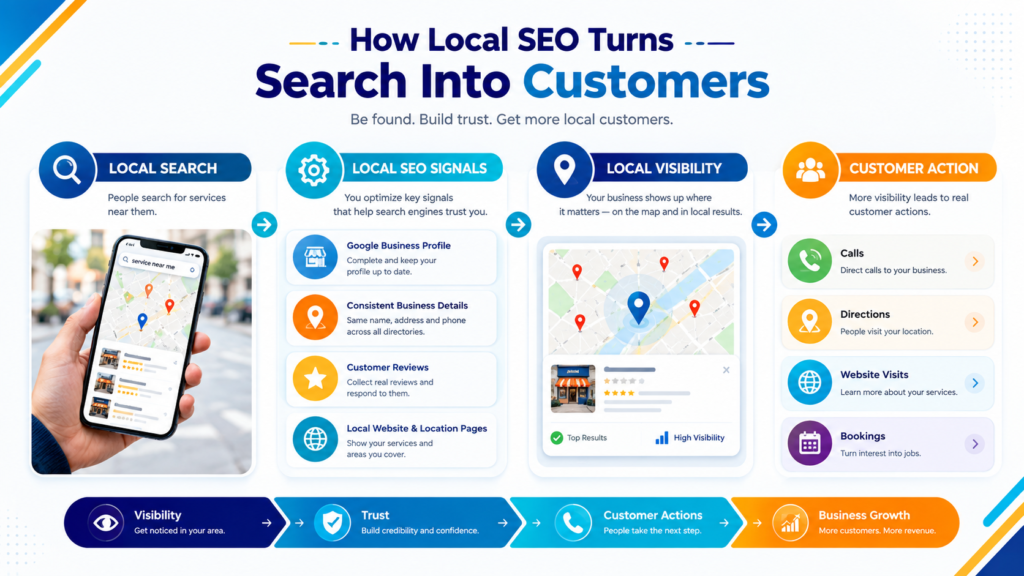
Why does it matter so much? Picture someone typing “emergency plumber.” They’re standing in a puddle. Not browsing. They need a name and a number inside a minute, and I mean one minute.
Now compare that to a regular ad. You’re tapping strangers on the shoulder and most of them don’t care. Local search flips it, because people show up already wanting what you sell.
Your brand matters here too, and trust me, people forget this. If your logo and photos and overall look are all over the place, folks hesitate before they call. We wrote about that in our graphic design and branding guide, and the two topics overlap way more than you’d expect.
The bakery nobody could find
I looked at a bakery once. Gorgeous cakes, some of the best I’ve come across, and a lovely website on top. Search “birthday cakes near me” though? Nothing. Just not there.
The reasons were almost funny. No photos on the profile. Hours that were flat wrong. And the address written three different ways around the web, like the place couldn’t decide where it lived.
Meanwhile a shop with mediocre cakes popped up every single time. Better? No. Clearer, that’s all.
Search engines go with whatever they can double check. The bakery gave them nothing to check.
We sorted the basics over a couple of weeks. New photos, right hours, one address format everywhere, and a handful of real reviews from regulars who were happy to write them. Nothing fancy. A couple of months later the phone was ringing with people who’d never heard of the place.

That gap is the whole job, really. Things shift, rivals get sharper, and what worked last year can quietly stop working. It’s why people bring in help instead of burning a Sunday afternoon clicking around and hoping.
And if you do nothing?
Not much happens. At first. That’s the trap.
You lose a customer here, another one there. You never meet them, so you never miss them. They searched, found somebody else, went on with their day.
Add that up over a year and it’s a big pile of lost jobs. The shop that did the work keeps collecting calls and reviews and repeat visits, and their lead just grows without any noise.
I’d rather you hear it from me now than figure it out mid slow quarter.
Anyway. That’s the why. Knowing it fixes nothing on its own, so here’s the doing part.
Top Strategies Used by a Professional Local SEO Company
A professional local SEO company doesn’t have some secret trick. Nobody does. It’s a few boring habits done well, over and over, for a long time.
Here’s what actually moves the needle right now.
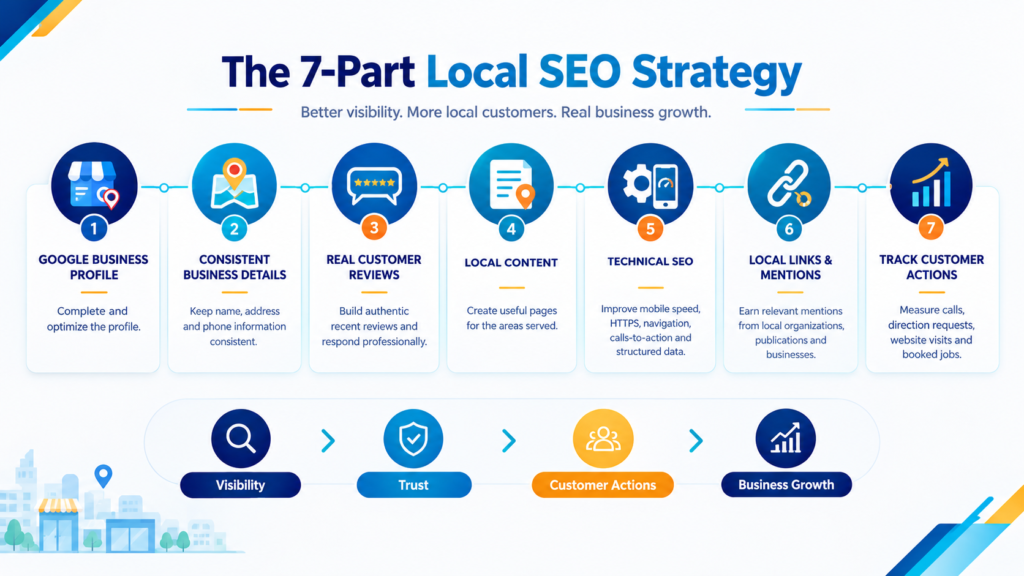
1. Get your Google Business Profile right
For tons of customers this is the first thing they see. Sometimes the only thing. Your website might never get a single visit.
So finish it. All of it. Pick the right main category, put in real hours, write a description that sounds like a person wrote it. Use photos of your actual team and your actual work, not stock junk.
Then keep poking at it. New post, fresh photo every month, replies to the questions people leave. Listen, a profile that looks alive feels safe to call. A dead one feels like a gamble.
Read the official Google Business Profile guidelines too, please. Tiny slip-ups, like stuffing keywords into your business name, can get you suspended. Getting back in is miserable.
2. Make your details match everywhere
Name, address, phone. Same on your site, same on directories, same on social. Even “St.” in one spot and “Street” in another can muddy things for search engines.
The usual culprit is some old listing nobody remembers. A phone number from three years back, sitting on a directory you forgot existed, quietly dragging you down.
I’ve watched businesses fix just this and see calls creep up within weeks. Boring? Totally. Works? Yep.
A proper audit digs these out. Wanna try it yourself first? Search your phone number in quotes and see what pops up. Might surprise you.
3. Collect reviews that feel real
Reviews help rankings, sure. But they help humans a lot more. Nobody wants to be the first person through the door at a place with zero feedback.
Ask while the customer’s still smiling. A text with a direct link beats a vague “please review us” every time, so make it stupidly easy. Some owners keep a little card at the counter with a QR code. Cheap trick, works great.
Then reply to everything, even the nasty ones. Stay calm, say thanks, offer to fix it. People read those replies, and a gracious one can win more trust than a wall of perfect scores.
Fake reviews? Don’t. Seriously. They get caught and it gets ugly.
4. Write pages for your area
Your site should say clearly where you work. Cover a few towns? Give each one its own useful page, with landmarks, common problems around there, jobs you’ve actually done.
Don’t just swap the town name into the same paragraph ten times. Everyone does it. Everyone can tell. Search engines notice and so do readers.
Ask yourself what a neighbor would wanna know, then write that. A plumber might talk about old pipes in the older parts of town, or what to do when a pipe freezes in winter.
5. Sort out the technical basics
Most local searches happen on a phone, often while somebody’s walking or driving. If your site crawls or looks jumbled on a small screen, they’re gone. They won’t wait around, trust me.
This is the foundation under any decent search engine optimization effort. Skip it and your rankings wobble, no matter how good your content is.
Quick checklist:
- Fast loading on mobile
- Secure connection (HTTPS)
- Simple, clean menus
- A tap-to-call button
- Schema markup, so search engines understand what you are
Not glamorous. All of it adds up.
6. Get local links and mentions
When local news sites, your chamber of commerce, or partner businesses mention you, search engines read it as a sign you belong in the area. So sponsor a youth team. Turn up at a community event. Pitch a story to a neighborhood blog.
A few relevant local links beat a heap of random ones. Quality, every time.
I once saw a small gym get more out of one write-up about a local charity event than months of generic directory submissions. Real world beats busywork.
7. Track what pays the bills
Rankings are nice. Phone calls, direction requests, and booked jobs are nicer, since that’s what keeps the lights on.
If a report only shows keyword positions, ask what it means for real customers. And if nobody can answer? Well, there’s your answer.
That’s the toolkit.
Next is the question I get before I’ve even finished explaining it. What’s this gonna look like, and how long till something actually happens?
Understanding Local SEO Services Pricing and What to Expect
Everybody asks about pricing early. Fair enough. But the answer’s annoying, because there’s no standard rate.
A dentist in a packed city is fighting a totally different battle than a mobile pet groomer in a small town. Different scope, different plan. Once you see what drives that, proposals get way easier to judge.
What shapes a local plan
- Competition. A quiet market is easier than a busy city where every rival is pushing hard.
- Where you’re starting. A clean profile and healthy site need less work than a mess of duplicate listings.
- Number of locations. One shop versus five branches. Very different jobs.
- Service area. One neighborhood is simpler than a whole region.
- Content needs. Some sites need small tweaks, others need a full plan.
- Reputation. Fixing a weak one takes longer than keeping a strong one strong.
- Support level. Some owners want everything handled, others just want guidance and regular check-ins.
No tricks in there. Just the real variables.
When a provider quotes you, the number should line up with these things. Doesn’t? Ask why. A good answer is specific. A bad one is a shrug and a sales line.
How long does it take?
Be wary of anyone promising overnight results. Look, it doesn’t work like that. Most businesses see early movement within a few months, then things build from there.
Quieter areas can move quicker. Crowded ones take patience, sorry.
Picture a garden. You can’t yank the plants upward. You get the soil ready, water it regularly, and growth shows up on its own schedule.
First month’s mostly cleanup. Fixing listings, finishing the profile, sorting the site. Feels slow, but that’s because the payoff comes after the groundwork, not during it.
What a good proposal looks like
A trustworthy provider tells you what’s included, how success gets measured, and what they need from you. You should be able to read it without a dictionary.
Red flags:
- Vague promises with zero detail
- Guaranteed number one rankings
- No explanation of how results get reported
- Pressure to sign right now
Something feels fuzzy? Ask. A good team likes questions. A shady one gets defensive fast.
I always tell owners to trust that gut feeling. Confused or rushed after reading a proposal? Walk away.
Say you’ve read a few and they all look fine on paper. Congrats. Now you’ve got the real problem, which is deciding who you trust with your name online.
How to Choose the Right Local SEO Specialist for Your Brand
This pick matters more than any single tactic. The right person can transform how you show up. The wrong one burns months and leaves you with a pretty report and zero new customers.
So what do you look for?
- Plain language. If they can’t explain the plan simply, be careful.
- Clear reporting. You should know what gets done and which numbers they’ll share.
- Real experience. Ask for examples of local businesses they’ve helped, and what actually changed.
- No shortcuts. Fake reviews and bought links might give a quick bump, but the penalties are brutal to undo.
- Honest communication. You’ll be stuck working together for months, so you want someone who says what’s working and what isn’t.
Also look for someone who sees the whole board. Local SEO works best next to your website, your reviews, and your wider digital marketing efforts, so ask how they’d tie it all together. If the answer’s “we just do rankings,” that’s worth noting.
Another one that trips people up is whether to hire a freelancer, a consultant, or a full agency. No single right answer. It depends on your size, your budget, and how much you wanna hand off. Our digital marketing consultant vs agency guide breaks down who tends to fit where, so give it a read before you sign anything.
Before you commit, ask a few blunt questions. How do you handle a profile suspension? What will I see in the first month? Who do I call when something looks off?
Their answers tell you plenty. So does how they say them.

Ready to Get Found Locally?
Look, you don’t need to fix everything this week. Pick one thing. Claim your profile, correct your hours, or text your last five happy customers and ask for a review.
Small moves stack up faster than you’d guess. And the earlier you start, the bigger your head start on that shop down the road that’s still ignoring all of this.
Not sure where you stand? Easy way to find out. Grab a free local audit with KPTL. We’ll look at how you show up right now, tell you straight what’s holding you back, and hand you a short list of next steps.
No pressure, no sales script. Just head to KPTL Services at kptlservices.com and book yours.