
Quick Answer
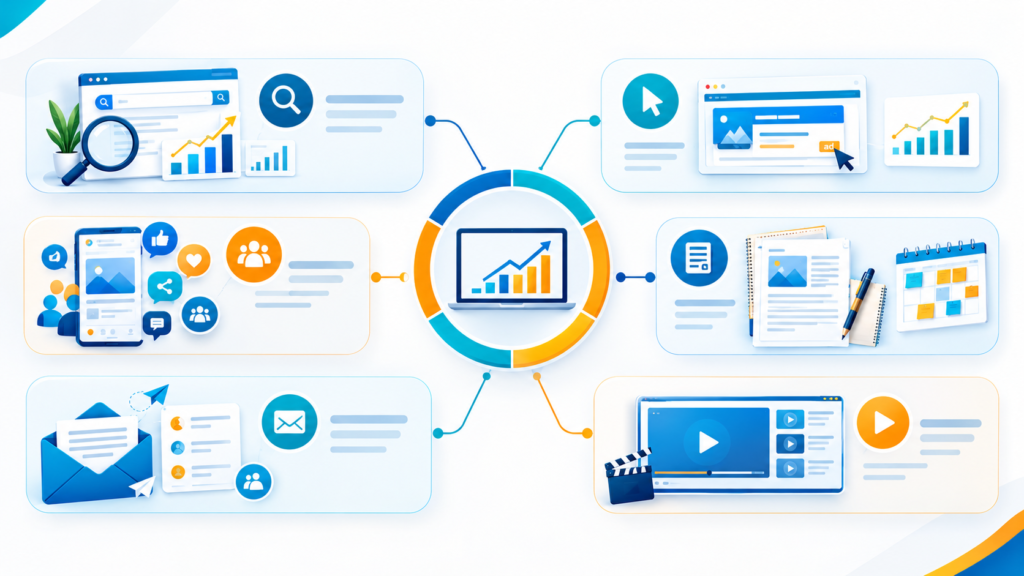
The main types of digital marketing services include search engine optimization (SEO), pay-per-click advertising (PPC), social media marketing, content marketing, email marketing, affiliate marketing, influencer marketing, video marketing, and local digital marketing. Other services include conversion rate optimization, marketing automation, online reputation management, and web analytics. Each service serves a different purpose, from increasing online visibility to generating leads and improving sales. The right combination depends on your target audience, business goals, industry, and available resources.
Introduction
A business can have an excellent product or service and still struggle to attract customers online. Sometimes the problem is low website visibility. In other cases, potential customers visit the website but do not make enquiries or complete purchases.
Digital marketing helps businesses address these challenges through different online channels and strategies. However, choosing the right services can be confusing because there are many options, and not every business needs all of them.
Understanding the different types of digital marketing services makes it easier to decide where to invest your time and resources. For example, a local service provider may benefit from local SEO and targeted advertising, while an online store may need ecommerce SEO, email marketing, and conversion optimization.
This guide explains the major digital marketing services, how they work, their benefits, and how businesses can select the most suitable options.
What Are Digital Marketing Services?
Digital marketing services are professional solutions that help businesses promote their products, services, or brands through digital channels. These channels include search engines, websites, social media platforms, email, online advertising networks, and video platforms.
Depending on the business objectives, a digital marketing provider may focus on increasing organic website traffic, attracting qualified leads, improving brand awareness, generating online sales, or retaining existing customers.
For example, a company may use SEO to attract people searching for its services, PPC advertising to reach potential customers more quickly, and email marketing to maintain relationships with existing customers.
Businesses can manage these activities internally, hire freelancers, or work with a digital marketing agency. The most suitable approach depends on the company’s expertise, workload, budget, and growth priorities.
For a broader overview of how these channels work together, read KPTL Web Solution’s digital marketing guide.
10 Major Types of Digital Marketing Services
1. Search Engine Optimization (SEO)
Search engine optimization helps improve a website’s visibility in unpaid search results. It involves making website pages easier for search engines to understand while providing useful information and a good experience for visitors.
SEO is particularly useful for businesses that want to attract people actively searching for relevant products, services, or information.
Common SEO services include:
- Keyword research: Identifying relevant search terms used by potential customers.
- On-page SEO: Improving titles, headings, content, internal links, and other page elements.
- Technical SEO: Addressing crawling, indexing, site structure, and technical accessibility issues.
- Content optimization: Making existing pages more relevant, helpful, and comprehensive.
- Off-page SEO: Building website authority through legitimate, relevant mentions and links.
- Local SEO: Improving visibility for relevant searches associated with a business’s location or service area.
For example, a plumbing company may optimize its website for searches such as “emergency plumber in Manchester” to reach people looking for its services.
SEO can support long-term visibility, but rankings and traffic growth are not guaranteed. Results depend on competition, website quality, relevance, implementation, and other factors.
Businesses looking to improve organic visibility can explore KPTL Web Solution’s search engine optimization services.
2. Pay-Per-Click Advertising (PPC)
Pay-per-click advertising allows businesses to display paid advertisements on search engines and other advertising platforms. In many PPC campaigns, advertisers pay when someone clicks an ad, although other bidding and charging models are also available.
Google Ads is one of the most widely used platforms for search advertising. Businesses can target relevant keywords, locations, audiences, and other campaign settings.
Common PPC services include:
- Search advertising
- Display advertising
- Remarketing campaigns
- Shopping advertising
- Campaign keyword research
- Ad copy development
- Landing page optimization
- Conversion tracking and campaign reporting
For example, a company selling office furniture can run search ads for product-related keywords to reach people actively looking to buy desks and chairs.
PPC can generate visibility soon after a campaign becomes eligible to run, but results depend on targeting, competition, budget, landing page quality, and conversion tracking. Advertising spend alone does not guarantee sales.
Businesses can review Google Ads’ official guide to online marketing to understand how advertising campaigns work.
3. Social Media Marketing
Social media marketing helps businesses connect with their audiences through platforms such as Facebook, Instagram, LinkedIn, and other relevant networks.
It can involve organic content, paid advertising, community engagement, audience research, and campaign analysis.
Typical social media marketing services include:
- Social media strategy development
- Content calendars and post scheduling
- Creative design and short-form videos
- Community management
- Paid social media campaigns
- Audience engagement and reporting
For example, a restaurant may share food photography, customer testimonials, menu updates, and promotional offers on Instagram to encourage local customers to visit.
A B2B consulting company may use LinkedIn to publish industry insights and connect with decision-makers.
Social media marketing is most effective when the selected platforms match the audience and the content provides a clear reason to follow, engage, or take action.
Businesses that need help managing their profiles and publishing consistent content can explore social media management services.
4. Content Marketing
Content marketing involves creating and distributing useful, relevant content to attract and engage a target audience. Instead of relying only on direct promotions, businesses provide information that helps potential customers understand a problem, evaluate solutions, or make decisions.
Content marketing can support SEO, social media, email campaigns, and other digital marketing activities.
Common content marketing services include:
- Blog writing and article optimization
- Website copywriting
- Guides, checklists, and educational resources
- Case studies based on verified results
- Infographics and visual content
- Video scripts and educational content
- Content strategy and editorial planning
For example, an accounting firm could publish an article explaining the documents required for filing business taxes. Readers who find the article useful may explore the firm’s services when they need professional assistance.
Effective content marketing requires a clear understanding of the audience, consistent quality, and useful information. Publishing more content is not automatically better if the material does not address real customer needs.
5. Email Marketing
Email marketing allows businesses to communicate directly with people who have subscribed to their mailing lists or otherwise provided appropriate permission to receive messages.
It can help businesses share updates, nurture leads, announce offers, encourage repeat purchases, and maintain customer relationships.
Common email marketing services include:
- Newsletter creation
- Welcome email sequences
- Lead nurturing campaigns
- Promotional emails
- Customer retention campaigns
- Audience segmentation
- Email performance analysis
For example, an online clothing store can send a welcome email to new subscribers, product recommendations based on relevant interests, and order-related updates to customers.
Email marketing works best when messages are relevant and useful. Businesses should obtain appropriate consent, follow applicable privacy and marketing laws, and make unsubscribing straightforward.
6. Affiliate Marketing
Affiliate marketing involves partnerships in which publishers, creators, or other partners promote a business’s products or services in exchange for an agreed commission or other compensation.
Compensation may depend on qualifying purchases, leads, clicks, or another clearly defined action.
Typical affiliate marketing services include:
- Affiliate programme planning
- Partner recruitment
- Commission structure development
- Tracking and attribution
- Affiliate communication
- Performance reporting
For example, a software company may work with industry bloggers who review its product and provide tracked referral links. When readers complete eligible purchases, the partners receive the agreed commission.
Businesses should establish clear terms, monitor referral quality, disclose commercial relationships appropriately, and ensure their partners follow applicable advertising rules.
7. Influencer Marketing
Influencer marketing involves collaborating with content creators who have an audience relevant to a business’s products or services.
These partnerships can help brands introduce products, demonstrate their use, and reach communities that may not respond to traditional advertising.
Services may include:
- Influencer research and selection
- Campaign planning
- Creator outreach and negotiation
- Sponsored content coordination
- Campaign tracking
- Performance evaluation
For example, a skincare company might partner with a beauty creator to demonstrate how a product fits into a skincare routine.
The right partner is not necessarily the one with the largest following. Audience relevance, genuine engagement, content quality, brand suitability, and campaign objectives also matter.
Paid partnerships and gifted products should be disclosed in accordance with the rules applicable to the campaign’s audience and location.
8. Video Marketing
Video marketing uses video content to explain products, demonstrate services, educate audiences, or communicate a brand’s message.
Businesses can distribute videos through YouTube, social media, websites, and other relevant channels.
Common video marketing services include:
- Product demonstrations
- Educational videos
- Customer testimonials
- Explainer videos
- Short-form social media videos
- Video advertising
- Video content optimization
For example, a web design company could publish a short video showing how a responsive website helps customers navigate a business’s services on mobile devices.
Video content can make complicated ideas easier to understand and provide another way for audiences to discover a brand. However, its effectiveness depends on the quality of the message, distribution, audience relevance, and the action the business wants viewers to take.
9. Local Digital Marketing
Local digital marketing helps businesses reach customers in specific geographic areas. It is especially relevant for service providers, restaurants, retailers, clinics, and other businesses serving a defined location.
Local digital marketing can combine several channels rather than operating as a completely separate discipline.
Common services include:
- Local SEO
- Business profile optimization
- Local landing page development
- Location-specific content
- Review management
- Local search advertising
- Relevant local directory listings
For example, a dental clinic may improve its local search presence, maintain accurate business information, encourage genuine customer reviews, and create a page explaining the treatments available at its location.
Businesses should ensure their business details are accurate and consistent, respond professionally to feedback, and avoid misleading location claims or fabricated reviews.
Local marketing works best when the business’s service area, customer needs, and online information are clearly defined.
10. Ecommerce Marketing
Ecommerce marketing focuses on attracting shoppers to an online store and helping them move from product discovery to purchase and repeat buying.
It often combines multiple digital marketing services because online retailers need to reach customers, communicate product value, and make purchasing straightforward.
Common ecommerce marketing services include:
- Ecommerce SEO
- Product page optimization
- Shopping advertising
- Product feed management
- Email marketing automation
- Retargeting campaigns
- Conversion rate optimization
- Customer retention strategies
For example, an online electronics store may optimize product titles and descriptions, improve product imagery, advertise eligible products, and send post-purchase emails with relevant information.
The most effective approach considers the entire customer journey, including product discovery, product comparisons, checkout usability, delivery information, and after-sales communication.
Other Digital Marketing Services Businesses Should Know
Beyond the ten major categories, several specialized services can improve campaign performance.
| Service | What it does | When it is useful |
| Conversion rate optimization (CRO) | Improves website pages and user journeys to encourage desired actions | When visitors arrive but relatively few enquire or purchase |
| Marketing automation | Automates tasks such as lead follow-ups and scheduled communications | When repetitive marketing tasks take significant time |
| Online reputation management | Monitors and helps manage a brand’s online reputation | When reviews and public feedback influence customer decisions |
| Mobile marketing | Reaches audiences through mobile-friendly experiences and appropriate mobile channels | When customers primarily interact through mobile devices |
| Search engine marketing (SEM) | Often refers to paid search marketing, although usage can vary | When a business wants to reach people through search advertising |
| Performance marketing | Emphasizes campaign outcomes and measurable performance | When campaigns need clearly defined targets and reporting |
| Web analytics and reporting | Measures traffic, engagement, leads, and other relevant activity | When a business needs evidence to assess marketing performance |
These services can complement SEO, paid advertising, social media, content, and email marketing. They should be selected according to a specific business need rather than added simply to make a marketing plan appear comprehensive.
For example, analytics can help a business identify which channels generate qualified enquiries, while CRO can investigate whether website visitors encounter problems completing a form.
Google’s official Google Analytics documentation explains how website activity and audience interactions can be measured.
Which Digital Marketing Services Does a Small Business Need?
Small businesses rarely need to invest in every marketing channel at the same time. The best starting point is to identify the most important business objective and select services that support it.
| Business goal | Services to consider | Example |
| Improve organic visibility | SEO and content marketing | Publish useful service pages and relevant educational articles |
| Generate enquiries quickly | PPC and landing page optimization | Run targeted search ads leading to a relevant enquiry page |
| Build brand awareness | Social media and video marketing | Share useful content with an audience on relevant platforms |
| Encourage repeat purchases | Email marketing and marketing automation | Send relevant product updates to subscribers |
| Attract nearby customers | Local SEO and local advertising | Improve location information and target relevant local searches |
| Increase online sales | Ecommerce SEO, PPC, and CRO | Improve product discovery and simplify the checkout journey |
Consider a small home renovation company. It may begin with a clear website, local SEO, useful service pages, and a way to track enquiries. If it needs more leads within a specific period, it may test paid search advertising alongside those foundations.
An online retailer, by comparison, may prioritize product page optimization, shopping campaigns, abandoned-cart communications where appropriate, and checkout improvements.
Businesses with limited resources should prioritize services based on customer demand, available capacity, expected costs, and measurable objectives.
For more guidance, see why small businesses hire a digital marketing agency.
How to Choose the Right Digital Marketing Services
Choosing the right combination involves more than comparing service packages. Businesses should consider the following steps.
1. Define Your Business Goals
Start by deciding what you want to accomplish. Your objective might be more qualified enquiries, increased online sales, stronger local visibility, or better customer retention.
Clear objectives make it easier to choose appropriate channels and measure progress.
2. Understand Your Target Audience
Identify who your customers are, what they need, which questions they ask, and where they search for information.
A service aimed at local homeowners may require a different marketing strategy from a business selling software to enterprise decision-makers.
3. Review Your Existing Marketing Performance
Examine your website, search visibility, advertising campaigns, social media activity, and enquiry process.
Analytics tools can help identify where visitors come from and how they interact with your website. Confirm that tracking is configured correctly before relying on the results.
4. Consider Budget and Resources
Different services require different levels of investment, expertise, and time.
For example, paid advertising requires an advertising budget as well as campaign management, while SEO requires ongoing work on content, technical issues, and website relevance.
Choose a realistic starting scope that your business can maintain and evaluate.
5. Evaluate Providers Carefully
If you plan to hire an agency or freelancer, review their relevant experience, proposed strategy, deliverables, reporting process, and communication standards.
Ask how success will be measured, who owns the accounts and campaign data, and which activities are included in the agreement.
Avoid providers that promise guaranteed rankings, guaranteed sales, or results without explaining the assumptions and work involved.
6. Measure Results and Improve
Select metrics that reflect your objectives. These may include qualified leads, conversion rate, customer acquisition cost, revenue, or organic search performance.
Review results regularly and use the findings to refine campaigns. No single metric provides a complete picture of marketing performance.
Why an Integrated Digital Marketing Strategy Matters
Individual services can be useful on their own, but they often become more effective when coordinated around a shared objective.
For example, SEO and content marketing can attract people researching a problem. A useful landing page can explain the available solution, while email marketing can support follow-up when a visitor has chosen to subscribe or request further information.
Similarly, social media can distribute educational content, paid advertising can test relevant offers, and analytics can help compare the resulting traffic and conversions.
An integrated strategy does not mean using every channel. It means ensuring that the selected services work together, communicate a consistent message, and support the same business goals.
Your website is an important part of this process because it often provides the destination where potential customers learn about your business and take action. Businesses planning to improve their online presence can explore KPTL Web Solution’s web design services.
Conclusion
The different types of digital marketing services serve different purposes. SEO can improve organic visibility, PPC can provide paid reach, social media can build engagement, content marketing can answer customer questions, and email marketing can support customer relationships. Specialized services such as local SEO, ecommerce marketing, CRO, and analytics address more specific business needs.
The right combination depends on your goals, audience, industry, resources, and existing marketing performance. Start with the services most closely connected to your priorities, measure meaningful outcomes, and expand your strategy as your needs develop.
KPTL Web Solution offers digital marketing and related services to help businesses strengthen their online presence. Explore our digital marketing services to learn more about potential solutions for your business.
Frequently Asked Questions
1. What are the main types of digital marketing services?
The main types include SEO, PPC advertising, social media marketing, content marketing, email marketing, affiliate marketing, influencer marketing, video marketing, local digital marketing, and ecommerce marketing. Businesses may also use analytics, marketing automation, and conversion rate optimization.
2. Which digital marketing service is best for a small business?
There is no single best service for every small business. Local service providers may benefit from local SEO, while businesses that need to test demand quickly may consider paid advertising. The best choice depends on the target audience, business objectives, competition, and available resources.
3. What is the difference between SEO and PPC?
SEO focuses on improving visibility in unpaid search results, whereas PPC advertising involves paid campaigns that can display ads to relevant audiences. SEO may support longer-term organic visibility, while PPC can provide paid exposure once campaigns are eligible to run. Both require suitable targeting, useful landing pages, and performance measurement.
4. Can businesses use multiple digital marketing services together?
Yes. Businesses can combine services to support different stages of the customer journey. For example, SEO can attract organic traffic, content marketing can answer customer questions, and email marketing can nurture subscribers. The combination should reflect the business’s goals and resources.
5. How do I measure the success of digital marketing services?
Measure outcomes that match your objectives, such as qualified leads, online sales, conversion rate, customer acquisition cost, organic search visibility, and revenue. Use suitable analytics and advertising reports, and ensure tracking is configured correctly before drawing conclusions.
6. Should I hire a digital marketing agency or manage marketing in-house?
An agency may be useful when your business needs specialist skills, coordinated campaign management, or additional execution capacity. In-house marketing may provide greater direct control when the business has the necessary skills and resources. Compare expertise, costs, communication, accountability, and the scope of work before deciding.