Quick Answer:
AI Search Optimization helps businesses make their content easier for search engines and AI-powered search experiences to discover, understand, and reference. Start by answering the audience’s main question clearly, creating original and reliable information, organizing content with descriptive headings, strengthening internal links, and maintaining a technically accessible website. Support important claims with credible sources and measure performance using available search analytics. These practices can improve discoverability, but they cannot guarantee inclusion in AI-generated answers.
Introduction
Search is changing how people discover information, compare businesses, and make purchasing decisions. Instead of opening several websites, users can increasingly ask AI-powered search tools a detailed question and receive a synthesized answer with links to relevant sources.
For businesses, this creates a new challenge: publishing content is no longer enough. Your website must provide information that is useful to readers, accessible to search engines, and clear enough to be understood in different search contexts.
This is where AI Search Optimization becomes important. It brings together established SEO practices and a stronger focus on original information, clear explanations, brand credibility, and helpful content.
However, optimizing for AI search does not mean abandoning traditional SEO or filling every paragraph with keywords. Google’s official guidance explains that its AI search experiences continue to rely on foundational SEO principles, including crawlability, indexing, and helpful, people-first content.
In this guide, you will learn how to optimize website content for AI search engines, improve AI search visibility, and build a practical strategy that supports both conventional search results and emerging generative search experiences.
What Is AI Search Optimization?
AI Search Optimization is the process of improving website content and its technical accessibility so that search engines and AI-powered discovery systems can find, interpret, and potentially reference useful information.
Traditional SEO often focuses on helping pages appear in search results for relevant queries. AI search introduces additional ways for users to discover information, including synthesized answers, conversational follow-up questions, and contextual links to supporting sources.
For example, a business owner searching for a digital marketing agency might ask an AI-powered search tool, “What should a small business look for when choosing a digital marketing agency?”
A useful page could explain the evaluation criteria, show how to compare agencies, identify common warning signs, and provide a practical checklist. This is more valuable than a page that merely repeats the phrase “best digital marketing agency” several times.
Three related terms are worth understanding:
- AI Search Optimization: A broad approach to improving discoverability in AI-assisted search experiences.
- Answer Engine Optimization (AEO): A term often used for making information easy to retrieve and present in direct answers.
- Generative Engine Optimization (GEO): A term used for strategies intended to improve the visibility of content in generative AI responses.
These terms overlap, and their definitions vary across the industry. Google describes optimization for its generative search features as an extension of SEO rather than a separate system requiring special tricks.
1. Understand Search Intent Before Creating Content
Every effective optimization strategy begins with understanding what the reader wants to accomplish.
A person searching for “what is AI search optimization” needs an explanation. Someone searching for “AI search optimization services” may be comparing providers. A business owner searching for “how to improve my company’s AI search visibility” needs practical steps and a way to measure progress.
Treating all three searches with the same generic article can leave important questions unanswered.
Identify the questions behind the keyword
Before writing, review relevant search results, customer enquiries, sales conversations, and related questions. Group these findings according to the reader’s needs.
For this topic, useful questions include:
- What is AI Search Optimization?
- How does Google AI Overviews work?
- Is traditional SEO still important for AI search?
- How can businesses improve AI search visibility?
- Does AI-generated content affect search performance?
- How can a business measure its presence in AI search?
Use these questions to plan sections that provide distinct answers rather than creating separate pages for every minor keyword variation.
KPTL Web Solution’s guide to the key components of an effective SEO strategy provides a useful foundation for connecting keyword research, search intent, content quality, and technical SEO.
2. Answer the Main Question Clearly and Early
Readers should not have to work through several paragraphs of background information before finding the answer they came for.
Place a concise explanation near the beginning of the article, followed by the reasoning, supporting evidence, and practical details. This structure benefits people who scan pages and helps establish the context of the content.
Use direct answers without oversimplifying
Consider this example.
Weak explanation:
AI search is an exciting development in online marketing, and businesses need to understand the importance of content optimization in the modern digital environment.
Improved explanation:
AI Search Optimization helps businesses make their content easier to discover and understand in AI-powered search experiences. It combines helpful content, sound technical SEO, clear page structure, credible information, and ongoing performance measurement.
The improved version defines the concept immediately and identifies the main elements involved.
Use the same approach throughout the article. Start each major section with its central idea, then explain how it works, why it matters, and what the reader should do next.
Concise answers are useful, but there is no need to force every paragraph into a fixed word count or divide all content into tiny blocks solely for AI systems.
3. Create Original, Reliable, People-First Content
Originality is one of the most important opportunities for improving AI search visibility.
If your article repeats information already available across dozens of websites, it gives readers little reason to choose your business as a source. A stronger article adds relevant examples, specific expertise, practical comparisons, original observations, or evidence that helps readers make better decisions.
Add information that competitors cannot easily copy
A business offering SEO services could explain how it evaluates a client’s existing content, prioritizes technical problems, and decides which pages to update first.
Useful additions may include:
- Examples based on genuine business scenarios.
- Original research or verified company data.
- Expert explanations of complicated concepts.
- Screenshots, demonstrations, or documented processes.
- Clear limitations and realistic expectations.
- References to reliable sources for factual claims.
Do not invent customer results, personal experience, or case studies to make content appear authoritative. If you use an illustrative example, identify it as an example rather than a documented result.
Use AI writing tools responsibly
AI tools can help with research organization, outlines, and initial drafts. They should not replace fact-checking, editorial judgment, or the information that makes your business distinctive.
Review every draft for factual accuracy, repetitive wording, unsupported claims, and generic recommendations. Add human expertise where it genuinely improves the content.
Google’s guidance on using generative AI content emphasizes quality, accuracy, relevance, and compliance with spam policies. The issue is not simply whether AI helped write a page; publishing large volumes of low-value content without meaningful user benefit can create problems.
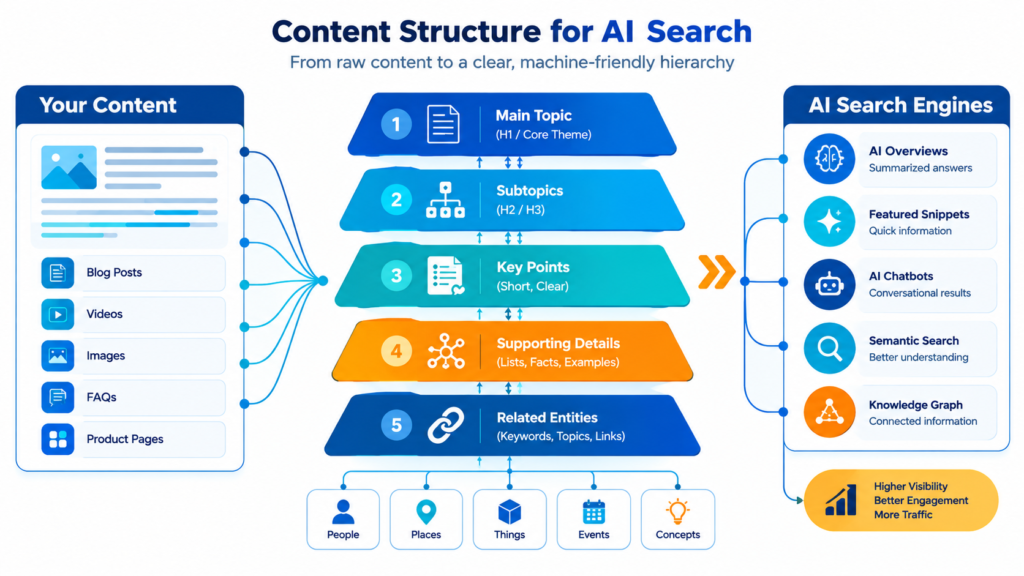
4. Structure Content So Readers Can Understand It Easily
Clear organization helps readers navigate a page and helps search engines interpret its subject matter.
Use one descriptive H1 for the main article title, H2 headings for major sections, and H3 headings for supporting points. Each heading should accurately describe the information that follows.
Make every section useful on its own
For example, a section titled “How to Improve AI Search Visibility” should explain specific actions rather than simply repeat general advice about creating better content.
A practical structure might include:
- A direct explanation of the recommended action.
- Why the action matters.
- Steps readers can follow.
- An example or supporting source.
- Any relevant limitations.
Write clear paragraphs and use lists when they make instructions easier to follow. Include tables when readers need to compare options or make decisions.
For example, a table comparing traditional SEO and AI search optimization can clarify the relationship between the two.
| Area | Traditional SEO focus | AI search consideration |
| Content | Relevance and usefulness for search queries | Clear, reliable information that can support synthesized answers |
| Structure | Logical headings and page organization | Clear context and relationships between concepts |
| Technical health | Crawling, indexing, and page accessibility | The same foundations remain important |
| Authority | Credibility and relevant references | Original expertise and reliable supporting information |
| Measurement | Search visibility, clicks, and conversions | Available AI-specific reporting and referral analysis |
These are differences in emphasis, not completely separate sets of ranking rules.
5. Strengthen Traditional SEO and Technical Accessibility
AI content optimization cannot compensate for a website that search engines cannot access or index properly.
Google’s documentation states that pages must meet its existing Search eligibility requirements to be considered for supporting links in AI Overviews and AI Mode. Even when a page meets those requirements, inclusion is not guaranteed.
Review the technical foundations
Check the following areas:
- Crawlability: Confirm that important pages are not unintentionally blocked by robots.txt or other access restrictions.
- Indexing: Use Google Search Console to inspect important URLs and identify indexing issues.
- Internal linking: Connect related service pages and blog posts with descriptive anchor text.
- Mobile usability: Make sure the page is easy to read and navigate on different screen sizes.
- Page performance: Investigate slow loading, layout instability, and unnecessary technical complexity.
- Content accessibility: Ensure important information is available in a format search engines can process.
- Duplicate content: Consolidate unnecessary duplication and use appropriate canonicalization where needed.
Businesses planning improvements to their website structure or usability can explore KPTL Web Solution’s web design services.
Do not chase unsupported technical shortcuts
There is no universal markup or special formatting trick that guarantees a page will appear in an AI-generated answer. Google specifically says that its AI search features do not require special AI schema or an llms.txt file.
Use structured data when it accurately describes visible content and supports an appropriate search feature. Do not add markup simply because it is being promoted as an AI ranking shortcut.
6. Build Context With Strategic Internal and External Links
Links help readers explore a subject in greater depth and help search engines discover relationships between pages.
A strong internal linking strategy connects related articles, service pages, and foundational guides. It should follow the reader’s journey rather than an arbitrary number of links.
Connect related pages naturally
For example, an article about AI Search Optimization can link to a foundational SEO strategy guide when explaining technical and content fundamentals.
When discussing how a website’s structure supports discoverability, it can link to relevant web design services. When explaining how SEO fits into a broader marketing plan, it can reference KPTL’s digital marketing services.
Previously published content can also extend the reader’s understanding. KPTL’s article on AI website builders in 2026 is relevant when discussing AI-generated content, website structure, and the importance of human review. Its guide to website design for small business provides additional context about usability, navigation, and clear business information.
Use descriptive anchor text that accurately reflects the destination. Avoid repeating the same anchor or linking every mention of a keyword.
Support important claims with credible external sources
External links are useful when they allow readers to verify technical recommendations or explore primary documentation.
Prioritize official documentation from search engines, original studies, and reputable sources with relevant evidence. Place each reference close to the claim it supports.
For this article, Google’s documentation on AI search features and its guidance on generative AI content are particularly relevant. They provide a more reliable foundation than unsupported claims about secret optimization formulas.
7. Improve Brand Credibility and Topical Authority
A website’s authority is built over time through the quality and consistency of its information, not by publishing a large number of loosely related articles.
Topical coverage means answering the important questions within a subject area and connecting those answers logically.
For example, a digital marketing agency might develop a content cluster covering:
- Traditional SEO strategy and technical optimization.
- AI Search Optimization and GEO fundamentals.
- Content research and search intent.
- Website design and user experience.
- Content measurement and conversion improvement.
Each article should serve a distinct purpose. Supporting articles can link to a broader guide, while the broader guide links to the most useful supporting resources.
Make business information consistent
Keep your company name, service descriptions, contact information, and relevant business profiles accurate and consistent. Publish clear author information where appropriate, describe your qualifications honestly, and support claims with evidence.
Genuine mentions from relevant publications, industry partners, customers, or professional communities may help people discover your brand. However, do not manufacture reviews, buy spammy links, or create artificial mentions solely to influence AI responses.
Brand visibility is a long-term outcome of useful work and credible communication, not a guaranteed result of any single tactic.
8. Use Images and Examples to Explain Complex Ideas
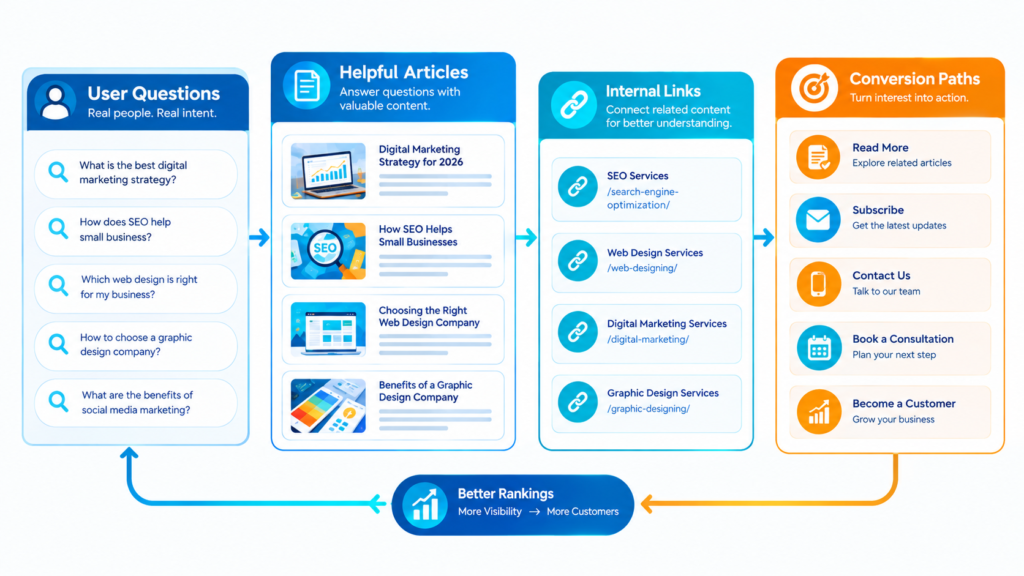
Visual content can help readers understand processes, comparisons, and relationships that are difficult to explain in text alone.
Useful options include original diagrams, process illustrations, product screenshots, comparison tables, and explanatory videos.
For every image, use an appropriate file format, descriptive filename, and meaningful alt text when the image conveys information. Keep images relevant to the surrounding content and avoid adding decorative graphics that slow the page without helping the reader.
For example, a simple diagram could show the relationship between a customer’s question, a useful article, supporting evidence, internal links, and a conversion opportunity.
If visual branding or custom graphics are important to your content strategy, KPTL’s graphic design services are a relevant resource to explore.
Remember that images support the content; they do not replace essential explanations that readers need to understand.
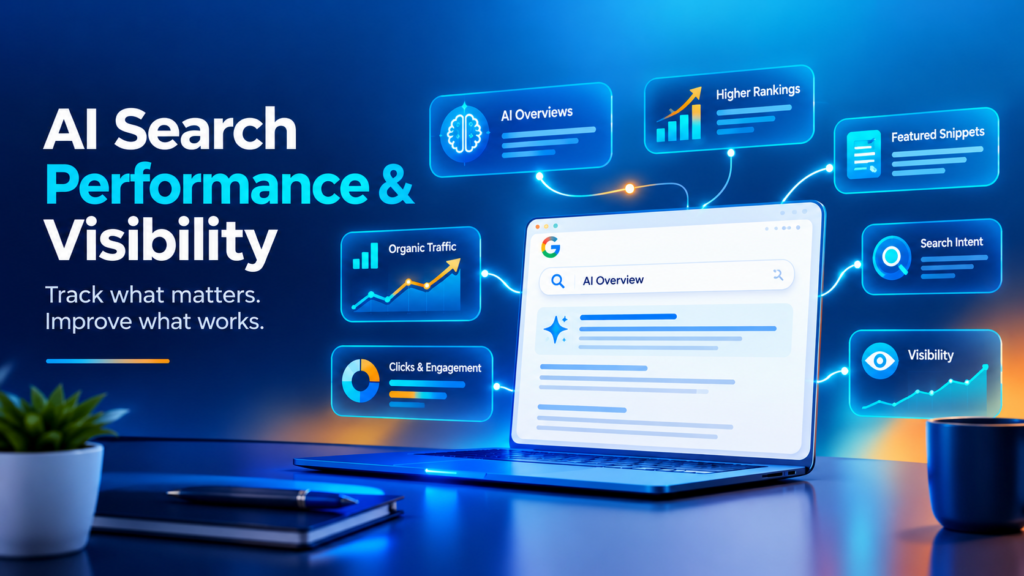
9. Measure AI Search Visibility and Business Outcomes
Optimization should be guided by evidence rather than assumptions about what an AI system might prefer.
Start with Google Search Console to understand search performance, query patterns, indexing status, and changes in organic visibility. Use Google Analytics or another suitable analytics platform to monitor relevant visits, engagement, enquiries, and conversions.
Google’s official documentation explains how traffic from AI features is included in Search Console reporting. Where dedicated AI performance reporting is available for your property, use it to examine visibility in generative search experiences.
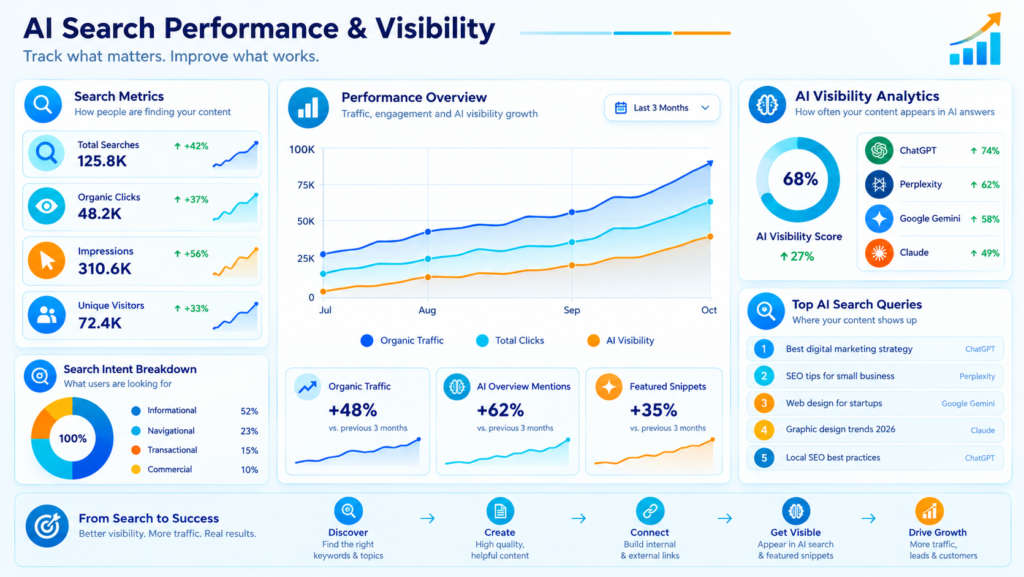
Track meaningful indicators
| Metric | What it helps you understand |
| Search impressions | How often your content is shown in eligible search results |
| Organic clicks | How often people visit from conventional search results and reported AI search traffic |
| Relevant queries | The questions and topics associated with your visibility |
| Referral traffic | Visits arriving from identifiable external AI platforms |
| Conversions | Whether visitors enquire, book, subscribe, or complete another valuable action |
| Content engagement | Whether visitors interact meaningfully with your pages |
Do not assume every AI referral will be identifiable in analytics, or that every mention of your brand will produce a click. Reporting capabilities vary across platforms, and measurement methods may change.
Review your most important pages regularly. Update outdated claims, improve weak explanations, fix technical problems, and compare performance before and after substantial changes.
The objective is not merely to be mentioned by an AI tool. It is to help the right people discover your business and make informed decisions.
10. Common AI Search Optimization Mistakes to Avoid
Some popular recommendations promise quick AI visibility but are not supported by official search guidance.
Avoid these mistakes:
- Keyword stuffing: Repeating a phrase unnaturally instead of explaining the topic clearly.
- Mass-producing generic articles: Publishing many pages without adding meaningful value.
- Overusing short answer blocks: Forcing every section into an artificial format rather than matching reader needs.
- Adding unnecessary AI files or schema: Assuming a special file or markup guarantees inclusion in AI results.
- Buying artificial brand mentions: Pursuing quantity over genuine relevance and trust.
- Ignoring technical SEO: Focusing on writing while important pages remain inaccessible or unindexed.
- Treating AI mentions as guaranteed: Promising clients specific citations, placements, or ranking outcomes.
- Measuring vanity metrics alone: Ignoring qualified traffic, enquiries, and business outcomes.
A more reliable approach is to combine sound SEO, original content, accurate business information, and ongoing measurement. These fundamentals remain useful even as individual AI search products evolve.
Conclusion: Build Content for People First
AI Search Optimization is best approached as an extension of a strong SEO and content strategy. Businesses should focus on answering real questions, publishing original and reliable information, maintaining technically accessible websites, connecting related resources, and demonstrating genuine expertise.
No technique guarantees that a search engine or AI platform will cite your content. Nevertheless, useful information and a well-maintained website give your business a stronger foundation for discovery across different search experiences.
Start by reviewing your most important service page and one existing blog post. Check whether each answers the reader’s main question, supports its claims, links to relevant resources, and offers a clear next step.
If you need help improving your site’s search foundations, explore KPTL Web Solution’s SEO services for further information about relevant optimization support.
Frequently Asked Questions
1. What is AI Search Optimization?
AI Search Optimization is the practice of improving content quality, website accessibility, and contextual relevance so that search engines and AI-powered discovery tools can find and potentially reference useful information.
2. Is traditional SEO still important for AI search?
Yes. Traditional SEO remains important because search engines still rely on technical accessibility, indexing, relevant content, and established search quality systems. AI search optimization builds on these foundations rather than replacing them.
3. How can I improve my visibility in Google AI Overviews?
Create useful, original content; ensure important pages are crawlable and eligible for search; use clear headings and internal links; keep business information accurate; and monitor available Search Console reports. No method guarantees inclusion in AI Overviews.
4. Does AI-generated content hurt SEO?
AI assistance does not automatically make content ineligible to rank. The important considerations are accuracy, originality, usefulness, and compliance with search spam policies. Publishing large quantities of unhelpful or repetitive content can create problems regardless of how it was produced.
5. What is the difference between SEO and GEO?
SEO covers a broad set of practices for improving search visibility. GEO, or Generative Engine Optimization, is a term used for efforts to improve content visibility in generative AI experiences. The approaches overlap substantially, and terminology varies across the industry.
6. How can I measure AI search performance?
Use available Search Console reporting to review search visibility and AI-specific performance where supported. Supplement this with analytics for identifiable referral visits, relevant engagement, enquiries, and conversions. Not every AI mention or visit will be measurable.