
Quick Answer
To do SEO for a website in 2027, focus on understanding search intent, publishing helpful and original content, improving technical SEO, building relevant internal links, and making your website fast, accessible, and easy to use. Businesses should continue using keyword research, on-page optimization, quality backlinks, and performance tracking. However, they should change outdated practices such as keyword stuffing, publishing content only to meet a word count, buying low-quality links, and creating multiple pages that target nearly identical keywords.
SEO is also evolving as people discover businesses through traditional search results, AI Overviews, AI Mode, and other digital platforms. Therefore, companies should strengthen their existing SEO foundations while creating content that demonstrates genuine expertise, answers customer questions, and helps people make informed decisions. The ultimate goal is not simply to increase website traffic but to attract the right visitors and turn them into enquiries, leads, and customers.
Introduction
Search engine optimization remains an important part of sustainable online growth. However, the way businesses approach SEO needs to reflect how customers search, compare options, and make purchasing decisions.
Imagine that you run a company offering web design, accounting, consulting, or digital marketing services. Your website may receive thousands of impressions, but if visitors cannot understand your services, find useful answers, or contact your team easily, those impressions may not generate meaningful business results.
This is why learning how to do SEO for a website in 2027 requires more than adding keywords to a few pages. Businesses need a connected strategy that combines useful content, technical performance, search visibility, customer experience, and conversion tracking.
Google’s guidance continues to emphasize helpful, reliable, people-first content and established SEO fundamentals, including for its AI-powered search experiences. The following guide explains what businesses should keep, what they should change, and how to prioritize SEO improvements for measurable growth.
1. Start With Search Intent and Business Goals
Before changing your website, identify what your potential customers want to accomplish when they search online. Search intent refers to the purpose behind a query. Some people want information, while others are comparing providers or preparing to purchase a product or service.
For example, someone searching for “what is technical SEO” probably needs an explanation. However, someone searching for “technical SEO services for small businesses” may be evaluating agencies. These queries represent different stages of the customer journey and should not automatically lead to the same page.
Start by reviewing your main services, target audience, and commercial objectives. Identify which searches could attract potential customers, then match each search intent to an appropriate page. Informational queries can be answered through useful blog articles, while commercial queries should lead to relevant service pages with clear descriptions, proof of expertise, and next steps.
Business owners should also decide what success means before investing in SEO. Depending on the company, this could mean qualified enquiries, consultation bookings, product sales, or requests for quotations. This approach keeps the SEO strategy connected to business growth instead of focusing exclusively on rankings.
2. Keep Keyword Research, but Change How You Use Keywords
Keyword research remains a valuable part of website SEO. It helps businesses understand customer language, discover relevant topics, and identify opportunities to improve existing pages. However, choosing keywords only because they have high search volume can lead to visitors who have little interest in your actual offering.
Instead, evaluate search intent, relevance, competition, and commercial value together. A phrase with modest search volume may be more valuable than a broad keyword if it attracts people who are actively looking for your services.
For example, a web design company might target broad terms such as “website design” alongside more specific phrases such as “website design for small businesses.” The second phrase may communicate a clearer need and help the company create a more relevant landing page.
Use your primary keyword naturally in the page title, main heading, introduction, and other appropriate sections. Add secondary keywords and related terminology wherever they improve clarity. There is no need to repeat an exact phrase in every paragraph or force a fixed keyword density.
Furthermore, assign each important page a clear primary purpose. If several pages compete for the same search intent, review whether they should be differentiated, improved, or consolidated. This helps create a more organized website and a clearer experience for visitors.
3. Keep Publishing Content, but Make It More Useful
Content marketing remains important because customers need information before deciding which company to trust. Nevertheless, publishing more articles does not automatically create better SEO results. A website with fewer detailed, relevant resources can offer more value than a website filled with repetitive articles.
In 2027, prioritize content that addresses real customer problems, explains decisions, and provides information people can use. Business owners should ask whether each article answers an important question, supports a service, or helps potential customers understand their options.
For example, instead of publishing several articles that explain basic SEO definitions, a marketing agency could create a practical guide showing how to identify indexing problems, evaluate organic traffic quality, or decide whether to hire an SEO agency.
Include original examples, realistic scenarios, useful recommendations, and evidence where available. When citing statistics or industry guidance, link to credible sources and explain how the information applies to your audience.
It is also important to review existing content. Update pages when facts, processes, services, or customer expectations have changed. Remove obsolete advice where necessary, and consolidate overlapping articles when that creates a more complete resource. Do not change publication dates or rewrite useful pages simply to make them appear fresh.
For businesses developing a broader content strategy, website design for small business is one example of a topic that can help educate customers while connecting their informational needs with relevant services.
4. Adapt Your Website Content for AI Search Without Abandoning SEO
Search experiences are changing as users receive answers and recommendations through AI-powered features. These experiences can influence how people discover businesses, compare solutions, and decide which websites deserve further attention.
However, businesses do not need to abandon traditional SEO or follow every new optimization trend. Google’s published guidance states that established SEO best practices remain relevant for AI Overviews and AI Mode. There is no separate special markup or guaranteed shortcut that makes a website appear in these experiences.
Instead, make your content easy to discover, understand, and verify. Begin important sections with direct answers, then provide explanations, supporting details, examples, and relevant next steps. Use descriptive headings that accurately communicate what each section covers.
For instance, a page about SEO services should explain what the service includes, which problems it addresses, how the process works, and how a business can evaluate whether it is suitable. Avoid vague promotional statements that could describe almost any agency.
Also, include genuine evidence of experience, such as project examples, original observations, documented processes, or case studies with accurate results. Clear authorship and trustworthy information help readers evaluate your business.
Read Google’s guide to optimizing for generative AI features in Search for official guidance. The key lesson is straightforward: strengthen the fundamentals and create information that provides value beyond what readers can find on every competing website.
5. Keep Technical SEO as a Core Priority
Even excellent content can struggle to attract organic traffic when important pages cannot be crawled, indexed, or accessed properly. Technical SEO helps search engines discover website pages and understand their structure.
Start by checking Google Search Console for indexing issues, crawl-related problems, and unexpected changes in search performance. Confirm that important service pages and blog posts are accessible to search engines. Review your robots.txt file, XML sitemap, canonical tags, redirects, and internal links when investigating problems.
Pay particular attention to pages that have accidentally been marked as noindex, redirected incorrectly, or excluded from the sitemap despite being important to your business. Also, investigate duplicate URLs and inconsistent canonical signals instead of assuming that publishing more pages will improve visibility.
Website speed and mobile usability deserve equal attention. Test important pages on mobile devices, check whether content loads reliably, and make sure navigation, forms, and contact buttons work as expected.
Core Web Vitals can help you assess real-world loading performance, responsiveness, and visual stability. However, do not treat a perfect technical score as a guarantee of higher rankings. Prioritize improvements that resolve genuine performance problems and make the website easier to use.
For companies that need a coordinated approach, web design and development services can support the creation of a website structure that balances usability, performance, and business requirements.

6. Keep On-Page SEO, but Make Every Page Clearer
On-page SEO helps search engines and visitors understand what a page offers. Its basic principles remain useful, but optimization should support clarity rather than turn every page into a collection of keywords.
Write a unique, descriptive title tag that communicates the page’s purpose. Create one clear main heading and organize the remaining sections with logical subheadings. Make the opening paragraph explain the subject and why it matters to the intended audience.
Meta descriptions should accurately summarize the page and give searchers a reason to visit. Although they are not a direct ranking factor, they can influence how attractive a search result appears. Google may also generate snippets from page content instead of using the supplied description.
Use descriptive URLs, meaningful image alt text, and contextual internal links. Alt text should explain the purpose or content of an image when appropriate rather than repeat the primary keyword unnecessarily.
For service pages, include the information a potential customer needs to make a decision. Explain the scope of the service, your process, relevant experience, and how to get in touch. Avoid generic paragraphs that could be copied onto every service page without changing their meaning.
When each page has a distinct purpose and provides a clear answer, on-page SEO becomes more useful to both visitors and search engines.
7. Change Your Approach to Backlinks and Authority
Backlinks can help search engines discover pages and understand how websites are connected. Relevant links from credible websites can also introduce your business to new audiences. However, the number of backlinks alone does not establish the quality or value of a website’s link profile.
Avoid buying large packages of low-quality backlinks, creating irrelevant guest posts solely for links, or participating in link schemes designed to manipulate rankings. These approaches can waste resources and create unnecessary risk.
Instead, earn links by publishing resources worth referencing. Original research, detailed industry guides, useful tools, insightful case studies, and genuinely helpful contributions can give other publishers a reason to mention your company.
For example, a digital marketing agency could publish a practical website audit checklist that business publications, consultants, or industry communities find useful. Building professional relationships and contributing meaningful expertise can also increase relevant referral traffic.
Businesses should evaluate link opportunities based on relevance, credibility, editorial quality, and the likelihood of reaching an appropriate audience. A relevant mention from a trusted industry website may be more useful than numerous links from unrelated directories.
For a broader strategy, connect digital marketing services with content marketing, organic search, and other channels that help potential customers discover your business.
8. Improve Internal Linking and Website Structure
Internal links connect related pages within your website. They help visitors discover additional information and provide search engines with paths to important content.
Start by organizing your website around clear service categories and supporting topics. Your homepage should link to important services, while relevant blog posts should guide readers toward related resources or service pages when the connection is useful.
For example, an article explaining technical SEO problems could link to your SEO service page when readers may need professional support. A guide about social media strategy could link to your social media management service page if the link provides a natural next step.
Use descriptive anchor text that explains what the destination page offers. Avoid repeating identical commercial anchors across unrelated articles or adding links simply to reach a target number.
Review important pages that receive little internal link support, especially useful service pages and articles that already attract organic traffic. Adding a relevant link from an established, related page can improve navigation and help readers continue their journey.
Businesses can also connect their search engine optimization services with supporting educational content so visitors can move naturally from learning about a problem to exploring possible solutions.
9. Make User Experience and Conversions Part of SEO
Ranking well is only one part of a successful SEO strategy. The website must also help visitors take the next appropriate step.
Imagine that a potential customer arrives on your website after searching for a service. If the page has confusing navigation, unclear pricing information, weak explanations, or a difficult contact form, the visitor may leave without making an enquiry.
Review important landing pages from the perspective of a first-time visitor. Can someone understand what your company does within a few seconds? Is the main benefit clear? Can they find evidence of credibility? Is the next step easy to identify?
Use clear calls to action that match the page’s purpose, such as requesting a consultation, viewing a relevant case study, or asking for a quotation. Make forms straightforward and remove unnecessary fields that create friction.
Trust signals should be accurate and relevant. Depending on your business, these might include genuine testimonials, team information, project examples, service details, and transparent contact information.
Companies can also strengthen the customer journey by connecting their social media management services with useful website content and consistent brand communication. The goal is to create a coherent experience rather than treat each marketing channel as an isolated activity.
10. Measure SEO Performance Using Business Outcomes
SEO decisions should be based on evidence rather than assumptions. Google Search Console and Google Analytics can help businesses understand how people discover and interact with their websites.
Search Console provides information about search queries, impressions, clicks, click-through rates, and average positions. Analytics can help you examine landing-page engagement and conversions when tracking is configured correctly.
Review these metrics together. If impressions increase but clicks remain low, investigate whether the page title and description accurately address the search intent. If organic traffic increases but enquiries do not, examine visitor relevance, page content, conversion paths, and tracking configuration.
Similarly, a ranking decline should trigger investigation rather than an immediate rewrite. Check which pages and queries changed, whether indexing or technical issues appeared, and whether competitors now provide more useful information.
Set a regular reporting schedule and connect SEO work to business objectives. Depending on the sales cycle, track qualified leads, conversion rates, organic revenue, and the quality of enquiries alongside visibility metrics.
For companies combining organic and paid search, Google Ads services can complement SEO by helping businesses reach relevant audiences while organic visibility develops. Keep the performance of each channel measurable so decision-makers can understand its contribution.
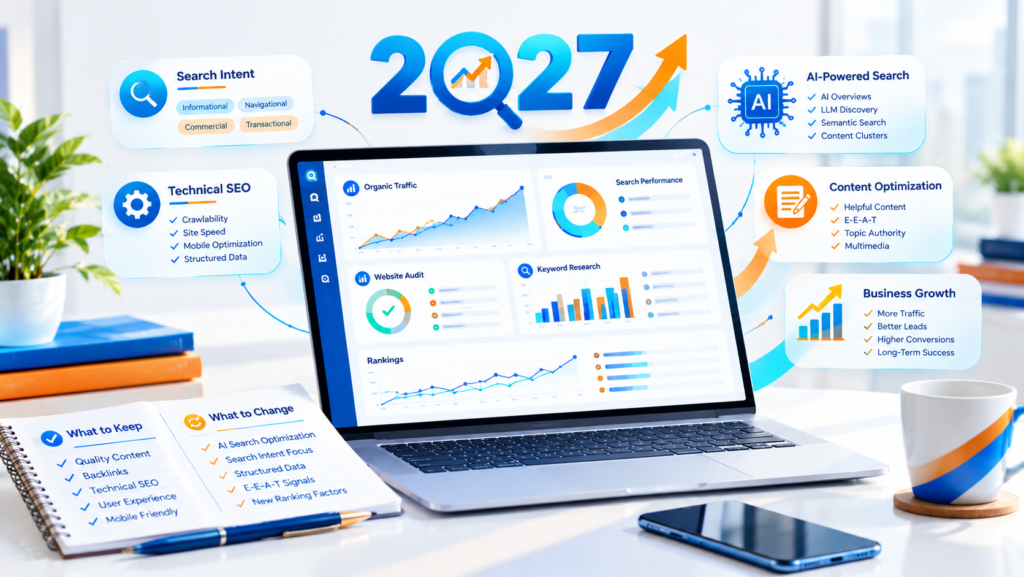
11. What Businesses Should Keep, Change, and Stop in 2027
The most effective SEO strategy does not require replacing every existing practice. It requires identifying which activities still provide value and which ones need improvement.
Keep: Continue keyword research, useful content creation, technical SEO, internal linking, relevant link earning, mobile optimization, and regular performance monitoring. These activities remain important when they support discoverability and customer needs.
Change: Move from keyword-focused writing to intent-focused content. Replace traffic-only reporting with business outcome measurement. Improve old content based on evidence, build more helpful service pages, and prepare for AI-driven discovery through the same strong foundations that support conventional search visibility.
Stop: Avoid keyword stuffing, thin content created at scale, manipulative backlink schemes, unnecessary duplicate pages, unsupported ranking promises, and routine content updates that add no real value.
Most importantly, avoid making major decisions based on rumors about algorithm updates. Review official guidance, investigate your own performance data, and prioritize changes that solve identifiable problems.
12. Build a Practical SEO Roadmap for 2027

A clear implementation plan helps business owners allocate time and resources effectively. Instead of attempting every possible SEO task at once, begin with the changes most likely to improve website quality and business performance.
First 30 days: Audit important pages, review Search Console data, check indexing and technical issues, identify outdated content, and establish baseline performance metrics. Prioritize problems affecting your main services and conversion paths.
Days 31–60: Improve service pages, refine titles and headings, update high-potential articles, strengthen internal linking, and address the most important mobile and performance issues. Make sure each major page serves a distinct search intent.
Days 61–90: Publish genuinely useful supporting content, develop relevant outreach opportunities, improve conversion tracking, and compare performance against your baseline. Use the findings to decide which activities deserve more attention.
After the initial 90 days, continue reviewing performance and adjusting priorities. Some technical fixes can produce relatively quick improvements, while competitive rankings and business outcomes may take longer. Results depend on the website’s starting condition, competition, resources, and implementation quality.
A practical roadmap gives decision-makers a clearer view of what is being done, why it matters, and how its contribution will be evaluated.
Conclusion
Learning how to do SEO for a website in 2027 means building a website that search engines can understand and customers have a good reason to trust. The fundamentals remain important, but businesses need to apply them with greater attention to search intent, originality, technical quality, user experience, and measurable outcomes.
Continue investing in keyword research, helpful content, technical SEO, internal links, and relevant backlinks. At the same time, stop treating keyword density, publishing volume, and ranking positions as the only measures of success.
As search experiences evolve, businesses that consistently provide useful information and make it easy for customers to evaluate their services will be better positioned to build sustainable visibility.
If your website is attracting visitors without generating enough qualified enquiries, start with an SEO audit. Identify the biggest obstacles, prioritize improvements, and measure whether each change helps your business reach its goals. A focused, evidence-based strategy is a more reliable foundation for long-term growth than chasing every new SEO trend.